Boat Propeller Fit Guide
Are you looking for a prop? You've come to the right place to find the prop you need for your boat. You may simply need a replacement for a prop you damaged or you may be trying to address a performance issue: being under or over propped or wanting better fuel economy. Whichever the case, we can help you find the right propeller for your needs.
Choosing the best propeller for your boat is a key factor in performance and choosing the wrong prop can lead to poor fuel efficiency and issues with engine performance including slower speed and increased wear and tear on your engine.
1) Find a Replacement by OEM Part Number
If you know the OEM part number and basically just need to find the replacement, use the Prop Finder tool. Or search the pages and PDF guides below by your OEM part number to find a suitable replacement. Give us a call at 1-800-998-9508 or Intl. +1-206-780-5670 if you don't find what you need and our boating experts will quickly help you locate a replacement.
Solas OEM Cross-Reference
- OEM Cross-Reference Table for BRP, Evinrude, Johnson Outboard & OMC Stern Drives
- OEM Cross-Reference Table for Honda
- OEM Cross-Reference Table for Mariner, Mercury Outboard & Mercruiser Stern Drives
- OEM Cross-Reference Table for Mercury / Michigan Wheel / Quicksilver / Turbo / Turning Point
- OEM Cross-Reference Table for Suzuki
- OEM Cross-Reference Table for Volvo
- OEM Cross-Reference Table for Yamaha
2) Learn How Propellers are Constructed
Propellers are comprised of different materials, shapes, and sizes to suit the broad spectrum of use cases and conditions in which a propeller must perform. If you're looking to change your propeller for one that better suits your need, it will help to learn a little about propeller construction, types of propellers, materials used in constructing propellers, as well as the number of blades on a propeller, and other blade performance factors.
Materials Used to Make Propellers:
High Speed Propellers are commonly constructed of Aluminum or Stainless Steel, each with its own features. Aluminum propellers come in the widest variety of sizes and configurations.| Aluminum Propellers | Stainless Steel Propellers |
|
|
Number of Blades:
Propellers are commonly available in either three or four blades.| 3 Blade Propellers | 4 Blade Propellers |
|
|
Design Elements:
Propeller Sizes are given in a set of numbers, e.g. 13x17 or 19x23 usually labeled on the propeller. The first number is the Diameter (width of the circle of the blades) and the second is the Pitch (theoretical travel distance of the angled blades in one revolution).Two other design features include Rake and Cup. These elements are not labeled on the propeller. The Rake measurement indicates the angle of blades’ tilt towards or away from the gear case. A propeller with 0 degree rake has blades 90 degrees perpendicular to the center of the hub. A 20 degree rake results in a blade that is angled 70 degrees from the hub. Cup is any added curved lip on the trailing edge or blade tip. Both Rake and Cup are set by the manufacturer of the propeller, BUT they can be altered by a professional propeller tuner to modify the propellers performance.
Propellers are made to turn either clockwise or counterclockwise. The common rotation of a propeller is clockwise; often called right hand rotation, right or just “R”. When running dual engines on a powerboat, the engines will tend to be counter-rotating. Counter-rotating engines are when one propeller runs Right or clockwise and the other propeller runs Left or counterclockwise. A left hand rotation propeller may be labeled – 13x17L
Most propellers have a splined flexible rubber bushing in the hub that connects the propeller to the propeller shaft. This rubber acts like a shock absorber in case the propeller strikes something hard, then the rubber flexes and helps protect the gear case components from damage.
3) Propeller Performance Factors
Selecting your next propeller and its use go hand in hand because determining the use of your boat and engine will help determine the correct propeller. The factors to look at are the boat AND the engine.
| The Boat | The Engine |
|
|
Finally, when choosing your propeller a good place to start is with the manufacturer’s recommendation, then;
- Test your engine at Wide Open Throttle (WOT).
- Record the result with a tachometer at WOT.
- The maximum horsepower rating (the engine HP number) of a marine engine happens in a narrow RPM band, typically 5,000-5,500 for two strokes and 5,000-6,000 for 4 strokes. If you are running either above or below your RPM band, you should consider a different propeller.
To help with your selection process for a replacement or upgraded propeller with a larger or smaller pitch, use the following suggested guidelines:
When maintaining the same diameter and rake –
- Adding 1 inch of propeller pitch will reduce full-throttle (WOT) RPM by 150 to 200.
- Subtracting 1 inch of propeller pitch will increase full-throttle RPM by 150 to 200.
- Moving from a 3-blade to a 4-blade propeller, a 4-blade generally turns 50 to 100 RPM less than a 3-blade propeller with the same pitch.
- Switching from an uncupped to a cupped propeller will also reduce your RPM by 200.
- WOT Operating Range = 5000-5600 RPM
- Top End of Operating Range (highest horsepower) = 5600 RPM
- Tachometer Reading when testing = 4800 RPM
- Difference = 800 RPM
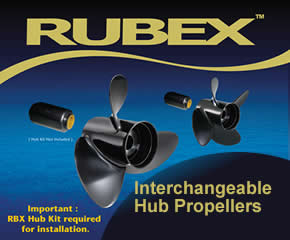
Knowing this, take the difference in the above example at 800 and divide it by 200. The result is 4. The prop to use will be 4" in pitch less than the prop that was used during the test. Ultimately you may need to accept a compromise or be prepared to swap propellers. Interchangeable propeller systems (and they are all compatible) such as the Solas Rubex System, Flo-Torq and Vortex are an option for quick swapping. For propeller choice, consultation or confirmation, please contact Go2marine at 1-800-998-9508 or Intl. +1-206-780-5670.
4) Solas Propeller Installation Instructions
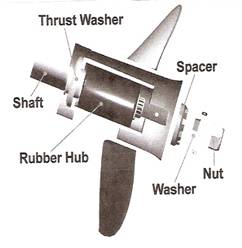
 It is very important to refer to your Engine’s Owner Manual for important safety precautions when installing the propeller. Use the original propeller hardware- thrust washer, spacer, locking tab, nut, and cotter pin depending on engine/drive manufacturer. This is a universal installation instruction.
 - Place the original thrust washer on propeller shaft just as it came off. The taper on the thrust washer should mate properly with the taper on the propeller shaft.
- Grease the propeller shaft.
- Slide the propeller assembly onto the propeller shaft.
- Install spacer or washer if required. Consult your engine/drive manual.
- Install the tab washer if required. Consult your engine/drive manual.
- Install the shaft nut. Consult your engine/drive manual for proper torque.
- Install the cotter pin or bend locking tabs so the propeller shaft nut will not loosen. Consult your engine/drive manual. Picture may not be exact to your application. Please consult your owner’s manual