Narrow By
2 Products
Binoculars & Telescopes
2 Products
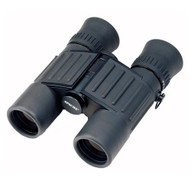
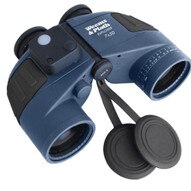
SKU: 195175
|
Mfr: WEEMS & PLATH
|
Mfg# BN29
Binoculars - What to look for before you buy
A good pair of binoculars is essential equipment on any boat or outdoor adventure. However, buying binoculars can be overwhelming with all the technical information available. The following guide defines the key terms and specification details used.
Binocular Ratings
BinocularsTwo numbers identify binoculars, the first number given represents the "magnification power" and the second number is the "objective lens diameter".
Magnification Power:
The first number indicates how much closer (or how many times larger) an item will appear when compared to the unassisted eye. For example, if you view a buoy that stands 350 yards away through 12X binoculars, it will appear as though it were 29.2 yards away (350 divided by 12).It is important to remember though, that while a higher magnification power seems the way to go, as this number increases the movement of your hands will be amplified making steady viewing more difficult.
Objective Lens Diameter:
The objective lens is the large lens at the front end of the binoculars; this second number refers to the size of the objective lens in millimeters. Since this lens determines how much light is captured, the larger the objective lens, the brighter the view will be, especially in low light conditions.Other Key Binocular Specifications In addition to magnification power and objective lens diameter, there are several other terms and measurements that should be considered prior to your purchase.
Eye Relief:
This is the distance from your eye to the eyepiece at which a complete image (the whole field of view) is visible with no image cutoff. Longer eye relief is more comfortable as it allows you to hold the binoculars away from your face.A longer eye relief spec is especially desirable if you wear glasses. Many manufacturers recommend rolling down the rubber eyepiece collar before use with glasses.
Exit Pupil:
The size of the image at the eyepiece, or exit pupil. This number is calculated by dividing the objective lens diameter by the magnification. Generally, the larger the exit pupil, the brighter the image will be. A large exit pupil will also make it easier to maintain a full image if your hands are unsteady.For better viewing in low light, look for binoculars with an exit pupil of 4mm or more.
Field of View:
An angle with the viewer as the starting point, used to define how wide an area, usually in feet, that can be viewed at a glance 1,000 yards away. A higher power (magnification) will often have a narrower field of view, a wider field of view makes object location easier.
Brightness:
Sometimes called relative brightness, this number is equal to the square of the exit pupil and indicates the quantity of light the binoculars transmit to your eyes. A higher number will provide a brighter image, and a good choice for nighttime viewing.
Coatings:
Applied to optical surfaces to reduce reflection and increase light transmission. All binoculars have coatings at least on the objective and ocular lenses (lenses closest to the eyes). The best binoculars are those in which every optical surface is coated, preferably with as many as 13 or more coatings each measuring less than a millimicron.
Prism:
Objective lenses form images that are both upside down and reversed, prisms are utilized in binoculars to correct the orientation. Two primary types of prisms are used, porro or roof. When the roof prism is used in binoculars, the result is a straight-line design while the porro prism gives binoculars the zig-zag profile.
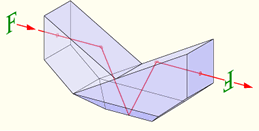
Roof Prism
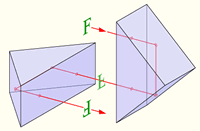
Double-Porro-Prism
When properly designed and manufactured, either type of prism provides excellent viewing results.