Anchoring
Buy anchors & anchoring hardware including bow rollers, high test chain & line, many anchor styles, and mooring buoys, shackle, chocks and more.
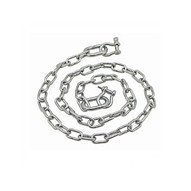
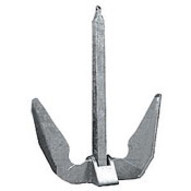
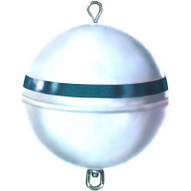
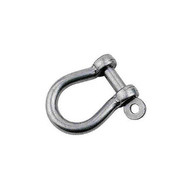
Anchoring and mooring hardware and accessories for buoys, boat decks, chain or line.
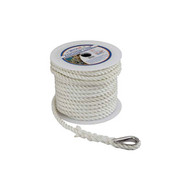
Anchor/Dock rope and line. LFS/Go2marine have a wide variety of Nylon, Polyester, Polypropylene.
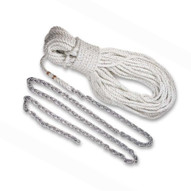
Anchors & Anchoring
Everything you need to know about anchors and anchoring. Spend any time away from the dock and you will soon need to anchor your power or sailboat. Anchoring consists of either an all chain or mixed chain and rope rode connected to an anchor; forming the anchoring ground tackle. To winch up your anchor rode, you use a windlass. Along with the anchoring equipment, we recommend a class in rodes and anchors as well as on anchoring techniques.
Anchors
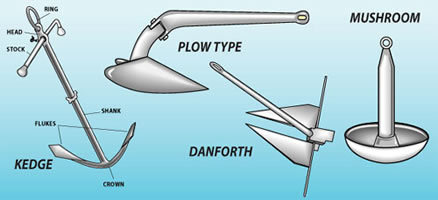
The anchor you chose will depend on the type of anchoring you do. Cruising anchors are larger plow or claw anchors capable of holding boats to various bottoms. Kedging, Forfjord and Workboat anchors are used on commercial vessels. For day use, as a backup anchor or specialty anchor the fluke or grapnel anchors are used, depending on the size of boat.
Anchor Chain and Line
Anchor rode connects your anchor on the bottom to your boat on the top of the water.
Anchoring rode may be all BBB, High Test or Proof Coil galvanized anchor chain. For some boats, a mix of chain with rope rode will be used for anchoring.
Anchor Windlasses
Anchors and ground tackle soon become too big for a person to haul in by hand. You will need to Choose a Windlass to help haul your anchor up. Windlasses may be electric, manual or hydraulic powered and can often handle both robe rode and chain for pulling up your anchor.
Choosing Your Anchor
How big of an anchor should I carry on my boat? An important question that often isnt asked is, How many anchors should I carry?
Consult the manufacturer of your boat for an answer to these questions. The size, displacement, type of boat and its intended use are important considerations. Often you have one main anchor, one storm anchor (a size or two up from your boat requirement) and one lunch anchor (a size or two down).
Fluke Anchors
The Danforth is lightweight compared to its holding power, the Danforth is superb in sand and mud, and its flat configuration makes it easy to carry aboard. The Danforth doesnt set well in hard bottoms, and sea grass can keep it from reaching the bottom. There are many similar lightweight fluke anchors on the market, including the Fortress, which is aluminum. In a strong current, the broad flukes of the Danforth and similar fluke anchors can make them sail through the water rather than sink to the bottom.
Plow Anchors
Popular cruising anchors in this class are the old cruising standard CQR secure and the Delta. They get their name from the plow shape witch digs in well and this anchor will reset itself if a change in pull trips it. Although it may not bury in hard bottoms, this anchor is more effective in grass than other lightweight anchors. This anchor is hard to stow, except on a bow roller.
Claw Anchors
Claw and Manta anchors are originally based on the Bruce anchor; the anchor designed to keep North Sea Rigs in their place. the Bruce anchor will reset itself if tripped. However, it doesnt do well in hard bottoms, and the shape of the flukes makes it vulnerable to fouling in heavy grass. A fixed shank anchor that is harder to stow.
Other Anchors
Specialty anchors are usually carried for unique situations. The grapnel anchor works well on rock bottoms as its narrow tines are more likely to snag small crevices while other anchors will slide over the bottom. A small grapple is often carried to rescue lost chain, to drag the bottom or to use on a small tender. The yachtsman, or kedge, anchor works well in sand and mud, and is better in hard bottoms and grass than other anchors. A small mushroom anchor makes a great dingy dive anchor. A 34 foot cruising sailboat might carry 4 anchors; 35# Plow (main), 33# Claw (backup), 50# Fisherman or 40# Fluke (storm) and a 8.8# grapnel (lunch hook, dingy, dredging). A 35 foot power boat might carry 3 anchors; 33# stainless steel Claw (main), 40# Fluke (backup, storm) and a small grapple or fluke anchor (lunch hook, dingy, dredging).
Anchoring Scope
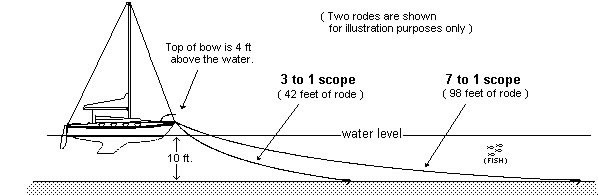
A normal scope for a line rode is 7:1, which means the rode should be 7 times longer than the depth (including the water to deck height). A 5:1 scope is usually sufficient during the day in settled conditions with good holding ground, but you shouldnt leave the boat unattended with such a short scope. In stormy conditions, you may need a scope of 10:1 or more. When using a chain rode in normal conditions, you can reduce scope to 3:1 or 5:1 because the chains weight keeps the pull on the anchor horizontal or nearly so.
Docking and Mooring Your Boat
Both boat docking (some people refer to tying a boat to a pier as mooring) and mooring are permanent places where your boat is stored in the water. Mooring and Boat Docking require different equipment. When you come alongside a dock, pier or wharf you will use fenders, dock lines and other equipment to protect and secure your boat while docked. A permanent anchor spot is called a boat mooring, with its mooring float, a rode and a permanent anchor at the bottom. Even if your boat is kept on a mooring, you will require docking equipment.
Docking Equipment Checklist
- Fenders - Carry 4-6 depending on your boat length and size
- Dock lines - Carry at least 4 that run the length of the boat
Mooring Your Boat: Equipment and Information
Mooring consists of three functional parts; the bottom anchor, often a heavy mushroom, Delta, Danforth or screw anchor, although blocks of concrete and steel are also used. The second part is the rode that connects the anchor to the float, typically of all chain, a size above what you would use for anchoring. Finally, you will need some type mooring float at the top to lift the chain and give you a place to tie to.
Mooring Equipment Checklist:
- Anchor- 3 times weight of your service anchor or a mushroom or block
- Chain- 3 times length of depth, 1/4" larger than service chain
- Mooring Float, sized to float chain
Mooring and docking both require practice. Just like when flying an airplane, the greatest challenge is taking off and landing; leaving and returning to dock is one of the hardest situations in calm weather boating. Practice and proper equipment will make this a whole lot easier. For docking, purchase a set of fenders that are a size or two larger than what the minimum manufacturer recommended size is for your boat. A 20’ - 30’ boat should have 4 decent fenders; a 30’-40’ boat should have 6 good sized fenders.
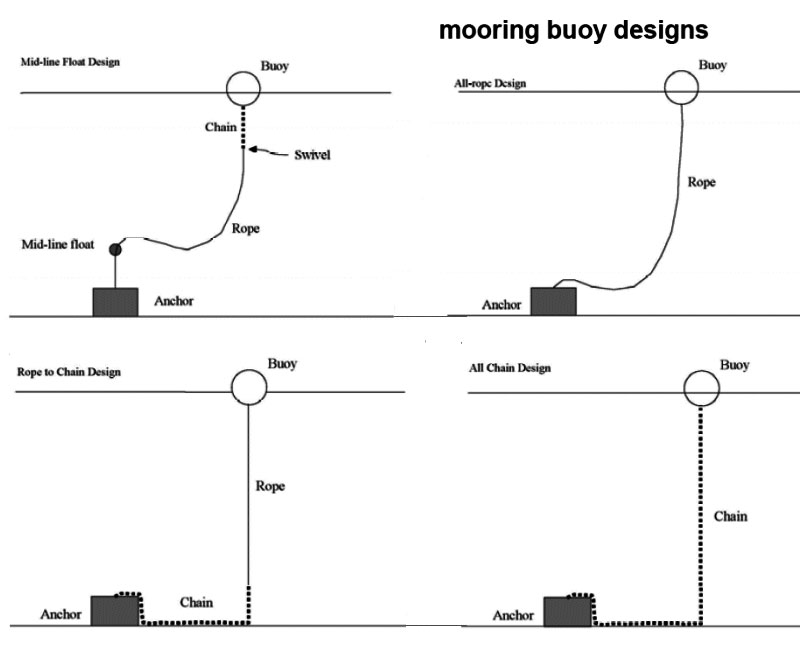
Remember, you will need enough fenders to put over either side of the boat (both sides when rafting). You will also find that larger fenders will protect your vessel in marina waves and storm conditions. Setting a couple large fenders close together on the front quarter of your boat when coming into dock will act as a “bumper” and protect your vessel..