
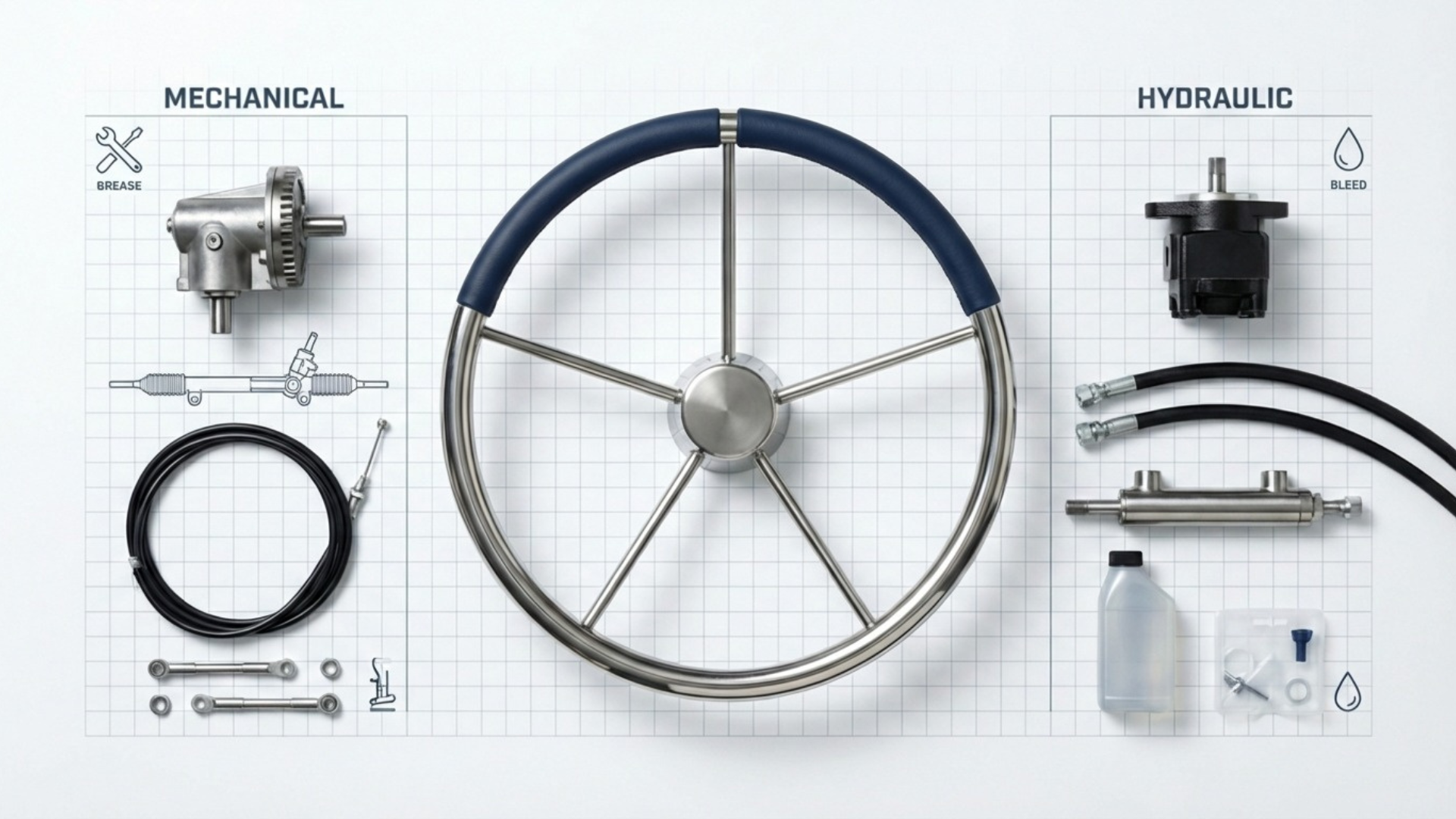
Whether you use your boat on weekends, go fishing offshore, or have been dealing with a stiff steering wheel all season, knowing how your boat's steering system works is one of the most useful things you can do as a boat owner. How quickly your boat turns, how easy it is to control at high speed, and how well it handles at the dock all come down to the type of steering system you have.
In this guide, we break down the two main options: mechanical boat steering and marine hydraulic steering. We'll explain how each one works, where each one does well, where each one has problems, and how to know when it's time to switch. Whether you're buying a new boat or thinking about an upgrade, this guide will help you make a smart choice.
What Is a Boat Steering System and How Does It Work?
A boat steering system is the connection between your steering wheel and your motor or rudder at the back of the boat. When you turn the wheel, that movement must travel through a set of parts and either push or pull the motor to change the direction your boat moves.
Unlike a car, where the driver sits close to the front wheels, boat steering has to send that movement over a longer distance, often through tight spaces, and in conditions that include salt, heat, and water. That's why the design and condition of your steering system matter so much for both safety and comfort.
Main Parts of a Boat Steering System
No matter which type of boat steering you have, every system includes a few essential components that work together to move the engine when you turn the wheel.

The helm sits directly behind the steering wheel. In a mechanical system, it uses internal gears to push and pull a steering cable. In a hydraulic steering system, the helm acts as a pump that moves hydraulic fluid when you turn the wheel.

The steering cable or hydraulic hoses transfer movement from the helm to the motor. Mechanical steering uses a solid push-pull cable, while marine hydraulic steering uses fluid-filled hoses to carry pressure.

The steering cylinder, found only in hydraulic systems, receives fluid pressure and converts it into motion that turns the motor left or right.

The tiller arm connection links the steering system to the motor itself. This final connection is what physically moves the engine to change direction.
Another important concept is steering ratio, which describes how many turns of the wheel are required to move the motor from one side to the other. More turns provide lighter steering effort but slower response. Fewer turns give a quicker response but require more physical effort.
How Mechanical Boat Steering Works

Mechanical boat steering is the classic, tried-and-true option. It's simple, costs less, and works well for many boats. Understanding how it works and where it starts to have problems helps you compare it fairly.
When you turn the steering wheel, it drives an internal gear that pushes or pulls a cable. That cable runs inside a protective outer sleeve from the wheel station to the motor bracket at the back of the boat. As the cable moves, it turns the motor left or right.
Some older mechanical systems use a rack and pinion setup, where a straight gear track moves the steering cable. While once common on smaller boats, rack systems are gradually being phased out by many manufacturers. Replacement parts are still available, but modern rotary steering systems are now the preferred option for most new installations.
How the Force Works in Mechanical Steering
Mechanical boat steering works in a straightforward way, but it has limits as engine size increases.
The steering cable carries all the force from the wheel to the motor. While the helm gears help reduce effort, they do not remove it completely. As the engine gets bigger and heavier, the cable has to handle more force, which makes the wheel harder to turn.
Over time, friction builds inside the cable. Salt, dirt, and moisture can cause rust, and the inner cable begins to rub against its outer housing. This increases resistance and makes steering feel stiff, even if the motor itself is working fine.
Another common issue is torque pull. When the propeller spins, it creates a sideways force that can travel back through a standard mechanical cable to the steering wheel. At higher speeds, this may feel like a constant pull you have to hold against. However, many modern rotary cable systems offer a No Feedback (NFB) helm option. These helms use internal gearing to counteract propeller torque, helping prevent the wheel from turning on its own and reducing steering effort, especially toward starboard.
How Hydraulic Steering Works

Marine hydraulic steering replaces the cable with a closed loop of fluid. When you turn the wheel, a small pump inside the helm pushes fluid through hoses to a cylinder mounted at the motor. That fluid pressure pushes or pulls the motor left or right.
The beauty of this system is simple: fluid doesn't rust, it doesn't bind, and it doesn't stretch. The force travels smoothly and evenly no matter what. And because the system absorbs the pull from the propeller before it ever reaches your hands, the wheel stays light and easy to control.
How the Force Works in Hydraulic Steering
When you turn the steering wheel, the helm pump pushes hydraulic fluid through hoses to a steering cylinder at the motor. The amount of fluid moved controls how far the motor turns, and this movement stays consistent every time you turn the wheel.
The fluid carries the force evenly through the system. Even when the engine is under heavy load, such as at high speed or in strong current, the steering effort at the wheel remains steady and light.
The force created by the propeller is absorbed at the cylinder. It does not travel back to the steering wheel. This means the wheel does not pull or fight against you, even at higher speeds.
Because the pressure is spread across the entire cylinder instead of a single cable, hydraulic steering can handle larger engines and perform reliably in demanding conditions.
Why Hydraulic Steering Stops Torque Pull
Propeller torque can create a noticeable sideways pull at the wheel, especially on larger outboards or higher-speed boats. In standard mechanical systems, that force travels back through the cable to the helm.
Many modern rotary cable systems offer a No Feedback (NFB) option. These helms use internal gearing to apply counterforce, reducing starboard pull and helping prevent the wheel from turning on its own. Some rotary systems are rated for higher horsepower engines, even up to 300 HP, and certain multi-engine configurations.
Hydraulic steering manages torque differently. Instead of counteracting the force at the helm, the closed-loop fluid system absorbs it at the steering cylinder. The result is consistently light, stable steering effort under heavy load, high speed, or demanding offshore conditions.
Hydraulic vs Mechanical Steering: Side-by-Side Comparison
Now that we know how both systems work, let's look at how they compare in the ways that matter most, including steering effort, engine size, offshore use, and multi-station capability.
|
Feature |
Mechanical Steering |
Hydraulic Steering |
|---|---|---|
|
Steering Effort |
Increases with HP & speed |
Consistent and light |
|
Torque Feedback |
High, especially at speed |
Minimal absorption by fluid |
|
Load Handling |
Best under 115 HP |
Ideal for 115 HP+ |
|
Maintenance |
Cable lubrication/replacement |
Fluid checks, bleed as needed |
|
Initial Cost |
Lower upfront |
Higher upfront |
|
Long-Term Value |
More frequent replacements |
Durable and reliable |
|
Offshore Suitability |
Limited in heavy seas |
Preferred for offshore use |
|
Docking Control |
Adequate for smaller vessels |
Superior feedback in the current |
|
Multiple Helm Stations |
Limited support; parts for dual-station cable systems are difficult to source and largely discontinued |
Easily supports dual or multiple helm stations |
At higher speeds, the difference becomes obvious. Mechanical steering gets harder to turn as speed, engine power, and water resistance increase. Hydraulic steering stays smooth and steady because the fluid handles the load.
At the dock, both systems work well in calm conditions. But in a strong current or with a heavier boat, hydraulic steering gives you better control with less effort, making it easier to guide the boat into a tight slip.
At What Horsepower Do You Need Hydraulic Steering?
Engine size is the clearest sign of when hydraulic steering becomes necessary.
For engines under 115 horsepower, mechanical steering usually works well, especially on smaller and lighter boats. With proper care and regular lubrication, a good steering cable can last for years. Some boat owners still choose entry-level hydraulic systems in this range for a smoother feel.
Between 115 and 175 horsepower, many boaters begin to notice the limits of cable steering. Hydraulic steering becomes the better choice, especially for saltwater use, offshore trips, or boating in strong currents.
At 175 horsepower and above, hydraulic steering is strongly recommended. Larger engines create more force at higher speeds, which can make mechanical steering tiring and harder to control.
For twin-engine boats, hydraulic steering is almost always required. The combined force of two engines demands the strength and consistency that hydraulic systems provide.
It is also important to follow engine manufacturer guidelines. Using a mechanical steering system with an engine that produces more force than it is designed for can lead to damage or even steering failure.
Common Boat Steering Problems and How to Find Them
Both types of steering can develop problems over time. Here's how to spot and figure out the most common ones:
Stiff Steering at Speed
If your boat's steering feels stiff only at higher speeds, water pressure on the motor is usually the cause. In mechanical systems, a worn or corroded cable can make this worse. In hydraulic steering, stiffness at speed is uncommon and may point to low fluid, a blocked hose, or a cylinder issue. If steering feels fine at the dock but heavy at speed, your engine may be pushing the limits of a cable system.
Soft or Spongy Hydraulic Steering
If the steering wheel feels soft or loose, air is likely trapped in the hydraulic lines. Air compresses, but fluid does not, which causes a vague response. This usually happens due to low fluid, a leak, or improper bleeding. The solution is to bleed the hydraulic steering system and fix any leaks.
Uneven Steering Left or Right
If the boat turns more easily in one direction, a damaged cable is often the cause in mechanical steering. In hydraulic systems, worn cylinder seals may allow fluid to leak internally, reducing pressure on one side. Both issues should be repaired quickly to prevent further damage and maintain safe control.
How to Maintain and Inspect Your Boat Steering
Good maintenance is what keeps a steering system working safely year after year. The American Boat and Yacht Council (ABYC) publishes voluntary safety guidelines for boat steering systems that are widely followed by marine professionals and boat builders. While ABYC standards are not required by federal law, they represent the best-practice benchmark for safe steering system care, and the U.S. Coast Guard encourages compliance.
Mechanical Steering Inspection Checklist
-
Inspect the entire steering cable for any kinks, rust, or damage to the outer covering. The cable should look smooth and intact along its full length.
-
Check the steering wheel at the helm. It should turn smoothly without feeling loose or sloppy.
-
Apply marine-grade grease to the cable where it enters and exits the helm and where it connects to the motor. This helps reduce friction and prevent corrosion.
-
Examine the tiller arm connection at the motor. Make sure there is no rust, excessive wear, or loose hardware.
-
Turn the wheel fully to both sides and feel for any tight spots or uneven resistance.
-
Finally, check the helm unit itself. If it feels loose or has extra movement, it may be worn and should be inspected or replaced.
Hydraulic Steering Maintenance Schedule
Hydraulic steering systems are low maintenance, but they still need regular checks to stay safe and reliable.
Every 100 hours or about every 6 months, check the hydraulic fluid level and add fluid if needed. Look closely at all hoses and fittings for leaks. Make sure nothing is loose and that the system does not have excessive play. The steering should feel tight and controlled, not loose.
Every 200 hours or once a year, repeat those checks and do a deeper inspection. Clean and re-grease the steering support rod at the engine. Lightly grease the steering wheel mounting area if needed. Check the hydraulic fluid for dirt or discoloration and replace it if it looks contaminated.
Regularly inspect the steering cylinder for fluid leaks around the moving shaft and confirm that all mounting bolts are secure.
If the steering wheel ever feels soft or spongy, air may be in the system. Bleed the hydraulic steering following the steps in your owner’s manual.
The American Boat and Yacht Council recommends that steering systems should allow the boat to return to center smoothly and continue functioning safely even if one component begins to fail. Keeping up with maintenance helps ensure safe control on the water.
Final Thoughts
Boat steering is something many owners overlook until a problem appears or they experience the difference a better system can make. Whether you are maintaining a mechanical cable system, fixing a soft hydraulic wheel, or considering an upgrade, understanding how your steering works helps you make safer and smarter decisions on the water.
If you are ready to maintain, repair, or upgrade your boat steering system, Go2Marine offers a wide selection of steering cables, hydraulic kits, helm pumps, and replacement parts. Choosing the right system starts with knowing your boat type, engine size, and how you use it. The right setup will improve control, comfort, and long-term reliability every time you head out.
Whether you need a replacement steering cable or you are ready to switch to a full marine hydraulic steering setup, choosing the right system makes a real difference in control and safety.