
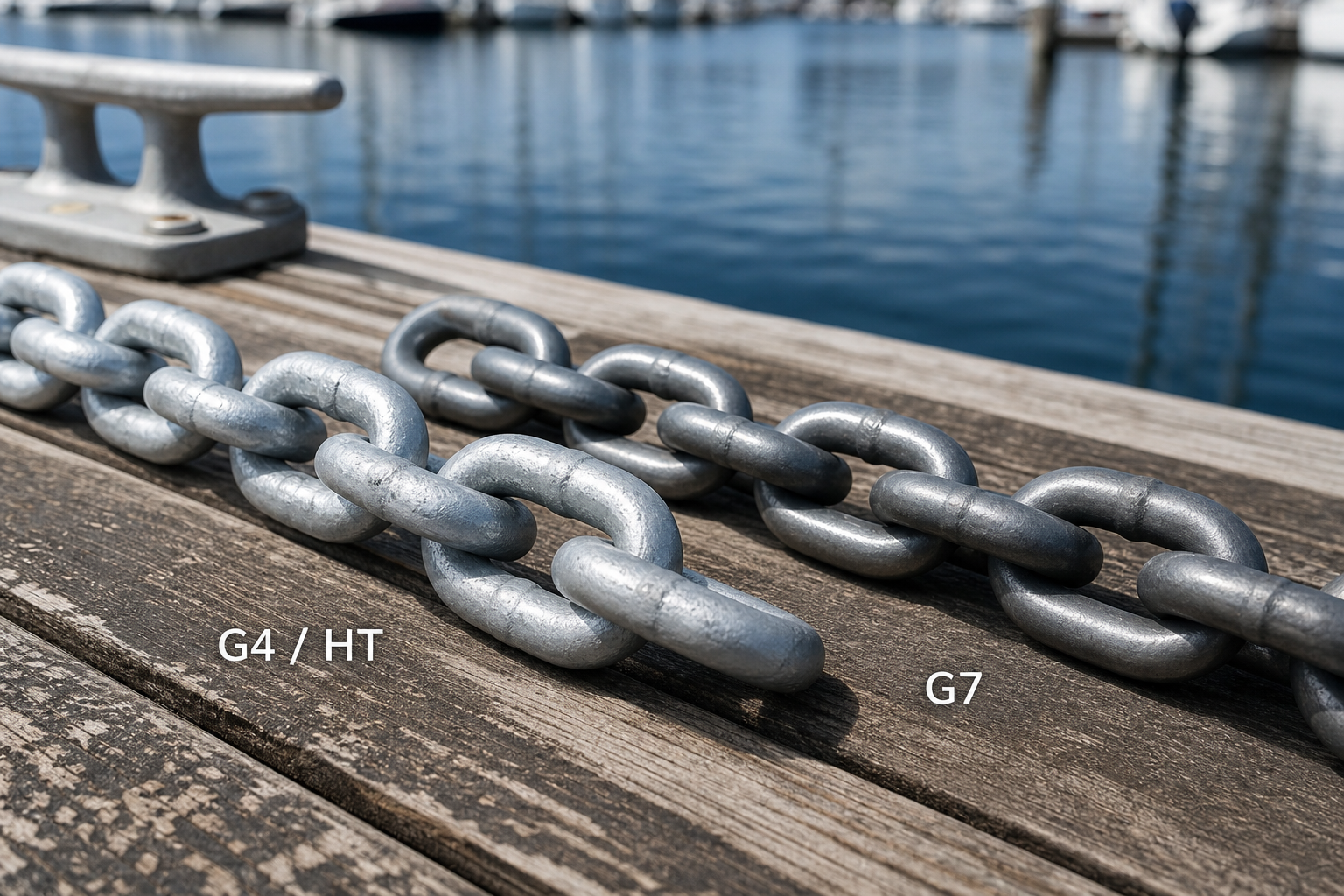
What is the difference between G4, G7, and HT anchor chain?
In practice, there is no difference between G4 and HT. G4, G40, G43, and HT are all names for the same chain: Grade 43 high test. The real anchor chain grade comparison is high test (G4, G43, or HT) against Grade 70 (G7), which is a stronger and lighter chain. The right choice depends on your boat, how and where you anchor, and your windlass, rather than one grade being best for every boat. The table and sections below explain how the two compare and how to choose with confidence.
|
Factor |
High Test (G4 / G43 / HT) |
Grade 70 (G7) |
|
What it is |
Grade 43 high-test carbon steel; G4, G40, G43, H4, and HT all name this same chain |
Grade 70 heat-treated carbon steel; a higher grade than high test |
|
Relative strength |
Stronger than Grade 30 (BBB and proof coil) at the same size; the modern standard |
Stronger than high test at the same size |
|
Weight |
Lighter than Grade 30 for the same holding power |
Lighter than high test at the same size; chosen to reduce weight on the bow |
|
Galvanizing |
Hot-dip galvanized for salt water without losing strength |
Galvanizing lowers its strength, and it should not be re-galvanized |
|
Windlass fit |
Calibrated and supported by most marine windlasses |
Fewer gypsies are cut for it; verify the fit, ideally with a sample |
|
Common boats |
Coastal cruisers, fishing boats, powerboats, and sailboats |
Performance sailboats, long-distance cruisers, and offshore vessels |
|
Availability |
Widely stocked; ACCO Grade 43 is an industry standard |
Made by major chain makers such as ACCO and Peerless |
Why anchor chain sizing matters
Anchor chain sizing is one of the most important decisions when you build or upgrade a boat’s anchoring system. Many owners focus on the anchor itself, but the chain does a great deal of the work. It adds holding power, absorbs shock, keeps the pull on the anchor low and horizontal, and helps the anchor stay set as conditions change. Choosing between high test and Grade 70 is not simply a matter of buying the strongest chain you can find. Your boat’s size and weight, the conditions where you anchor, your windlass, and the rest of your anchor chain rode all shape the right choice. Getting the grade and size right helps you build a safer, more efficient ground tackle system and avoid costly compatibility problems during an anchor chain replacement or a windlass upgrade.
What do anchor chain grades mean?
An anchor chain grade is a classification that describes the steel and the relative strength of the chain. The grade number is, in simple terms, a strength rating: a higher number means stronger steel for the same link size. Quality chain is stamped with its grade roughly every foot, so you can read a link to confirm what you have or what you are buying. The grade you choose affects every part of a boat anchor chain setup, from holding power to how the chain feeds through the windlass. A higher grade often means more strength for the size, but grade alone should never drive the decision. The chain still has to suit your anchor, your windlass, your boat’s weight, and the way you anchor. Grade matters most when you are replacing existing chain or upgrading a windlass, which is exactly when a mismatch becomes expensive.
What is high test (G4, G43, HT) anchor chain?
High test is the everyday standard for recreational and cruising boats. You will see it sold as G4, G40, G43, H4, or HT, and all of these describe the same Grade 43 chain. It is stronger than the older Grade 30 chain (BBB and proof coil) at the same size, which lets you carry a lighter rode for the same holding power. Its links are calibrated to feed smoothly over a windlass, and it is hot-dip galvanized to stand up to salt water without losing strength. ACCO anchor chain in Grade 43 is an industry standard and the version many windlasses are set up for. It is also the same high-test West Marine anchor chain that many boaters already run, and you can order it from Go2Marine cut to length by the foot.

High test suits coastal cruisers, fishing boats, powerboats, and sailboats that anchor for the day or overnight, and for most owners it is the practical default. You will find high test anchor chain and other galvanized anchor chain sold by the foot, but before you buy, confirm your windlass is designed to accept the size and link profile of the chain you choose.
What is G7 anchor chain?
Grade 70 (G7) is a higher grade than high test. It is heat-treated, so it is lighter and stronger than high test at the same size. In a g4 vs g7 chain decision, owners usually choose G7 in order to drop a size, reduce weight on the bow, and stow more rode in the same locker, which can help trim, performance, and weight distribution. Major chain makers such as ACCO and Peerless produce it. G7 anchor chain does carry trade-offs to weigh: galvanizing lowers its strength, it should not be re-galvanized later, and fewer windlass gypsies are cut to fit it. For that reason, windlass compatibility is the main consideration with G7. Confirm it against your windlass manufacturer’s recommendations and your gypsy before you buy, ideally by testing a short sample. G7 appeals most to performance sailboats, long-distance cruisers, and offshore boats carrying a lot of ground tackle, where saving weight is worth the extra care over fit.
How does anchor chain sizing affect performance?
Choosing the right chain size is as important as choosing the grade. Size affects how the anchor holds, how much the chain sags into a shock-absorbing curve (the catenary), how the chain feeds through the windlass, and how much room the rode takes in the locker. Heavier chain along the rode helps keep the pull on the anchor low and horizontal as conditions change, which improves holding. The trade-off is that larger chain adds weight to the bow, takes more locker space, and asks more of the windlass, while undersized chain can leave you short of confidence in rough weather or strong current. The goal is not the largest chain you can fit, but the right anchor chain sizes for your boat and the places you anchor. Always check the manufacturer’s working-load chart for your exact size, such as your 5/16 anchor chain working load, rather than estimating from the grade. One detail to keep in mind: in the United States, Grade 43 uses a 3 to 1 strength-to-working-load ratio while Grade 30 and Grade 70 use 4 to 1, so you cannot compare grades by the working-load number alone.
How do you match chain size to your boat?
Size the chain as part of the whole ground tackle system, not on its own. Longer boats generate larger anchoring loads and usually call for heavier rode components, and a heavily loaded cruising boat needs more than a light boat of the same length. Boats with tall cabins, flybridges, enclosed cockpits, or high freeboard catch more wind, which adds load. Where you anchor matters too: a boat that anchors now and then in protected bays has different needs from one that regularly anchors offshore. Finally, match the chain to your anchor, since modern anchors work best with a properly matched chain and rode. How much chain you let out also counts: a widely used guideline is five to seven feet of rode for every foot of water depth, measured from the bow roller, with more in strong wind. Weighing these factors together produces a far more reliable system than picking chain by grade alone.
Galvanized, stainless, or coated chain?
Finish is the other half of the choice. Hot-dip galvanized is the practical, lower-cost standard, with a thick zinc coating that holds up well in salt water, and it is what most high test and Grade 70 chain uses. Type 316 stainless looks clean on the bow and will not leave rust stains, which makes it popular on rope-and-chain rodes; keep in mind it is stronger than Grade 30 but not as strong as Grade 43, so size it accordingly. A vinyl-coated galvanized anchor chain adds a protective layer that guards your deck and bow roller from scratches. Whichever finish you choose, the grade and windlass rules still apply, and a ready-made rode that pairs ACCO G4 chain with three-strand nylon is a simple option for smaller and mid-size boats.

How does windlass compatibility affect chain selection?
Windlass compatibility is one of the most overlooked parts of an anchor chain replacement. A chain can look right on paper and still feed poorly if it does not match the windlass gypsy, the toothed wheel that grips it. A mismatch shows up as chain that jumps, jams, feeds unevenly, wears quickly, or is hard to retrieve. Two chains can share the same nominal size, such as 5/16 inch, yet differ enough between manufacturers that one feeds perfectly and the other does not. That is what windlass chain compatibility comes down to. Before you buy replacement chain, confirm the size, the link profile, and your windlass manufacturer’s approved chain specification. This step matters most when you move from one grade to another, especially to G7. Match your parts in the windlasses and windlass parts collection, and if you anchor with a mix of rope and chain, size the anchor rode and line to suit.
Which chain grade is used for coastal cruising?
Coastal cruisers usually value reliability, availability, and easy maintenance. Depending on the boat’s size and equipment, many coastal boats run high test as their primary chain, since it balances strength and weight and is widely stocked. Typical coastal anchoring means protected anchorages, overnight stays, and moderate current, where the aim is a balanced, dependable ground tackle system without excess weight. As always, choose the chain alongside the anchor, the rode length, and what the windlass can handle.
Which chain grade is used for offshore boating?
Offshore anchoring adds considerations such as weight distribution, equipment redundancy, how often and how long you anchor, and heavy-weather preparation. Here, some owners look at Grade 70 to save weight, while others stay with high test for its availability and simple windlass fit. The right answer varies from boat to boat. Rather than asking which grade is strongest, offshore owners get more value from asking whether the whole anchoring system, from anchor to chain to windlass, is matched to their cruising plans.
When should you replace anchor chain?
Anchor chain lives a hard life of salt water, abrasion, bottom contact, repeated tension, and corrosion. Signs that it is time for an anchor chain replacement include heavy corrosion, deformed or stretched links, excessive wear at the contact points, visible damage, and worn galvanizing that no longer protects the steel. Inspect the chain regularly, especially before a long cruising season or an offshore passage, and replace worn chain before it fails, which is far cheaper than dealing with a dragging anchor. Replacing a tired rode is also the right moment to reconsider your grade and size rather than buying like for like. You do not need a trip to a store to find your replacement boat part: match your size and grade, or step up a grade and down a size to save weight. Go2Marine is a dependable source for West Marine replacement parts and upgrades, with chain sold by the foot so you buy only what you need.
How do you match anchor chain to an anchor rode?
Your anchor rode works as a complete system: the anchor, the chain, a rope section where used, shackles, a swivel, the windlass, and the deck hardware that guides it. When you choose chain, make sure it is compatible with every one of those parts, because chain grade alone cannot make up for a weak link elsewhere. The connectors deserve particular attention, since a rode is only as strong as the part that joins it. A common mistake is pairing a stainless shackle with Grade 40 galvanized chain: to fit, the stainless shackle usually has to go up a size, and even then it may carry only about 60 to 70 percent of the chain’s strength. Size it carefully, or use a connector built to match. A Mantus anchor swivel is designed to be stronger than its matching Grade 40 chain and takes the twist out as the boat swings; the S2 suits 5/16 to 3/8 inch chain and the larger S3 suits 3/8 to 1/2 inch. Whatever you use, secure the shackle pin with stainless or Monel wire so it cannot work loose, and find rated shackles in anchoring and mooring hardware. A well-matched rode sets the anchor more reliably, reduces shock loads, and is easier to retrieve.

The answer comes down to how and where you use the boat. High test (G4, G43, or HT) is the durable, versatile default that suits most recreational and cruising boats and is the easiest to match to a windlass. Grade 70 (G7) is worth considering when reducing weight on the bow is a priority and you are willing to confirm the gypsy fit. To decide, weigh your boat’s size and displacement, your windlass, your cruising plans, the design of your anchor rode, and the rest of your ground tackle together. Considered as a system, the right grade usually becomes clear.
Putting it all together
High test and Grade 70 each have a place in a modern anchoring system. High test (G4, G43, HT) is the standard for most recreational and cruising boats, while Grade 70 is chosen where strength-to-weight efficiency matters most. Rather than chasing the strongest grade, focus on a chain that matches your boat, your windlass, your anchor rode, and the waters you cruise. A properly matched ground tackle system anchors better, operates more safely, and gives you more confidence, whether you are out for an afternoon of fishing or an extended cruise. When you are ready to buy, Go2Marine is a straightforward alternative to West Marine and other stores like West Marine for ground tackle. You can buy anchor chain online by the foot, add matching shackles and a swivel, complete the rest of your anchor, dock and trailer gear, and order your marine supplies online, with most orders over $99 shipping free and boat parts delivered fast. Start with the anchor chain collection or browse the full range of anchors.