
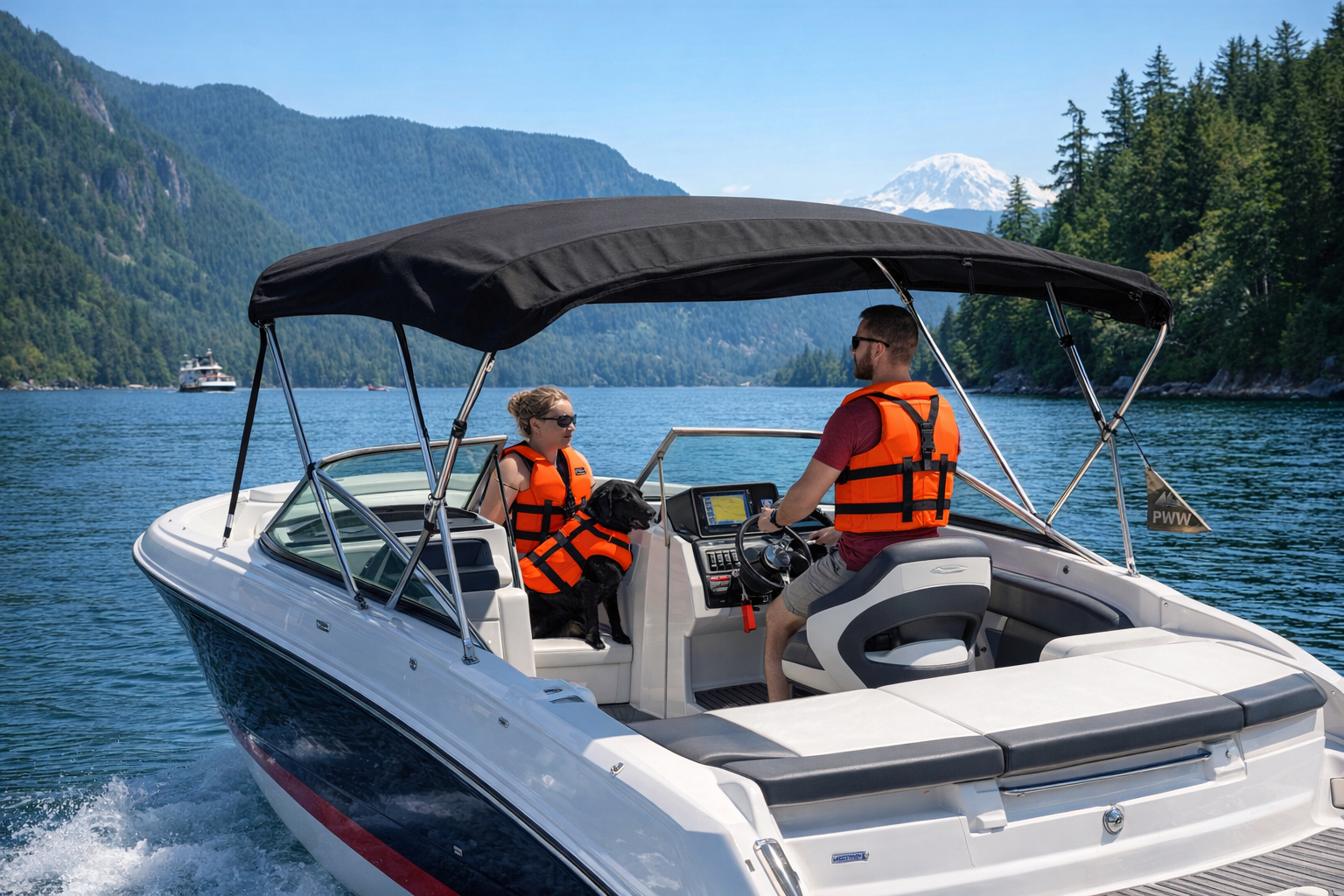
A bimini top is a collapsible canvas canopy mounted on your boat to provide shade from the sun and protection from light rain. Choosing the right one requires measuring your beam width at the mounting points, selecting the correct number of bows for your desired shade coverage, and matching the frame material and fabric to your boating conditions.
What Is a Bimini Top and Why Does Your Boat Need One?
A shade canopy for your boat is a shade canopy supported by a folding aluminum or stainless steel frame that mounts to the gunwales or deck of your boat. When deployed, it creates an overhead sun shade that covers the helm, cockpit, or seating area. When not in use, the frame folds down and stores under a zippered boot.
Bimini tops matter for more than comfort. Prolonged sun exposure on the water causes heat exhaustion, sunburn, and long-term skin damage. A good canopy also keeps vinyl seats, helm electronics, and gel coat from UV damage. For pontoon boats, center consoles, jon boats, and runabouts that lack a hardtop or cabin, a bimini is the most practical and affordable way to create a shaded area on board. Manufacturers like Taylor Made, Westland, and Carver produce bimini top kits in a wide range of sizes and fabric options, making it possible to find a Taylor Made bimini top or equivalent that fits almost any boat on the water today.
How Do You Measure for a Bimini Top?

Getting the right fit starts with three measurements. The Go2Marine team walks customers through this process regularly, and incorrect sizing is the most common reason for returns on bimini orders.
Width. Measure the distance between the two points on opposite sides of the boat where the bimini frame will mount. This is not necessarily the same as your boat’s maximum beam. The mounting points are typically on the gunwale, railing, or deck edge. Measure between these specific points and select a bimini width range that includes your measurement. Taylor Made bimini frames are sold in width ranges (54–60 inches, 61–66 inches, 67–72 inches, and so on) to fit slight variations in mounting position.
Height. Measure the vertical distance from the centerline floor of the boat (where you stand) to the lowest bimini mounting point on the side of the boat. Then decide how much total headroom you want when standing under the canopy. Subtract the floor-to-mounting-point distance from your desired total height to get the bimini frame height you need. Common frame heights are 36 inches (low profile, good for trailering), 42 inches (standard for most boats), 48 inches (extra headroom), and 54 to 56 inches (tall, used primarily on pontoon boats).
Length. Length determines how much fore-to-aft shade coverage the bimini provides. A 4-foot bimini covers the helm area. A 6-foot bimini extends shade over a larger cockpit or seating area. An 8-foot bimini covers most of the cockpit on larger boats. Longer biminis require more bows for structural support.
What Is the Difference Between 2-Bow, 3-Bow, and 4-Bow Frames?
The bows are the curved aluminum or stainless steel tubes that form the skeleton of the bimini canopy. The number of bows determines the structural rigidity and the length of shade coverage the top can support.
2-bow bimini tops are the most compact option, typically providing about 4 feet of shade coverage. They work well on smaller boats, jon boats, and inflatable tenders where space is limited and the bimini needs to fold into a tight package. Two-bow frames are lighter and less expensive, but they offer less rigidity in wind and less shade area.
3-bow bimini tops are the most common setup for recreational boats. They cover 5 to 6 feet of length and provide a good balance of shade, structural stability, and compact storage. Three-bow frames are the most popular choice for center consoles, walkarounds, bay boats, and runabouts in the 16 to 24 foot range.
4-bow bimini tops span 7 to 8 feet or more and are designed for larger boats, pontoons, and any vessel where maximum shade coverage is the priority. The additional bow adds significant structural strength, which is important on wider boats where wind load on the canopy is higher. Four-bow frames are common on pontoon boats, deck boats, and cruisers.
How Do Aluminum and Stainless Steel Frames Compare?
Aluminum frames. The vast majority of bimini tops sold for recreational boats use anodized aluminum tubing for the frame. Aluminum is lightweight, corrosion-resistant in both fresh and salt water, and significantly less expensive than stainless steel. Most aftermarket bimini kits from Taylor Made and Westland use 7/8-inch or 1-inch diameter bright-dipped anodized aluminum with marine-grade nylon fittings. Aluminum frames are the right choice for the majority of recreational boaters.
Stainless steel frames. Stainless steel is stronger and more rigid than aluminum, which allows for thinner tubing and a sleeker profile. Stainless steel resists bending from wind loads better than aluminum of the same diameter. The tradeoff is weight and cost. Stainless steel frames are heavier, more expensive, and primarily found on custom or high-end installations. For most boaters, anodized aluminum delivers comparable durability at a fraction of the price.
Which Bimini Top Fabric Should You Choose?
The fabric is the part of the bimini that takes the most abuse from sun, rain, salt spray, and mildew. As Go2Marine’s own product team notes, fabric choice is the single biggest factor in how long your bimini top lasts before it needs replacement.
Sunbrella. Sunbrella is the industry benchmark for marine canopy fabric. It is a solution-dyed acrylic that resists UV fading, mildew, and water penetration while remaining breathable. Sunbrella carries a 10-year limited warranty against UV wear and loss of color. It is the most expensive option but delivers the longest service life. Go2Marine considers Sunbrella the best-in-class fabric for bimini tops.
Ultima and Sharkskin Supreme. These brand-specific fabrics from Taylor Made and Westland sit in the mid-range between Sunbrella and standard polyester. They offer good UV resistance, water repellency, and durability at a moderate price point. For boaters who want better-than-basic performance without the Sunbrella price tag, these are practical choices.
Polyester (Hot Shot, Sharkskin). Standard marine polyester is the most affordable option. It is coated for water resistance and treated for UV protection, but it will fade faster and break down sooner than acrylic fabrics. Budget polyester tops are a reasonable choice for freshwater boaters, seasonal boats, or boaters who plan to replace the canopy every few seasons rather than investing in premium fabric upfront.
Which Bimini Top Fits Your Boat Type?
Center consoles. A 3-bow bimini in the 6-foot length is the most popular fit. Mount behind the center console T-top (if your boat has one) or independently over the helm station. Height depends on whether you fish standing or seated.
Pontoon boats. Pontoons typically need a 4-bow, 8-foot bimini with a 54 to 56 inch frame height to clear standing passengers. Pontoon railings are square tubing, so you need square tube bimini hardware designed for that profile rather than standard round-tube fittings.
Jon boats. A compact 2-bow or small 3-bow jon boat bimini top in the 4-foot length keeps weight low and fits narrow beam widths. Low-profile 36-inch frames with clear rod tips work well for trailering without removal.
Runabouts and bowriders. A 3-bow bimini in a 5 to 6-foot length typically covers the cockpit. Mount behind the windshield using deck hinges or slide track assemblies. Choose a frame height that clears the windshield header when folded forward.
What Hardware Do You Need for a Bimini Installation?
A complete bimini top kit includes the frame, fabric canopy, and storage boot. However, mounting and support hardware is equally important for a secure installation. Go2Marine stocks a full selection of bimini top hardware and accessories for both new installations and repairs.
Deck hinges. These mount to the gunwale or deck and serve as the pivot point for the bimini frame. Taylor Made offers horizontal mount deck hinges in nylon and stainless steel for flat decks, plus side-mount and vertical-mount options for angled surfaces. Choose based on where your mounting surface sits relative to the frame base.
Jaw slides allow the bimini frame to fold forward or aft along a rail or track. They are sized for 3/4-inch, 7/8-inch, and 1-inch bimini tubes and available in marine nylon, chromed zamak, or stainless steel. Essential on boats where the bimini needs to collapse behind the helm for trailering or open-water running.
Slide assemblies and support poles. Rear support poles and aluminum slide assemblies brace the bimini against wind loads and keep the canopy taut when deployed. Taylor Made slide assemblies are available in 18-inch, 30-inch, and 45-inch lengths and sold in pairs.
Straps and snap fasteners. Nylon hold-down straps secure the bimini canopy to the deck or railing in windy conditions. Stainless steel snap fasteners attach the canopy to the frame and allow easy removal for cleaning or fabric replacement.
Most bimini top kits come with all the hardware needed for a standard installation on a flat deck. The process typically takes one to two hours with basic hand tools. For boats with non-standard mounting surfaces, curved gunwales, or railing systems, you may need additional adapters or rail-mount brackets.
How Do You Care for a Bimini Top?
A bimini top is exposed to the harshest conditions on your boat. Sun, rain, salt, bird droppings, and mildew all take a toll on the fabric and frame. Regular maintenance extends the life of both.
Clean the fabric regularly. Rinse the canopy with fresh water after every salt water outing. For deeper cleaning, use a mild soap solution and a soft bristle brush. Never use bleach, harsh detergents, or pressure washers on marine fabric. Allow the canopy to dry completely before folding it into the storage boot. Storing a damp canopy is the fastest way to develop mildew.
Inspect the frame and fittings. Check all hinges, jaw slides, and snap fittings at the start of each season. Look for cracked nylon fittings, corroded stainless steel snaps, and bent or fatigued aluminum tubing. Replace any component that shows damage before it fails underway.
Use a storage boot. When the bimini is folded down, a zippered storage boot protects the fabric from UV exposure, rain pooling, and abrasion. A boot matched to your canopy width and fabric type keeps the top in serviceable condition between uses and extends its lifespan significantly.
Reapply water repellent. Over time, the factory water repellent coating on polyester fabrics wears off. Reapply a marine-grade fabric waterproofing spray at the start of each boating season. Sunbrella fabric retains its water resistance longer due to the fluorocarbon finish applied during manufacturing, but it benefits from periodic retreatment as well.
Finding the Right Bimini Top for Your Boat
Choosing a bimini top comes down to measuring your beam width, selecting the right number of bows for your shade needs, and matching the frame and fabric to your boat’s size and usage. Browse the full selection of bimini tops and shade canopies to find the right fit for your vessel, or call the Go2Marine team at 800-998-9508 for help with sizing and fabric selection. We have been outfitting boaters since 1967.