
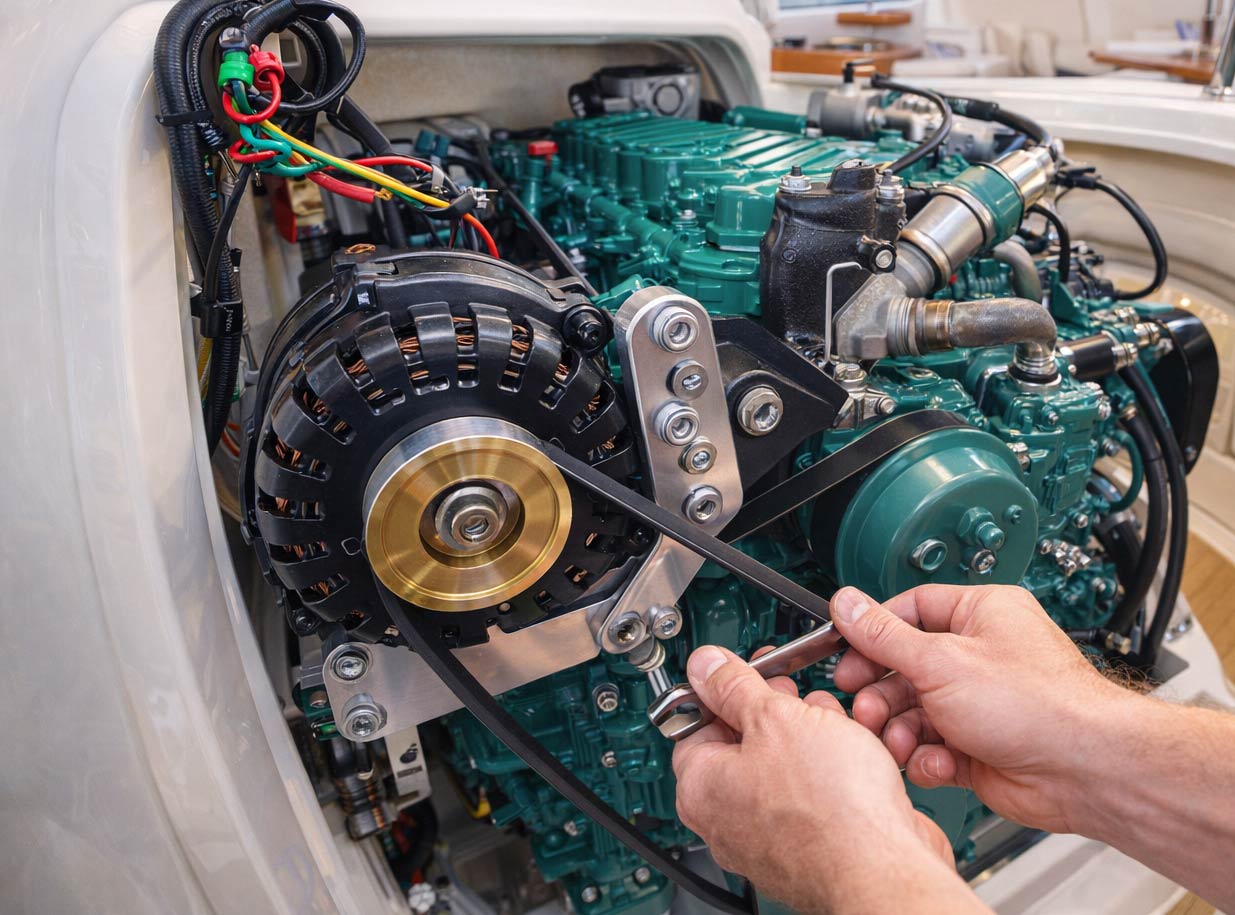
A marine alternator converts mechanical energy from your boat’s engine into the electrical power that charges your battery bank and runs your onboard electronics. When it fails, your batteries drain, your navigation instruments go dark, and your engine may not restart. Understanding the warning signs of alternator failure, how to match amp output to your charging system, and which brands fit your engine helps you solve the problem before it leaves you stranded on the water.
What Does a Marine Alternator Do?
Every time your engine runs, the boat alternator generates electricity. A drive belt connected to the engine crankshaft spins the rotor inside the alternator housing, creating an alternating current. The internal rectifier and diodes convert that AC into direct current that flows to your battery bank and powers every 12-volt electrical load on the boat, from your chart plotter and VHF radio to your bilge pumps and cabin lighting.
One question we hear regularly at Go2Marine is whether a standard car alternator will work on a boat. The short answer is no. A marine alternator is built with corrosion-resistant components, sealed housings, and marine-grade bearings to survive constant exposure to moisture, salt spray, and engine compartment humidity. An automotive unit will physically bolt on in many cases, but it lacks these protections and may violate federal safety regulations on an inboard gasoline engine.
There is also a meaningful difference between gasoline and diesel marine applications. Alternators on inboard gasoline engines must be ignition protected to SAE J1171 standards, a requirement enforced by the U.S. Coast Guard. Marine diesel alternators do not require ignition protection because diesel fuel is far less volatile, but they typically include a dedicated tachometer output terminal (labeled W or R on the housing) that automotive units do not have.
Warning Signs Your Marine Alternator Is Failing
After decades of helping boaters diagnose charging problems, the Go2Marine technical team sees the same failure patterns repeatedly. Here are the symptoms that signal your alternator is on the way out.
Chronic undercharging. If your batteries are consistently low despite regular engine running time, your alternator may not be delivering its rated amperage. Test with a multimeter at the battery terminals while the engine is at cruising RPM. A healthy 12 volt charging system should read between 13.8 and 14.4 volts. Anything below 13.5 volts points to a weak alternator or a failing voltage regulator.
Belt dust or squealing. Fine black dust around the alternator pulley or a high-pitched squeal during engine operation usually means belt slippage. This can be a simple belt tension adjustment, but it can also indicate that the internal bearings are seizing and creating resistance the drive belt cannot overcome. Inspect the belt for glazing, cracking, or uneven wear.
Burning electrical smell. An overheated alternator produces a sharp odor similar to hot insulation. This typically means the stator windings are overheating from a shorted diode, a locked bearing, or sustained operation above the unit’s rated amperage. Shut the engine down and inspect before running again.
Flickering instruments and lights. If your electronics dim at idle and recover at higher RPM, the alternator is producing inadequate current at low engine speeds. This is often an early sign that the brushes are wearing down or the rotor’s field coil is degrading.
Whining or grinding noise from the engine compartment. A healthy unit runs quietly. A pitch-changing whine indicates worn bearings. Grinding noise means the bearings have failed completely and the rotor is contacting the stator housing. At that stage, replacement is urgent.
Why SAE J1171 Ignition Protection Matters
SAE J1171 is a testing procedure developed by the Society of Automotive Engineers that certifies marine electrical devices for safe use in gasoline engine compartments. During the test, the alternator is exposed to a controlled propane and oxygen mixture while a sparking device simulates brush arcing inside the housing. If the unit’s construction prevents the internal spark from igniting the surrounding flammable atmosphere, it earns certification.
The U.S. Coast Guard mandates this certification for all electrical devices installed in enclosed gasoline engine spaces on recreational and commercial vessels. A non-certified unit can ignite fuel vapors from a hose failure, carburetor overflow, or fuel rail leak. Every replacement alternator for inboard gasoline applications, such as this ARCO 70-amp MerCruiser replacement, must carry SAE J1171 certification. Diesel and outboard applications are exempt.
When ordering, look for “SAE J1171” or “Ignition Protected” in the product listing. All ARCO, Sierra, API, and Balmar alternators sold for gasoline inboard applications through Go2Marine carry this certification. Never substitute an automotive alternator on an inboard gas engine, regardless of price or convenience.
How to Size a Replacement Marine Alternator
Correct alternator sizing is the most common question our team fields from boaters replacing or upgrading their charging system. An undersized unit leaves your house battery consistently undercharged, while an oversized one can overload the drive belt, crankshaft pulley, and mounting bracket.
Match amperage to battery bank capacity. The industry rule of thumb is that your alternator’s output should equal at least 25 percent of your house battery bank’s amp-hour rating. A 400 Ah flooded lead-acid bank needs a minimum 100-amp unit. AGM batteries have a higher charge acceptance rate (up to 40 percent), so the same bank in AGM could justify 160 amps. Lithium (LiFePO4) batteries accept even higher rates, often requiring 200 amps or more with a compatible external regulator. Keep in mind that most marinized engines ship from the factory with a basic internal regulator and a 50 to 65 amp unit sized to maintain a single starting battery, not to recharge a large house bank.
Account for real-world derating. Manufacturers rate output at full RPM and cool ambient temperature. Under sustained load in a hot engine compartment, expect roughly 80 to 85 percent of the rated figure. A 100-amp alternator realistically delivers about 80 to 85 amps when hot. At idle, most stock OEM units produce only 40 to 50 percent of their rating. A 65-amp factory alternator may deliver just 25 to 35 amps at low RPM.
Consider the drive belt capacity. A single V-belt can reliably drive an alternator producing up to approximately 100 amps of sustained output. Above that threshold, you need a serpentine belt conversion or a dual V-belt setup to prevent slippage and premature belt wear. Upgrading to a Balmar high-output alternator kit often includes the correct pulley for your engine’s belt configuration.
Verify the mounting style. Marine alternators use single-foot, dual-foot, or saddle mount (also called pad mount) configurations in 3.15-inch and 4-inch internal diameters. The replacement must physically fit your engine’s existing bracket. Measure the mounting pattern of your current unit before ordering, because swapping between mount types typically requires a custom bracket.
Marine Alternator Brands Compared
Go2Marine carries marine alternators from five manufacturers: ARCO Marine, Sierra, API Marine (Sterndrive Engineering), Quicksilver by Mercury, and Balmar. The right brand depends on whether you need a direct OEM swap at the original amp rating or a high output marine power alternator upgrade for a demanding electrical load.
ARCO Marine. Founded in 1960 in Pensacola, Florida, ARCO is a U.S. manufacturer specializing in OEM replacement alternators for MerCruiser, Volvo Penta, OMC, Crusader, Pleasurecraft, Westerbeke, and Yanmar engines. Their units are built to match exact factory specifications, mount patterns, and wiring configurations, making them a direct bolt-in replacement. All gasoline-application ARCO alternators carry SAE J1171 certification.
Sierra Marine. Sierra produces OEM-equivalent replacement alternators cross-referenced to original manufacturer part numbers from Mercury, MerCruiser, Volvo Penta, and other engine families. Their parent company, Dometic Marine, backs every Sierra alternator with a useful-life limited warranty. Sierra is a reliable choice for boaters who want a proven, factory-spec replacement at a fair price.
API Marine / Sterndrive Engineering. API (now operating as Sterndrive Engineering) produces aftermarket replacement marine alternators and starters across a wide range of inboard and sterndrive engines, including small-frame and large-frame configurations for MerCruiser, Volvo Penta, Pleasurecraft, Indmar, and Crusader. API offers a one-year fault-free warranty on rotating electrical parts.
Quicksilver by Mercury. Quicksilver is Mercury Marine’s factory-authorized replacement parts brand. For boaters who prefer to stay with OEM Mercury components for their MerCruiser or Mercury sterndrive, Quicksilver alternators are the direct factory option with guaranteed fitment.
Balmar. Balmar builds high-output marine power alternators for boats whose electrical demands exceed what stock charging systems can deliver. Cruisers running inverters, watermakers, refrigeration, or large house battery banks frequently upgrade to the Balmar 6-Series, which features dual internal cooling fans, custom-wound stators and rotors, and output ratings from 70 to over 200 amps in both 12-volt and 24-volt configurations. Every Balmar alternator meets USCG, ISO, SAE, and CE ignition protection standards for gasoline and diesel engines. Paired with a Balmar external multi-stage voltage regulator, these units deliver smart charging profiles tailored to AGM, gel, flooded, and lithium battery chemistry.
All five brands produce dependable, marine-grade products. For a standard OEM swap at the original amperage, ARCO, Sierra, API, and Quicksilver are all solid options. For boaters upgrading to a larger battery bank or adding significant electrical loads, Balmar is purpose-built for that demand.
What to Check Before Ordering a Replacement
Installing the wrong alternator can damage your wiring, your voltage regulator, or your battery bank. Verify all of the following before purchasing.
Engine make, model, and year. Fitment varies by engine family. A MerCruiser 5.7L gasoline sterndrive takes a different alternator than a Yanmar marine diesel. Cross-reference by exact engine model number and production year, not just block displacement.
Mounting configuration. Confirm single-foot, dual-foot, or saddle mount. Measure the internal diameter for saddle mounts (3.15 inches or 4 inches). If the mounting style does not match, you will need a new bracket.
Pulley type and diameter. Match the existing pulley: single V-belt groove, dual V-belt groove, or serpentine (K6). The pulley diameter must align with the crankshaft pulley to maintain the correct belt speed ratio and charging output across the RPM range.
Voltage, amperage, and ignition protection. Confirm 12 volt or 24 volt. Match or exceed the original amp rating. If the engine burns gasoline, SAE J1171 certification is mandatory.
Terminal configuration. Note the wiring connections on the existing unit: B+ (battery output), D+ (excitation and charge indicator light), W or R (tachometer signal, found on most diesel alternators), and ground. The replacement must match these terminals. Upgrading from an internally regulated unit to one with an external smart regulator requires additional wiring for the regulator, battery temperature sensor, and alternator temperature sensor.
Maintenance Tips to Extend Alternator Life

A well-maintained marine alternator can deliver reliable service for 5 to 10 years. Neglecting basic maintenance shortens that lifespan significantly.
Inspect and tension the drive belt regularly. A loose belt reduces charging output and accelerates wear. A belt that is too tight overloads the front bearing. Check tension per the engine manufacturer’s specification, typically about half an inch of deflection at the midpoint of the longest belt span. Replace the belt at the first sign of cracking, glazing, or fraying.
Keep electrical connections clean. Corrosion on the B+ terminal or ground connection increases resistance, reduces charging efficiency, and generates heat that shortens component life. Inspect terminals every season, clean with a wire brush or Scotch-Brite pad, and apply a corrosion inhibitor designed for marine electrical connections.
Monitor voltage output from the helm. A battery monitor or voltmeter installed at the helm lets you catch charging problems the moment they develop. On a healthy system, you should see 13.8 to 14.4 volts at the battery with the engine running at cruising RPM. A gradual decline in voltage over weeks or months often signals brush wear or regulator wear.
Maintain airflow in the engine compartment. Alternators generate substantial heat under sustained load. Poor ventilation is one of the leading causes of premature failure on boats with enclosed engine spaces. Keep intake vents clear, confirm that engine compartment blowers are functional, and verify that nothing is blocking airflow around the alternator housing.
Plan ahead for replacement. If your alternator still runs but delivers noticeably less output than it once did, the internal components are wearing down. Rather than waiting for a complete failure at the worst possible moment, order a replacement alternator while you can still choose the right part, not the only part available at a marina dock.