
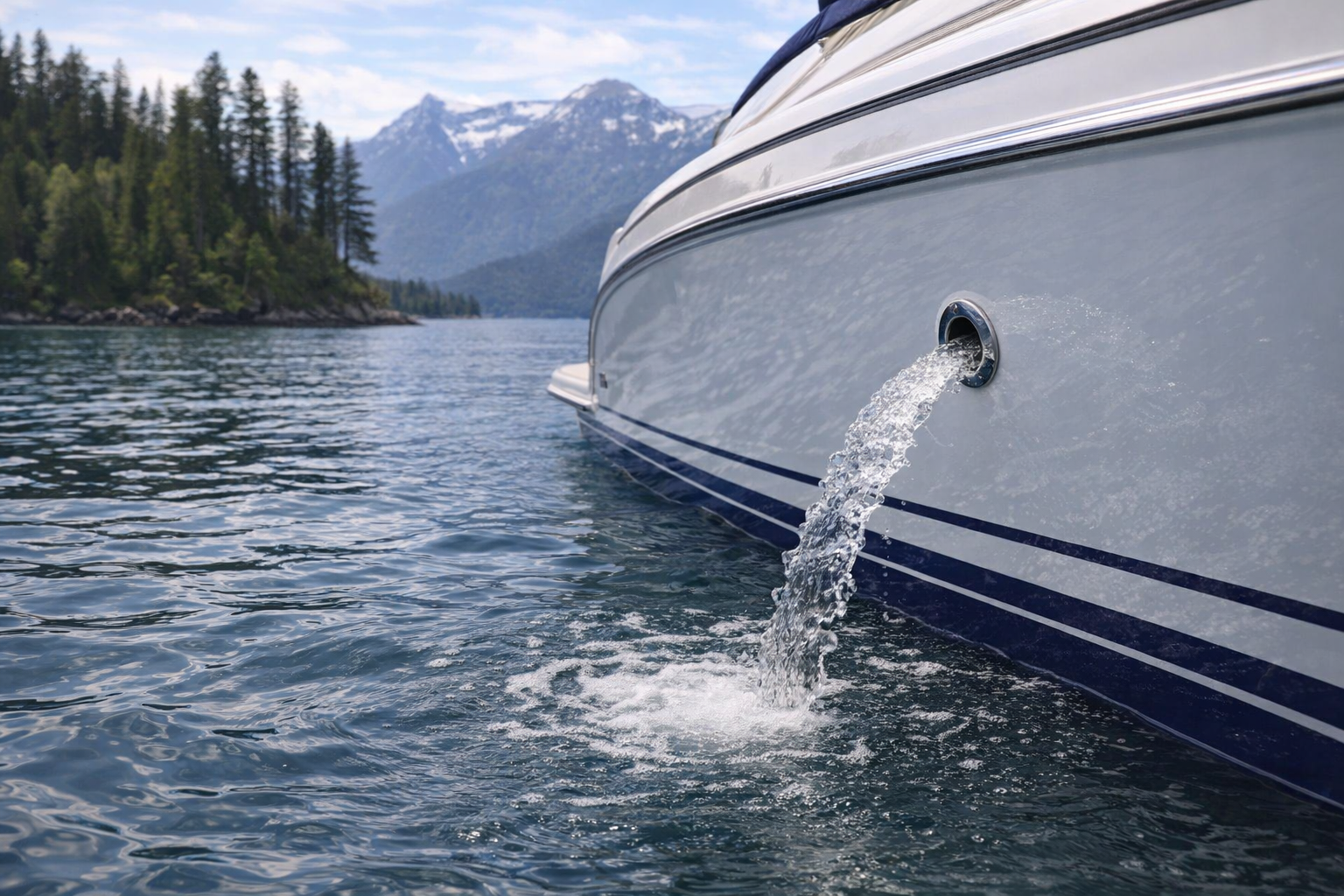
Choosing the right bilge pump depends on your boat’s length, bilge depth, and how the vessel is used. Most boats under 26 feet need 1,000–1,500 GPH of total capacity, while boats 26–36 feet require 1,500–2,500 GPH. Always use an automatic bilge pump as your primary and keep a manual backup. Here is the complete sizing and selection guide.
Does Your Boat Need a Bilge Pump?
Every boat takes on water. Rain, spray, stuffing box drips, leaky hatches, and washdown runoff all find their way to the lowest point of the hull, the bilge. Without a pump to remove it, that water causes corrosion, electrical damage, mold, instability, and, in serious cases, sinking.
The U.S. Coast Guard does not mandate electric bilge pumps on recreational boats, but it does recommend that every vessel carry a dewatering device. In practice, any boat longer than about 16 feet that spends time in the water should have at least one electric bilge pump and a manual backup.
The American Boat and Yacht Council (ABYC) publishes the voluntary safety standard ABYC H-22 specifically for electric bilge pump systems. While ABYC standards are not legally required, approximately 90 percent of boats on the water today are built to ABYC standards, and marine surveyors evaluate bilge systems against H-22 during pre-purchase inspections. If you are installing or replacing a bilge pump, following ABYC guidelines is the safest and most defensible approach.
Types of Boat Bilge Pumps Explained
Not all bilge pumps work the same way. Understanding the four main types helps you match the right pump to your boat’s layout and usage.
Automatic Pumps
Automatic bilge pumps are the most common type on recreational boats. These submersible pumps sit at the lowest point of the bilge and turn on by themselves when water reaches a set level, either through a mechanical float switch or an electronic water sensor. The Rule Next Generation series uses field-effect sensing with no moving parts, eliminating the float switch failures that are the most common cause of automatic pump malfunctions. Automatic bilge pumps are available in capacities from 360 GPH to over 4,000 GPH and should be wired directly to the battery so they operate whether the engine is running or not. They cannot pump the bilge completely dry, and debris such as fishing line, leaves, or hair can foul the impeller, so keeping the bilge clean is essential.
Diaphragm Pumps
Diaphragm bilge pumps use a flexible membrane to draw water through an intake hose and push it overboard. Because they are self-priming, they can be mounted above the bilge for easier maintenance access.
Diaphragm pumps handle debris better than centrifugal pumps and can pump the bilge almost completely dry. However, they cannot match the GPH capacity of centrifugal pumps and are more commonly used on sailboats or as secondary pumps on vessels where bilge access is limited.
Flexible Impeller (Engine-Driven) Pumps
Flexible impeller pumps, such as the Jabsco, Flexible Impeller Pump, are belt-driven or direct-coupled to the engine. They deliver very high flow rates and are self-priming, making them effective for emergency dewatering on larger inboard-powered vessels.
Because they depend on the engine running, flexible impeller pumps are not a replacement for electric bilge pumps; they are an additional high-capacity option for emergencies.
Manual Hand Bilge Pumps
A manual bilge pump operates without electrical power, using a handle or lever to pump water overboard. If your battery dies, your wiring corrodes, or your float switch fails, a hand bilge pump is the only dewatering tool that will still work.
ABYC recommends that every vessel carry a manual dewatering device. Even if you have two automatic pumps, a manual backup should be accessible from the cockpit or helm and ready to use at all times.
Automatic vs Manual Bilge Pumps: Which Do You Need?
The terms “automatic” and “manual” refer to how the pump is activated — not whether it uses electric power.
An automatic bilge pump activates on its own when water reaches a set level. Activation is triggered by either a mechanical float switch (a buoyant arm that rises with the water and closes a circuit) or an electronic water sensor that detects the presence of water without any moving parts.
A manual electric bilge pump requires the operator to flip a switch on the helm panel to turn it on. It uses the same submersible centrifugal pump motor as an automatic unit but has no float switch or sensor.
A manual hand pump is a human-powered pump with no electrical components at all.
Which Setup Is Right?
For most boats, the recommended setup is:
-
Primary pump: Automatic electric bilge pump with a float switch or electronic sensor, wired to run whether the engine is on or off
-
Backup pump: A manual hand bilge pump (diaphragm type) accessible from the cockpit
-
Optional third pump: On boats over 30 feet or with multiple compartments, a second automatic pump mounted at a different height than the primary
Float switches are the most proven activation method for long-term reliability. Electronic water sensors, such as the technology used in the Rule-Mate automatic bilge pump series, eliminate the risk of mechanical float switch failure by using field-effect sensing with no moving parts.
Whichever type you choose, always wire your automatic pump through a 3-way panel switch (Auto / Off / Manual Override) so you can test the pump manually and override it in any situation.
How Many Bilge Pumps Should Your Boat Have?
The minimum recommendation for any boat with an electrical system is two: one automatic electric pump and one manual hand pump.
For boats over 30 feet or boats with multiple separate bilge compartments, a pump should be installed in each compartment that can collect water. On a multi-compartment vessel, the primary automatic pump is at the lowest point in the main bilge, with the backup automatic pump mounted several inches higher. If the primary fails or the water level rises beyond its capacity, the backup activates.
Place the manual hand pump in a location that is accessible from the cockpit or helm, not buried in a lazarette or under floor panels. In an emergency, you need to reach it without tools and operate it from a comfortable position.
Bilge Pump Installation Tips
A bilge pump is only as reliable as its installation. Follow these guidelines to get the best performance from your system.
Mount the pump at the lowest point. The primary pump should sit at the very bottom of the bilge where water naturally collects. Use the manufacturer’s mounting hardware and secure the pump so it cannot shift underway.
Use smooth-bore discharge hose. Corrugated bilge hose creates internal friction that can reduce pump output by approximately 20 percent. Smooth-bore reinforced hose, sized to match the pump outlet (typically 3/4-inch or 1-1/8-inch), delivers significantly better flow.
Route the discharge hose above the waterline. The hose must rise from the pump to a point higher than the through-hull discharge fitting, then run down to the fitting. This prevents seawater from siphoning back into the bilge. Per ABYC H-22, a check valve must not be used as a siphon break use a vented loop if the discharge is below the heeled waterline.
Wire directly to the battery. Per ABYC E-11, bilge pump circuits are classified as essential circuits and should be wired directly to the battery (not through the ignition switch) with an inline fuse. This ensures the pump operates whether the engine is on or off. Use tinned marine-grade wire and waterproof heat-shrink butt connectors.
Size the fuse correctly. Use the fuse rating specified by the pump manufacturer. Over-fusing a bilge pump circuit does not improve performance it creates a fire risk.
Orient the float switch fore-and-aft. If you are using a separate mechanical float switch, install it in the bow-to-stern direction. Mounting it athwartship (side to side) can cause false activations when the boat goes on plane or rolls in waves.
Install a 3-way panel switch. A 3-way lighted rocker switch (Auto / Off / Manual) allows you to leave the pump in automatic mode during normal operation, manually activate it for testing, or shut it off entirely for maintenance.
Bilge Pump Maintenance Checklist

A bilge pump that is not tested regularly is a bilge pump you cannot trust. Follow this maintenance schedule to keep your system reliable.
Monthly: Test the pump manually by flipping the panel switch to the “on” position. Verify that water is actually being discharged overboard — not just that the motor is running. A humming pump with no water flow usually means a clogged intake, a jammed impeller, or an airlock in the hose.
Monthly: If you have a float switch, lift it by hand to confirm it activates the pump. Then pour water into the bilge and verify the switch triggers automatically at the correct water level.
Seasonally: Clean the bilge. Remove any fishing line, hair, leaves, zip ties, or debris that could foul the pump intake or impeller. Use a biodegradable bilge cleaner to dissolve oil and grease.
Seasonally: Inspect all wiring connections for corrosion. Bilge wiring is exposed to constant moisture, so connections should be made with adhesive-lined heat-shrink butt connectors. Replace any connection showing green corrosion.
Seasonally: Check the discharge through-hull fitting for marine growth or obstruction.
Every 3–5 years: Plan to replace the pump motor. Centrifugal bilge pump impellers wear over time, reducing capacity. If the pump runs but moves noticeably less water than when it was new, it is time for a replacement.
Common Bilge Pump Mistakes to Avoid
Even experienced boaters make these errors. Avoiding them can save your boat or your life.
Trusting the GPH number on the box. Manufacturer ratings are tested under lab conditions with zero vertical lift. Real-world output is roughly 60 percent of the rated GPH. Size your pump for real-world capacity, not the number printed on the label.
Running a single pump with no backup. If your only pump fails, whether from a stuck float switch, a dead battery, or a fouled impeller, you have no dewatering capability at all. Always carry a manual hand bilge pump as a minimum backup.
Using a corrugated hose. Corrugated bilge hose is cheap and easy to route, but the internal ridges create drag that significantly reduces pump output. Smooth-bore hose is a worthwhile upgrade on any installation.
Skipping float switch testing. Float switches are the most common point of failure in an automatic bilge pump system. Debris, corrosion, or a stuck arm can prevent the switch from activating. Testing monthly catches problems before they become emergencies.
Expecting a bilge pump to save a sinking boat. A one-inch hole just 12 inches below the waterline can admit water at a rate far exceeding any recreational bilge pump’s capacity. Bilge pumps are designed to manage nuisance water and to buy time during an emergency. They are not damage control devices.
Over-fusing the circuit. Installing a larger fuse than the manufacturer specifies does not make the pump more powerful. It allows the motor to draw excessive current without tripping the fuse, which can cause overheating and fire.
Shop Marine Bilge Pumps at Go2Marine
Go2Marine carries the full line of marine bilge pumps from Rule, Attwood, Johnson Pump, and Jabsco from compact 360 GPH units for small boats to heavy-duty 4,000 GPH pumps for offshore vessels. We also stock bilge pump hose, float switches, through-hull fittings, and all the accessories you need for a complete installation.
Not sure which pump is right for your boat? Contact our team for expert advice we have been outfitting boaters since 1967.