
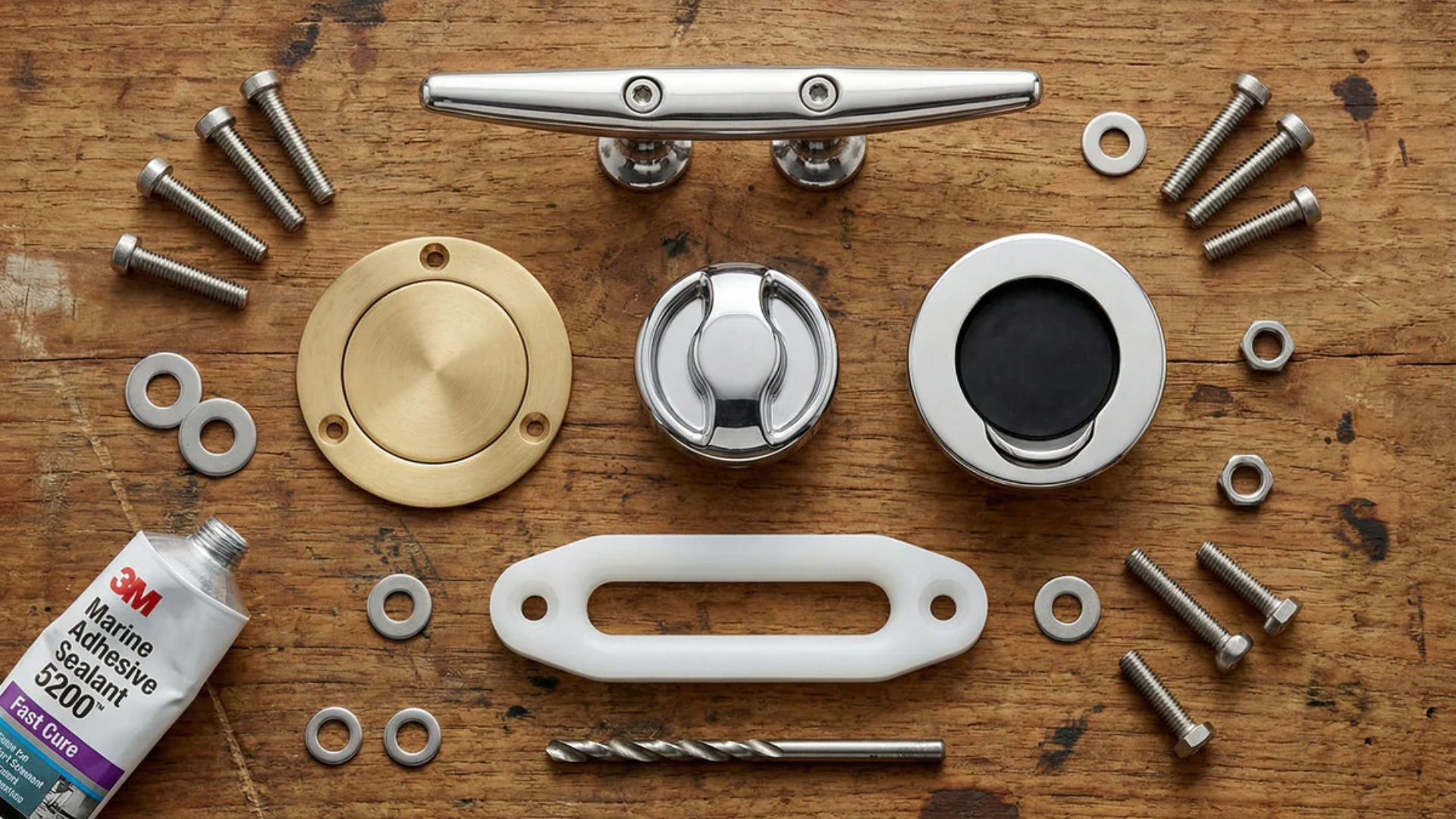
Your boat's deck is a working surface, and everything mounted on it either keeps you safe, keeps your lines organized, or keeps water where it belongs. That's exactly what marine deck fittings do. Yet most boaters only think about them when something goes wrong: a cleat that's pulled loose, a deck fill that leaks, or a handrail that wobbles underfoot.
This guide is here to change that. Whether you're outfitting a new build, refreshing an older vessel, or just trying to understand what's already on your boat, we've broken down every major type of boat deck hardware, what it does, where it fits, what material holds up best, and what to watch out for when you install it.
What Are Marine Deck Fittings, and Why Do They Matter?
In simple terms, deck fittings are the hardware pieces that are fixed to your boat's deck, hull, or transom. They come in dozens of shapes and sizes, but they all share one thing: they're built to handle a marine environment that would destroy standard hardware within a season.
Think about what your deck hardware has to deal with day after day:
-
Salt spray and humidity that accelerate corrosion
-
UV radiation from the sun that degrades plastics and sealants
-
Heavy mechanical loads from dock lines, anchor chains, and crew movement
-
Constant wet-dry cycles that work sealants loose over time
Due to these factors, marine deck fittings are made from materials specifically chosen for their durability in these conditions. The most widely used are:
-
Silicon bronze and brass: time-tested materials that have been used on boats for centuries. Naturally resistant to seawater corrosion and excellent for through-hull and below-waterline fittings.
-
Marine-grade aluminum: light and strong. Well-suited for freshwater environments and racing boats where weight savings matter, but must be properly anodized for use in saltwater.
-
Glass-filled nylon is used for lower-load fittings, such as fairleads and certain chocks. Lightweight, won't corrode, and is cheaper to replace when worn.
The 7 Main Types of Marine Deck Fittings (And What Each One Does)
1. Boat Cleats: Your Primary Line-Holding Fitting
If you've ever tied a boat to a dock, you've used a cleat. It's the horn-shaped fitting that dock lines, anchor lines, and halyards are secured to, and it's probably the single most important piece of boat deck hardware on your vessel.
Cleats come in a few different styles, each suited to specific situations:

-
Horn cleats the standard two-horn design you'll see on most powerboats and cruising sailboats. Reliable, straightforward, and available in every size from 4" to 20" and beyond.

-
Pop-up / retractable cleats. These sit flush with the deck until you need them, then pop up when released. A smart choice for high-traffic areas, such as cockpit coamings, where a fixed cleat would be a trip hazard.

- Jam cleats are used almost exclusively on sailboats. They grip a line under load automatically and release it with a quick upward flick, making them ideal for sheets and control lines that need fast adjustment.
One of the biggest mistakes boat owners make is under-sizing their cleats or securing them with screws instead of through-bolts. A dock line under load from wind, wake, or tidal surge can generate forces several times your boat's own weight. A properly sized cleat, through-bolted with a backing plate, will handle that. One that's screwed down from the top likely won't.
Go2Marine carries boat cleats in 316 stainless steel, cast aluminum, and brass, including retractable pop-up styles and heavy-duty dock cleats sized from 4" right up to 15".
2. Chocks and Hawse Pipes: Line Guides That Protect Your Hull

A chock is a fitting mounted on the rail or hull edge that guides your dock lines and anchor rodes cleanly from the cleat down to the water. Without one, a loaded line would saw back and forth directly across the hull's gelcoat or paint, and it wouldn't take long before you had deep grooves in what used to be a nice finish.
There are two main configurations:
-
Closed (or bull-nosed) chocks: the line is fully enclosed within a smooth, oval channel. Great for keeping dock lines in position even on a boat that pitches and rolls overnight.
-
Open chocks allow the top to be open, making it easy to drop a line in or lift it out quickly. Popular on powerboats, where the speed of handling matters more than line retention.

Hawse pipes serve a related purpose on larger vessels; they're tubes that run through the hull or deck structure, allowing the anchor chain to pass from the windlass down to the chain locker or through the bow. They protect both the chain and the structure around the hole from constant abrasion.
Shop chocks and hawse pipes in stainless steel from trusted brands like Perko and Sea-Dog at Go2Marine.
3. Deck Fills: Safe, Clearly Labelled Tank Access from Above

Take a look at almost any cruising boat, and you'll see a handful of flush-mounted caps set into the deck near the bow and amidships. Those are deck fills, and they serve a specific, critical purpose: allowing you to top up onboard tanks (fuel, fresh water, waste holding) from the surface, without needing to open hatches or access panels below.
Every deck fill is labelled for its specific use: Diesel, Petrol, Water, Waste, Oil, and the cap design is often keyed or colour-coded to reduce the risk of accidental misfuelling. Putting diesel into your freshwater tank (or vice versa) is a mistake that can be extremely expensive and potentially hazardous.
The fitting itself threads into the deck and connects below to the appropriate hose and tank.The cap seals with an O-ring that compresses to form a watertight barrier when closed.
Key points to get right during installation:
-
Use only fuel-certified hose below a fuel deck fill standard hose is not rated for hydrocarbons and will degrade
-
Potable water fills must connect to a food-safe hose to avoid taste and contamination issues
-
Waste deck fills need a sanitation-rated hose with the correct clamp spec to meet holding tank regulations
-
Bed the fitting with a marine-grade sealant rated for immersion. Standard silicone is not sufficient
-
Test the seal with fresh water before returning the boat to service
Go2Marine stocks a wide range of diesel, fresh water, and waste deck fills, along with replacement caps and O-ring kits if yours are worn or lost.
4. Deck Plates: Clean, Watertight Access to Below-Deck Spaces

A deck plate is a removable, watertight hatch that gives you access to the spaces under your deck bilge compartments, under-seat storage, wiring runs, cable trays, and inspection zones without needing to cut large holes or install full-sized hatches.
They're simple by design. A threaded ring or bayonet-style cap seats into a collar that's epoxied and through-bolted into the deck. When closed and correctly torqued down, the O-ring seal makes them fully watertight. When you need access, they unscrew or twist out in seconds.
What to watch for over time:
-
O-ring compression and hardening, replace annually or if you see any seepage
-
Cracks in the cap body, particularly in clear polycarbonate versions exposed to UV
-
Corrosion on the collar threads, especially in stainless-to-aluminum interfaces
Browse Go2Marine's range of deck plates.
5. Scuppers: Keeping Your Deck Dry and Your Cockpit Safe
Water on a boat deck is unavoidable. Rain, spray, waves, and washdowns all put water up top, and it all needs somewhere to go. That somewhere is a scupper, a drain fitting that channels deck water overboard before it can pool, flood a cockpit, or find its way below.
On most powerboats and self-bailing sailboat cockpits, scuppers are positioned at the lowest natural point of the deck or cockpit floor and drain either through the hull sides (cockpit scuppers) or through the transom (particularly on powerboats). Larger deck areas may use multiple scuppers to handle heavy rainfall or a big breaking wave.
Some scupper designs include a one-way flap valve. This allows water to drain out freely but closes when the boat heels in a gust or when a following sea comes aboard, preventing water from coming back in through the drain.
The most important rule in scupper placement is elevation. A scupper must be at the absolute lowest point of the surface it's meant to drain. Even a few millimetres of uphill slope means water will sit rather than drain, creating a breeding ground for mould and staining.
Go2Marine offers flush-mount, surface-mount, and through-hull scuppers from Perko and Sea-Dog, including cockpit-drain and transom-mount styles.
6. Handrails and Rail Fittings: Crew Safety Where It Counts Most
The old sailor's saying goes: one hand for the boat, one hand for yourself. Handrails and grab rails are the boat's side of that bargain. They're the stainless steel or teak bars running along the cabin top, cockpit sides, and bow that your crew grabs when the boat moves unexpectedly, and on a rough day offshore, they can be the difference between a scare and a man-overboard situation.
On the structural side, a handrail needs to be strong enough to take the full body weight of a person stumbling or grabbing hard. That means proper through-bolting into solid substrate, not just into the deck skin or moulded fibreglass.
Rail fittings are the modular connectors that let you build custom rail systems from stainless steel tube. The standard sizes are 7/8" OD and 1" OD tubes, and the fittings, base plates, 60° and 90° tees, end caps, and elbows snap or bolt onto the tube to create T-intersections, corners, and mounting points suited to your specific deck geometry.
What makes a well-installed handrail:
-
Through-bolted base plates with backing plates underneath
-
Angled base flanges that match your deck's camber (most decks crown slightly in the centre)
-
Smooth, burr-free tube ends and fittings that won't snag lines or skin
-
316 stainless steel throughout if the boat spends any time in salt water
Go2Marine carries stainless steel handrail fittings, grab rails, and tube by the foot, including solid teak grab handles for cabin top use and 316 cast tee fittings from Sea-Dog and Whitecap.
7. Pad Eyes, Eye Bolts, and Fairleads: Anchor Points and Line Directors
Pad eyes are low-profile metal loops with a flat base that bolt to the deck. They give you a fixed anchor point for attaching blocks, snatch blocks, jackline straps, safety harness tethers, and tie-down straps for gear on deck. Because they handle sharp, dynamic loads, particularly on a sailing boat where block loads can be significant, they must be installed over solid structural material, not just into a hollow-cored deck panel.
Eye bolts are functionally similar but use a threaded rod shank that passes through the deck and is secured with a nut and backing plate on the underside, making them slightly stronger in pure pull-out load.
Fairleads are smooth guides, usually a ring, roller, or slot fitting, that direct a line to run in a specific direction without rubbing or chafing. You'll find them at the base of masts for halyards, along the side decks for spinnaker sheets, and at the bow for snubbers on powerboats.
The key to any of these fittings is installation position: they need to be over a structural rib, bulkhead, or beam, not in an open mid-panel deck. If yours must go in an open panel, glass in a hardwood insert from below before installing.
Explore Go2Marine's full deck hardware range for pad eyes, U-bolts, bow eyes, and fairleads in stainless steel.
Installation Considerations: 5 Rules That Make the Difference
The quality of your deck hardware only matters as much as the quality of your installation. Expensive fittings poorly installed will fail just as surely as cheap ones. Here's what actually matters when you're putting hardware on a boat.
Rule 1: Through-Bolt Everything That Carries Load
Self-tapping screws are fine for lightweight fittings like cable clips or instrument brackets. For anything that takes a line load cleats, handrail bases, pad eyes, fairleads, you need through-bolts.
A through-bolt passes completely through the deck and is secured on the underside with a washer, backing plate, and nut. The backing plate is not optional: it spreads the pull force across a larger area of deck laminate, preventing the fitting from being 'popped' through by a sudden load. Use a backing plate at least as large as the fitting's base; larger is always better.
Rule 2: Seal Every Single Hole You Drill
Deck core rot is one of the most damaging and expensive problems a fibreglass boat can develop, and it almost always starts with an unsealed or poorly sealed hole. When water gets past the gelcoat and into a balsa or foam core, it wicks outward, softens the core material, and can spread far beyond the original entry point before you ever notice it.
For every hole drilled for a deck fitting:
-
Oversize the hole slightly and fill it with thickened epoxy to create an impermeable plug
-
Re-drill the correct size through the cured epoxy plug
-
Bed the fitting with marine-grade polysulphide or polyurethane sealant under the base
-
Apply sealant to bolt shanks before inserting them through the deck
-
Torque down firmly but not so hard that you crack the deck laminate
Rule 3: Never Mix Incompatible Metals
Galvanic corrosion, the electrochemical attack that occurs when two dissimilar metals are in electrical contact in the presence of an electrolyte like salt water, can eat through hardware surprisingly fast. The classic mistake is using a stainless steel fitting with a bronze backing plate, or aluminum hardware with stainless bolts, without any isolation between them.
To prevent this: use fasteners made from the same metal as the fitting, use nylon or neoprene washers to isolate dissimilar metals where they must contact each other, and apply a good-quality marine anti-seize compound to threads before assembly.
Rule 4: Size for the Worst Day, Not the Average Day
Hardware that's 'just about right' for calm-water docking will be too small when a 30-knot squall comes through and puts your dock lines under maximum strain. When choosing fittings, think about the most demanding scenario your boat will ever face, then select hardware rated beyond that.
This is especially important for cleats, handrail bases, and jackline attachment points. The incremental cost of going a size up is trivial compared to the cost of a failure.
Rule 5: Build a Maintenance Routine
Even the best marine hardware needs attention to stay in top condition. A simple routine makes all the difference:
-
After every trip: rinse all stainless fittings with fresh water to remove salt deposits
-
Monthly (in-season): check bolts for loosening, look for cracked sealant around fitting bases, inspect O-rings on deck plates and fills
-
Each season start: do a full inspection of all load-bearing hardware; re-bed any fitting where the sealant has cracked or separated
-
As needed: apply a marine-grade polish to stainless steel to remove surface oxidation before it becomes deep pitting
Wrapping Up: The Right Fittings, Fitted Right
Marine deck fittings are not glamorous. They don't get the attention that electronics, sails, or engines do. But they are, in many ways, the quietly critical infrastructure that keeps everything else working. A boat with properly selected, correctly installed, and regularly maintained deck hardware is a safer, more reliable, and more enjoyable vessel, and it holds its value far better, too.
The key takeaways from this guide:
-
Match your material to your environment: stainless for salt water, anodized aluminum where weight matters, bronze for below-waterline
-
Through-bolt every load-bearing fitting, always with a backing plate
-
Seal every hole properly. Unsealed deck penetrations are the leading cause of core rot
-
Size up rather than down; the cost difference is small, the safety difference is significant
-
Inspect and maintain on a regular schedule. Small problems caught early are always easier and cheaper to fix
If you're ready to start shopping, Go2Marine has a full range of marine deck fittings from the brands boaters trust, including Sea-Dog, Perko, Whitecap, and Lewmar. Browse the complete marine deck hardware collection at Go2Marine and find everything you need for a safe, well-fitted deck.