
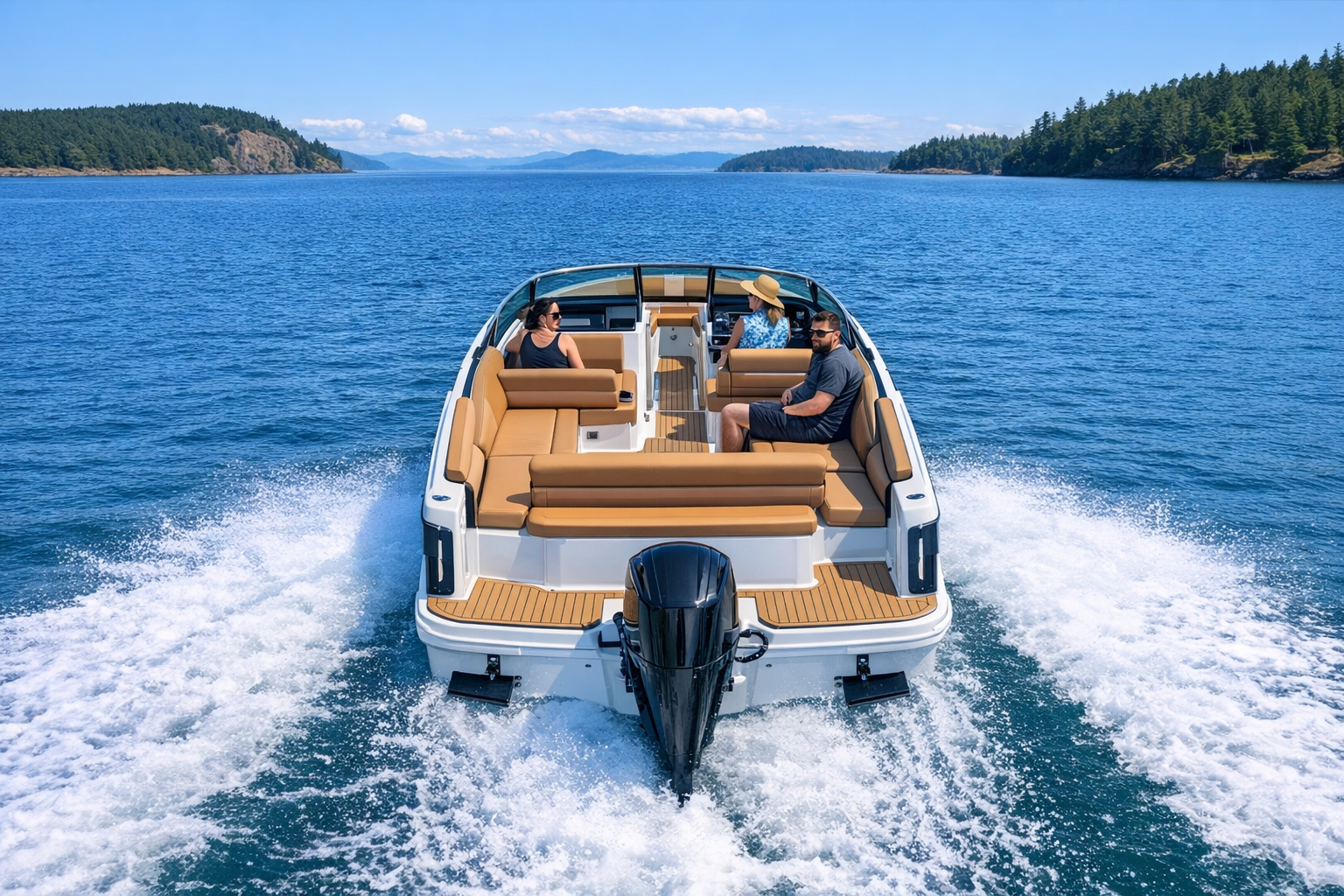
Trim tabs are adjustable metal plates mounted on your boat's transom that control the hull's running angle while underway. Lowering the tabs lifts the stern and pushes the bow down, gets you on plane faster, corrects listing from uneven loads, reduces pounding in rough water, and improves fuel efficiency. Every planing powerboat benefits from them, and choosing the right size, type, and brand makes a measurable difference in how your boat performs.
What Are Trim Tabs and What Do They Do?
So what are trim tabs exactly? They are two independently controlled stainless steel or composite plates mounted on either side of your transom, just above the running surface. Each tab connects to an actuator, hydraulic, electric, or spring-loaded, that moves it up or down from a switch at the helm.
When you lower a tab, water pushes against the angled plate and generates upward pressure on that side of the stern. Because each one operates independently, you can adjust both the fore-and-aft running angle and the side-to-side balance to correct for uneven passenger weight, crosswinds, or prop torque. The result: faster planing, better fuel economy, a smoother ride in chop, and elimination of listing.
Power trim on an outboard or sterndrive adjusts the propeller angle, not the hull. Tabs trim the hull directly while power trim optimizes the prop. Used together, they deliver performance neither achieves alone.
Does Your Boat Need Trim Tabs?
If your boat has a planing or semi-displacement hull, it will benefit from trim tabs for boats of virtually every size. You likely need them if your boat struggles to get on plane, runs bow-high with limited visibility, porpoises at certain speeds, lists when passengers shift or in crosswinds, burns excess fuel from an inefficient running angle, or pounds in head seas. Center consoles, bay boats, walkarounds, express cruisers, and fishing boats that carry uneven loads see the biggest improvement.
Types of Trim Tabs: Hydraulic, Electric, and Spring-Loaded
Hydraulic Systems
Hydraulic systems use a 12-volt motor to drive a pump, sending fluid through lines to actuator cylinders on the transom. Bennett Marine is the most established manufacturer in this category, having invented the first adjustable trim tab system in 1960. Systems like the Bennett hydraulic trim tab sets handle heavy loads well and are a common choice for boats over 30 feet, cruisers, and offshore sportfishing vessels. Installation requires routing hydraulic lines from the pump to the actuators, and the fluid level should be checked annually.
Electric Systems
Electric systems use ball-screw or worm-gear actuators mounted directly on the transom, with no hydraulic fluid, pump, or tubing to deal with. Lenco Marine pioneered this approach and their standard electric trim tab kits remain the most widely used electric system, though Bennett also offers electric tabs through their BOLT product line. Electric actuators respond instantly to switch input, require no fluid maintenance, and are simpler to install, making them popular on boats under 30 feet and for do-it-yourself installations.
Spring-Loaded (Self-Leveling) Systems
Nauticus Smart Tabs and the Bennett SLT are spring-loaded, self-adjusting units that require no electricity, no hydraulics, and no helm switch. A nitrogen gas actuator inside each unit reacts automatically to water pressure. They install in under an hour with a drill and screwdriver and require zero maintenance. The tradeoff is no helm control; you cannot independently adjust port and starboard sides or retract them for calm days. For boats 10–22 feet wanting basic planing assistance without complexity, spring-loaded systems are a practical starting point.
How to Size Trim Tabs for Your Boat
Proper trim tab sizing is the most important selection decision. The industry-standard rule, published by Bennett Marine, is: for boats under 40 MPH, allow at least one inch of tab span (width) per side for every foot of boat length. A 22-foot boat would use a system with a minimum 22-inch span; a 24" x 9" kit is the closest standard fit. For boats running over 40 MPH, Bennett recommends a smaller span — roughly three-quarters of an inch per foot — since faster hulls need less tab area to achieve the same lift, and oversized tabs can cause over-correction at speed. For trailered boats in the 17'–23' range, compact systems like the Bennett Sport Tab M120 are designed to fit under swim platforms without cutting.
A 9-inch chord (front-to-back depth) is the standard recommendation for most planing boats. A 12-inch chord provides more lift and suits slower boats under 15 MPH, semi-displacement hulls, boats over 50 feet, and transom configurations where a limited span must be compensated with a deeper chord. When in doubt, choose the widest span that fits; a wider tab generates more lift per degree of deflection, meaning less drag.
Bennett vs Lenco: How the Two Compare
Bennett Marine and Lenco Marine are the two dominant brands in the U.S. recreational market, and both produce proven, reliable systems. The right choice depends on your boat, your preferences, and how you weigh the factors below. For a more detailed comparison, read our Bennett vs Lenco: Hydraulic or Electric? guide.
System types. Bennett offers both hydraulic and electric (BOLT) systems, plus spring-loaded SLT tabs. Lenco offers electric-only systems. If you specifically want hydraulic power, Bennett is your option. If you prefer electric, both brands compete directly.
Response speed. Lenco’s electric ball-screw actuators and Bennett’s BOLT electric actuators both deliver fast response. Boaters who have used both often note that Lenco’s electric tabs respond slightly faster than Bennett hydraulic systems, though the difference narrows considerably when comparing electric to electric.
Installation. Electric systems from both brands are simpler to install than hydraulic, no pump, no fluid lines, fewer components. Lenco’s all-electric lineup means every kit they sell has this advantage. Bennett’s hydraulic systems involve routing fluid lines, which adds installation time but remains straightforward for an experienced installer.
Maintenance. Electric systems from both brands are maintenance-free, with no fluid to check. Bennett hydraulic systems use automatic transmission fluid (ATF) that should be inspected annually. This is a minor task but worth noting if you prefer a completely hands-off system.
Warranty. Bennett offers a lifetime limited warranty on actuators for both hydraulic and BOLT electric systems. Lenco offers a 5-year limited warranty on trim tab systems (extended from 3 years in April 2019). Both companies have established track records of honoring warranty claims.
Product range. Bennett covers the widest range: SLT spring-loaded tabs for small boats, BOLT electric for 17–28 foot boats, hydraulic for 15–80 feet, and the AutoTrim Pro automatic control system. Lenco covers boats from 14 to over 50 feet with Standard, Edge Mount, and Super Strong electric kits, plus the Auto Glide automatic leveling system.
Both brands have strong reputations built over decades. Many boaters have used both without issues. The decision often comes down to whether you prefer hydraulic or electric, and which product range best fits your boat’s size and transom layout.
Nauticus Smart Tabs: The Spring-Loaded Option
For boaters who want planing assistance without the complexity of powered systems, Nauticus Smart Tabs offer a self-adjusting, zero-maintenance solution. Available in stainless steel or composite, they install in under an hour and cost under $200. The limitation is no helm control and no independent port/starboard adjustment. They work well on boats 10–22 feet as a simple, affordable first step.
How to Use Trim Tabs on Your Boat
Learning how to use trim tabs takes practice. The helm switch has two sets of buttons, port and starboard, labeled “Bow Down” and “Bow Up.”
Getting on the plane. Press both “Bow Down” buttons in short half-second bursts as you throttle up. Once on plane, gradually retract until the boat finds its smoothest speed-to-RPM ratio.
Correcting a list. If the boat leans to port, lower the starboard tab slightly. Water pressure lifts the starboard stern, leveling the boat.
Running in head seas. Deploying both sides slightly lowers the bow into waves, reducing pounding. Avoid over-trimming in following seas.
Fixing porpoising. Porpoising, a rhythmic bow bounce at certain speeds, is one of the most common reasons boaters add tabs. A light tap of “Bow Down” usually eliminates it immediately.
The golden rule: always adjust in short bursts and let the boat react. Over-trimming can cause the boat to plow or dig in.
Installation Overview
Most complete trim tab kits from both Bennett and Lenco include everything needed: tab planes, actuators, mounting hardware, wiring harness, and a helm switch. An average do-it-yourself boater can complete the job in three to five hours for electric systems. Hydraulic installations take slightly longer due to fluid line routing.
Measure your transom first. Account for swim platforms, ladder brackets, transducer mounts, and any other hardware on each side of the engine or drive. The tabs mount along the very bottom edge of the transom, with the hinges at the bottom and actuators above.
Position symmetrically. Mount the tab planes at equal distances from the center of the transom. Use a straightedge along the hull bottom to align the hinge so the tab sits flush with the running surface when fully retracted.
Seal every transom penetration. Electric systems require a small hole through the transom for actuator wiring. Hydraulic systems require holes for fluid lines. Use marine sealant on every penetration to prevent water intrusion into the transom core.
Wire to a dedicated circuit. Run the wiring on a dedicated fused circuit using tinned marine-grade wire and waterproof connections throughout.
Maintenance
Inspect actuators seasonally. Look for corrosion on actuator shafts, hinge pins, and mounting hardware. On electric systems, verify boots and seals are intact. On hydraulic systems, check the power unit fluid level and inspect lines for leaks.
Install sacrificial anodes. Stainless steel tab planes are vulnerable to electrolysis in salt water. Mount zinc anodes on the blades for galvanic protection. Composite tabs (like Nauticus Smart Tabs) do not require anodes.
Retract when not in use. If your boat stays in the water, retract the tabs fully when the engine is off to minimize marine growth on actuator shafts.
Common Mistakes to Avoid
Over-trimming at speed. Deploying too far pushes the bow dangerously low. Always adjust in short half-second bursts.
Choosing undersized tabs. Follow the one-inch-of-span-per-foot rule and choose the widest that fit. Undersized units need more deflection, creating unnecessary drag.

Expecting tabs to fix a bow-heavy design. They lower the bow , they cannot raise it. Redistribute weight first, then use them for fine-tuning.
Never adjusting after installation. Conditions change constantly. Make a habit of adjusting every time you change speed, heading, or sea conditions.
Leaving them deployed on the trailer. Extended tabs catch on trailer bunks and damage actuators. Retract fully before trailering.
Finding the Right System for Your Boat
Choosing between hydraulic, electric, and spring-loaded systems comes down to your boat’s size, how much control you want, and your installation preference. Browse trim tabs and kits to see the full range of Bennett, Lenco, and Nauticus Smart Tabs systems available, or contact the Go2Marine team at 800-998-9508 for sizing and selection advice