
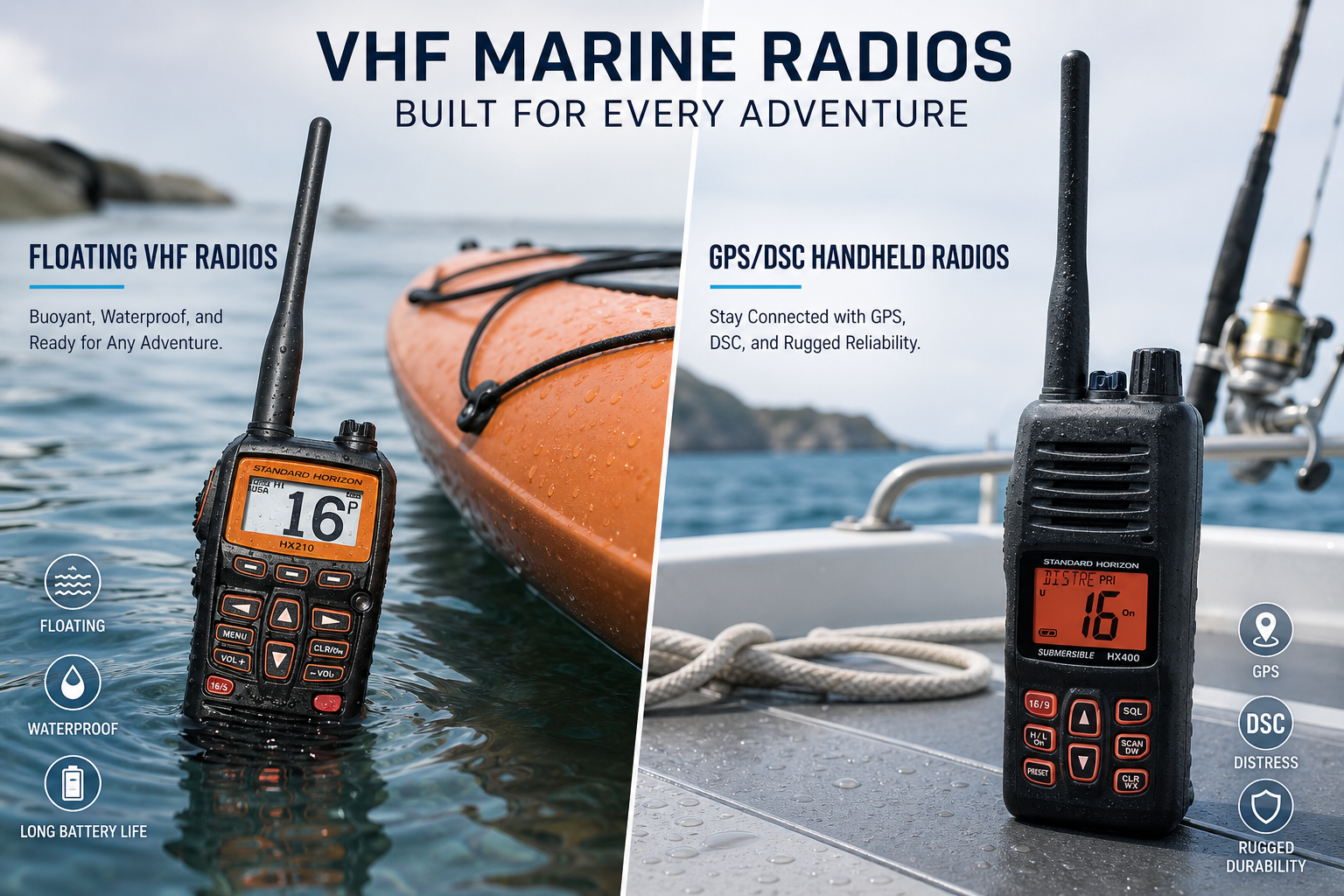
The best handheld VHF marine radio for 2026 is the one whose features match how you boat. For most U.S. boaters that means a floating design, a GPS-linked DSC distress button, a waterproof rating of at least IPX7, and battery life that comfortably covers a full day on the water.
Handheld VHF Marine Radio Categories Compared
Handheld VHF radios fall into a few broad categories. The table below compares them by the features that change how a radio performs in real boating situations. Treat it as a category map, not a model spec sheet, and always confirm exact figures on the manufacturer’s current data sheet for the specific model you choose.
| Feature | Basic floating handheld | GPS + DSC floating handheld | Commercial / submersible handheld | Ultra-compact handheld |
|---|---|---|---|---|
| Floating | Yes, built to float | Yes, built to float | Varies by model | Varies by model |
| GPS | Usually not built in | Built in | Model dependent | Usually not built in |
| DSC distress | Often not on entry models | Yes, sends position | Model dependent | Usually not built in |
| Waterproofing | Submersible class (often IPX7) | IPX7 to IPX8 class per maker | Rugged, submersible; some intrinsically safe | Submersible class per maker |
| Emergency features | Channel 16, NOAA weather; some add a locator light | GPS-linked DSC, NOAA weather, locator strobe on some | Heavy-duty channels; commercial options on some | Channel 16, NOAA weather; FM receive on some |
| Battery | Rechargeable Li-ion; alkaline tray on some | Rechargeable Li-ion | High-capacity Li-ion | Smaller Li-ion, lighter runtime |
| Typical use | Day boating, lakes, rivers, inshore backup | Coastal cruising and fishing; primary safety radio | Charter, work boats, demanding service | Kayaks, dinghies, paddlecraft, grab-bag backup |
Introduction
Choosing the best handheld VHF marine radio comes down to one question: when something goes wrong on the water, can you call for help and be heard? A cell phone loses signal offshore, does not survive a drop in saltwater, and can only reach one person at a time. A marine VHF radio broadcasts to every nearby boat and rescue station at once, which is why a marine VHF handheld is core safety gear rather than just another gadget. The U.S. Coast Guard keeps a continuous watch on VHF Channel 16, and a handheld unit puts that lifeline in your pocket whether you run a center console, paddle a kayak, or carry a backup beside your fixed-mount set. This guide compares the features that truly matter in 2026, floating designs, built-in GPS, Digital Selective Calling, waterproof ratings, and battery life, so you can match the right handheld VHF radio to the way you actually boat.

Why Carry a Handheld VHF Marine Radio?
A handheld VHF radio is the most widely recognized way to call for help on the water. Marine VHF is the system rescuers listen for, the system other boaters monitor, and the system that works in the places a phone often fails. When you transmit a distress call, every vessel within range hears it, not just one contact, so the boat closest to you can respond long before a shore-based crew arrives. That is why a VHF set, fixed or handheld, sits near the top of nearly every new boater and angler must-have list.
There is also a redundancy argument. A fixed-mount radio wired to the boat battery goes silent if you lose power, swamp the helm, or have to leave the boat, while a self-contained handheld keeps working on its own battery, which is why experienced crews keep one in the ditch bag with their life jackets and flares. Boaters who normally shop stores like West Marine will find the same trusted brands here, including Standard Horizon, so Go2Marine works as a straightforward alternative to West Marine for marine electronics. You can compare marine supplies online and have boat parts delivered fast.
What Features Matter Most in a Handheld VHF Radio?
Once you move past brand names, every handheld VHF decision comes down to a short list of features. Run through these in order, and the right radio usually becomes obvious.
-
Floating and visibility. A radio that floats and is easy to spot survives the drops that happen in real boating.
-
Waterproof rating. A waterproof marine radio with a published IPX rating tells you exactly how it handles spray, rain, and submersion.
-
GPS and DSC. Together these turn the radio from a voice device into a position-aware distress tool.
-
Battery life and charging. Match the runtime and charging options to the length of your typical trip.
-
Output power and channels. U.S., Canada, and international channel banks plus NOAA weather coverage matter for where you operate.
None of these features exists in a vacuum. A kayaker prioritizes a small, floating, submersible unit, while a coastal angler leans toward GPS and DSC. If you have been comparing a West Marine handheld VHF radio, the same Standard Horizon and Cobra models are stocked here, so you can weight features to your own boating rather than to whatever is on one shelf. The sections below explain what each feature actually does.
Why Is Floating Capability Important?

Floating capability matters because a radio that floats can be recovered after a drop, and it stays with you if you go overboard, instead of sinking out of reach. Dropping a handheld over the side is one of the most common ways boaters lose a radio. A floating model stays on the surface, and many are weighted to settle face-up so the screen and keypad stay visible, while some add a bright case color or a flashing locator light that activates in the water, a real advantage at dusk or in chop. Floating designs such as the Standard Horizon HX210 and the Cobra MR HH350 FLT are built around this idea, and if a radio does not float on its own, a clip-on flotation strap is a sensible add-on.
How Does GPS Improve Marine Radio Safety?
Built-in GPS does two jobs on a handheld VHF radio. The first and most important is feeding your exact position into a distress call. When you trigger a DSC alert, a GPS-equipped radio automatically attaches your latitude and longitude, so rescuers know where to go without anyone reading coordinates aloud under stress. The second job is everyday navigation: many GPS handhelds show your position, let you mark a man-overboard waypoint with one button, and give a bearing and distance back to a saved point.
This is why GPS and DSC are usually discussed together. A distress button is far more useful when it can broadcast where you are. Models that combine both, like the Standard Horizon floating handheld with GPS or the Cobra 600 handheld with GPS and DSC, give you position-aware emergency calling in a unit you can carry between boats.
What Is DSC and Why Does It Matter?
DSC stands for Digital Selective Calling. It is a digital layer built into modern marine VHF radios that does two things voice cannot. With one press and hold of the red distress button, a DSC radio sends an automated digital alert that includes your vessel’s identity and, when the radio has GPS, your position. The alert goes out on Channel 70, the dedicated DSC data channel, and repeats automatically about every four minutes until it is acknowledged or canceled.
On the receiving end, the U.S. Coast Guard’s Rescue 21 system keeps a continuous DSC watch on Channel 70 across roughly the first twenty nautical miles of the coast for most of the country, a zone defined as Sea Area A1. Other DSC-equipped boats within range also receive the alert, so help can come from a nearby vessel as well as a rescue station. Most recreational handhelds use a Class D DSC implementation, which covers distress, urgency, safety, and individual calling.
DSC depends on one piece of setup: a Maritime Mobile Service Identity, or MMSI. This is a nine-digit number programmed into the radio that identifies your vessel. Recreational boaters who stay in U.S. waters can register an MMSI at no cost through organizations such as BoatUS, Sea Tow, or the U.S. Power Squadrons. Boaters who travel internationally must obtain their MMSI through the FCC instead. Without a registered MMSI and a GPS position, the distress button cannot do its most valuable work, so program it before you leave the dock.
Waterproof Ratings Explained
Waterproof claims on marine radios use the IP code from international standard IEC 60529. You will usually see ratings written as IPX7 or IPX8. The X means the unit was not separately tested for dust intrusion, not that it lacks dust resistance. The number is what matters for water.
An IPX7 rating means the radio can be immersed in one meter of water for thirty minutes without damage, which covers most accidental drops and a good soaking. An IPX8 rating goes further, allowing submersion deeper than one meter for a duration the manufacturer specifies, so an IPX8 unit is the stronger choice if your radio will see regular hard use around water. Some manufacturers also publish a JIS submersion grade alongside the IP code.
|
Rating |
What it means (IEC 60529) |
|
IPX7 |
Immersion in 1 meter of fresh water for 30 minutes. Good for accidental drops and heavy spray. |
|
IPX8 |
Submersion deeper than 1 meter, for a depth and time the manufacturer specifies. Better for regular hard use around water. |
Two practical notes. First, these tests are run in still water, so they do not perfectly model the dynamic pressure of waves and spray. Second, waterproofing is a depreciating asset: gaskets and seals age, so a radio that was submersible when new needs care over time. Rinse the unit with fresh water after saltwater trips, keep the battery and accessory contacts clean, and do not assume an old radio still meets its original rating.
Battery Life Considerations for Boaters
Most modern handhelds run on a rechargeable lithium-ion battery, and runtime depends heavily on how you use the radio. Transmitting at high power draws far more current than listening, so a radio that you key up often will not last as long as the same unit used mostly to monitor. Many handhelds let you step output down to a low power setting for short-range talk and reserve high power for reaching farther, and most include a battery-save mode that stretches standby time. Match the rated runtime to your typical day on the water, then carry a margin. A charged spare battery and a charging cradle are cheap insurance, and some radios accept an alkaline battery tray as an emergency backup when you have no way to recharge. Spare batteries, antennas, and chargers are the kind of West Marine replacement parts boaters reorder most, and they are easy to find among the VHF radio accessories here. Cold weather reduces capacity, so plan for shorter runtimes in winter or offshore at night.
Handheld vs Fixed-Mount VHF Radios
Handheld and fixed-mount radios are not competitors so much as partners. The biggest difference is range. VHF is line-of-sight, so range depends mostly on antenna height. A fixed-mount radio transmits at up to 25 watts through a tall antenna mounted high on the boat, which reaches much farther than a handheld’s short antenna and lower output, typically up to 6 watts. For everyday communication, the fixed set is the workhorse.
The handheld earns its place as a portable, self-powered backup. It keeps working if the boat loses electrical power, it goes into the life raft or ditch bag if you ever have to abandon ship, and it travels between boats and to the dinghy. The strongest setup for most boaters is both: a fixed-mount VHF radio such as the Standard Horizon GX1800GB with GPS or the Icom M330 as the primary station, paired with a floating handheld for redundancy. Pay attention to the fixed antenna too, since a quality marine VHF antenna mounted high does more for range than radio wattage alone.
Which Handheld VHF Radio Features Are Best for Coastal Boating?
For coastal boating, the most useful handheld VHF features are a floating body, built-in GPS, DSC, and a waterproof rating of IPX7 or better. Coastal boating, day trips along the shore, nearshore fishing, and bay cruising, is the sweet spot for a full-featured handheld, because here the radio is often your primary safety device. A floating handheld VHF radio with GPS and DSC means you will not lose it overboard and that any call for help carries your position automatically. NOAA weather channels are worth confirming as well, since coastal conditions change fast and most handhelds can receive the automated weather broadcasts and alerts. Battery life that covers a full day, plus a charged spare, rounds out a coastal kit.
Which Features Matter Most for Offshore Boating?
For offshore boating, the features that matter most in a handheld are a floating, submersible body, built-in GPS and DSC, and long battery life, because offshore the handheld is your abandon-ship radio rather than your main link. A handheld VHF radio cannot match the range of a masthead-antenna fixed set, and once you pass the roughly twenty-mile Sea Area A1 coverage, VHF DSC alerts may not reach a shore station at all. Offshore safety planning leans on a fixed-mount radio with a high antenna plus dedicated distress beacons, an EPIRB on the boat and a personal locator beacon on the crew, often paired with satellite communication and electronic flares. In that picture, the handheld’s job is specific and vital: the unit you grab on the way into the life raft should float, be submersible, carry GPS and DSC, and hold a charge so it can still call nearby vessels and broadcast your position. Rugged commercial and submersible handhelds are built for this kind of hard service, and intrinsically safe models exist for crews working around flammable cargo or fuel.
How Do You Choose the Right Handheld VHF Marine Radio?
Choosing a boat VHF radio starts with how and where you boat, then weighting the features accordingly

Day and lake boaters. A simple floating handheld with a clear waterproof rating and easy access to Channel 16 and weather channels covers the basics. An ultra-compact floating model is easy to stow and carry.
Coastal cruisers and anglers. Step up to a floating handheld with built-in GPS and DSC, an IPX7 or IPX8 rating, and a full day of battery life. This is the category most recreational boaters should be shopping.
Offshore and passagemaking crews. Treat the handheld as your ditch-bag radio behind a fixed-mount station, EPIRB, and satellite gear. Prioritize a floating, submersible, GPS and DSC unit with long runtime.
Kayakers and paddlers. A small, light, submersible floating radio that clips to a PFD is the priority, since size and grab-ability matter more than long-range power.
Whatever you boat, register your MMSI, program it into the radio, and test the DSC function with a routine call rather than the distress button. When you are ready to find your replacement boat part or build a fresh safety kit, you can buy a handheld VHF online and browse the full range of VHF, SSB, and satellite communication gear in one place, with everything shipping direct.
Choosing Your Handheld VHF: The Short Version
The features that separate one handheld VHF marine radio from another are the same ones that protect you on the water. A floating design means a dropped radio is a recovered radio. Built-in GPS turns a distress call into a precise position. DSC, backed by a registered MMSI, lets one press of a button alert the Coast Guard and every nearby boat at once. A solid IPX7 or IPX8 waterproof rating keeps the unit working through spray and submersion, and honest battery planning keeps it powered when you need it. Match those features to whether you run lakes, cruise the coast, or head offshore, pair the handheld with a fixed-mount station where you can, and you will have a communication setup you can trust.