
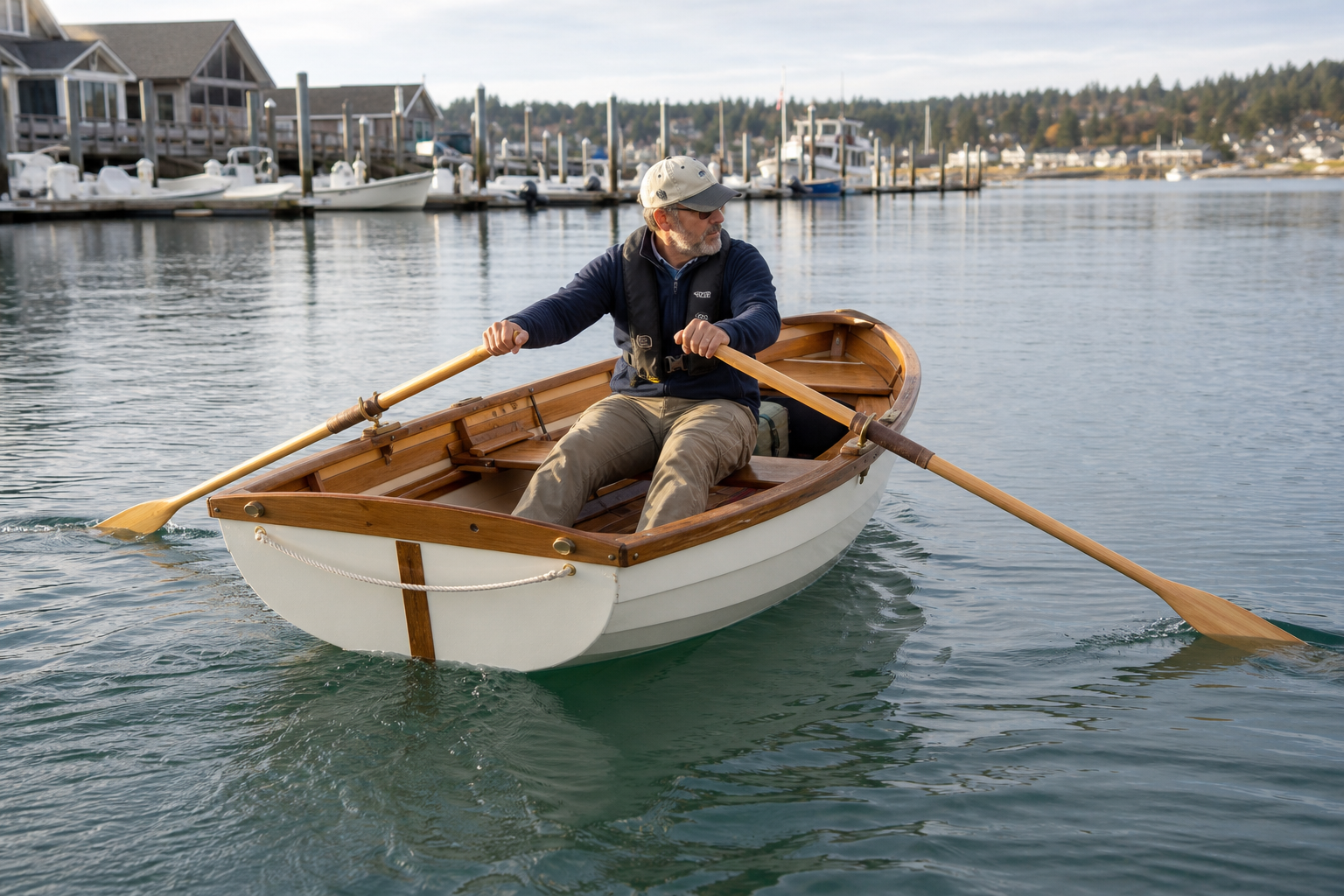
To size boat oars, measure the space between your oarlock sockets, divide by two, and add two inches. That gives you the "loom" length, the part of the oar inside the oarlock. Multiply that number by 25, then divide by 7. The result is the right oar length in inches. This is the Shaw & Tenney formula, used since 1858, and it gives you an oar that sits about one-third inside the oarlock and two-thirds outside, which is the balance that rows best.
Oars that are too short make you row with your hands too far apart, and they pop out of the oarlocks. Oars that are too long tire you out and won't clear your knees. This guide walks through the measurement, a sizing chart, how to pick the right oarlock, how to choose the right material and blade, and how to care for your boat oars so they last for years, whether you row a tender, a dinghy, or a small rowboat.
What length oars do I need?

The one measurement that matters most is the span, the distance between the centers of your port and starboard oarlock sockets. Everything comes from it:
-
Measure the span between the oarlock sockets, in inches.
-
Divide the span by 2, then add 2. This is your loom length (the inboard part).
-
Multiply the loom length by 25, then divide by 7.
-
Round to the nearest oar size you can buy. That's your oar length.
Worked example: say your span gives a 26-inch loom. Then (26 × 25) ÷ 7 = about 93 inches. Round that to the nearest oar size you can buy, which is 7½ feet.
When the oars are the right length, your hands sit 1 to 3 inches apart on the pull, and you pull straight toward your body. If your oars keep jumping out of the oarlocks, they are almost always too short, not a sign that you need different oarlocks. A quick rule for planning: the wider your boat, the longer the oars need to be.
|
Span between oarlocks |
Loom (span ÷ 2 + 2) |
Formula result |
Nearest oar size |
|---|---|---|---|
|
36″ |
20″ |
~71″ |
6′ (72″) |
|
42″ |
23″ |
~82″ |
7′ (84″) |
|
44″ |
24″ |
~86″ |
7′ (84″) |
|
48″ |
26″ |
~93″ |
7′ 6″ (90″) |
|
54″ |
29″ |
~104″ |
8′ 6″ (102″) |
Key takeaway: Measure the span, use span ÷ 2 + 2 for the loom, then × 25 ÷ 7 for the oar length. Round to the nearest size sold. When oars pop out of the locks, they're too short.
Why the one-third in, two-thirds out balance matters
That balance keeps rowing easy and comfortable. With about one-third of the oar inside the oarlock and two-thirds outside, you get enough leverage to move the boat without too much weight out past the oarlock tiring your arms. Too little inside, and every stroke takes more effort with poor form. Too much weight outside, and the oars feel heavy and hard to lift clear of the water. If your boat has two rowing spots, measure both. They usually need different oar lengths, so plan for two sets if you'll row with two people, or size to the spot you use most.
What oarlock and socket size fits my oars?

Oarlocks (also called rowlocks) are the pivot points that hold the oars. The socket is the fitting on the gunwale that the oarlock drops into. Two things matter: the shaft (pin) size, usually ½″ or 9/16″, and the mount style:
-
Top-mount sockets fasten to the top of the gunwale for a strong, straight-down hold.
-
Angle and side mounts fasten to the side of the gunwale.
-
Horn (open) oarlocks let you lift the oar right out. Round (closed) ones hold the oar in place so it can't drop out in chop.
-
Clamp-on oarlocks attach without a permanent socket, handy for a boat that didn't come set up to row.
Go2marine's oarlocks and sockets collection carries bronze, stainless, and nylon options in these styles, including clamp-on oarlocks in ½″ and 9/16″ shaft sizes, plus socket bushings that cut friction and quiet a worn setup. When you replace worn hardware, match the new oarlock shaft to your existing sockets so it drops straight in. Bronze lasts longest in saltwater, stainless is strong and bright, and nylon is quiet and inexpensive for a small tender.
Key takeaway: Match the oarlock shaft size (usually ½″ or 9/16″) to your socket, and pick the mount style- top, angle, side, or clamp-on- to suit your gunwale.
Do I need oar collars, stops, or leathers?
These small parts protect the oar and set where it pivots. A collar (also called a stop or button) is a ring around the loom that keeps the oar from sliding out through the oarlock. Set it so the loom sits just inside the oarlock when you're rowing, which fixes your leverage in the right spot. On wooden oars, a leather wrap or a wrap at the pivot point protects the wood from wear against the oarlock and gives a quieter, smoother pivot. Adjustable plastic collars, like the clamp-on type Go2marine stocks, let you fine-tune the pivot point and swap oars between boats. If your oars slide around in the locks or clunk with every stroke, a fresh pair of collars usually fixes it for a few dollars.
Wood, aluminum, or composite: which oars are best?
Material comes down to weight, toughness, and how much you'll row:
|
Material |
Strengths |
Best for |
|---|---|---|
|
Wood |
Warm feel, classic look, a little give |
Tenders and traditional dinghies |
|
Aluminum |
Light, low upkeep, often two-piece |
Inflatables, RIBs, backup oars |
|
Composite / laminated |
Strong, light, coated blades |
Regular rowing, harder use |
Wood oars, light spruce for general use, heavier ash for rough water or pushing off the bottom ,feel good in the hand and suit traditional boats. Aluminum oars, often two-piece so they store easily, are the practical pick for inflatables and as spares. Composite and laminated oars give you wood's feel with less weight and a tougher, coated blade for regular rowing.
For the blade, spoon blades are cupped and grab more water, which adds pull on round-bottomed boats and for anyone who rows often. Flat blades are simpler and fine on flat-bottomed boats and for light use. Longer, narrower blades feel easy over distance, while wider blades give a stronger bite for short, powerful strokes.
One-piece or two-piece oars?
One-piece oars are stiffer and stronger, with no joint to work loose, so they're the choice if you row a lot or want the best feel. Two-piece oars break down at a ferrule (a metal joint) so they fit in a locker, a car trunk, or an inflatable's bag. That storage win is why two-piece aluminum oars are so popular on tenders and dinghies. The trade-off is a little flex and a joint to rinse and check now and then. If you keep oars aboard a small boat with no room to lay a full pair flat, two-piece is the sensible call.
How do I care for and store my oars?
Rinse oars with fresh water after saltwater use, especially the blades and any metal joints or oarlocks, so salt doesn't build up. Check wood oars for cracks and refresh the varnish or oil once a season to keep water out. Look over the ferrule on two-piece oars and the collar on every oar, and tighten or replace anything worn. Store oars flat and out of the sun where you can, since years of UV dries out wood and fades plastic. Stow them so the blades don't take the weight of other gear. A few minutes of care keeps a good pair of boat oars rowing well for many seasons.
How should I row with the right form?
Good form makes correctly sized oars feel effortless. Sit facing the stern, drop the blades in cleanly, then push with your legs and lean back with your body ,your arms mostly just hold on. Keep your hands 1 to 3 inches apart, and at the end of the stroke lift the blades clear and swing them back for the next catch. Take slow, full strokes rather than fast, choppy ones; a longer, relaxed pull moves the boat farther with less effort and keeps the oars from popping out. On a wide boat, a slight "feather" ,turning the blades flat on the return ,keeps them out of the wind and chop. If rowing feels like all arms and no boat speed, check your oar length and collar position before you blame your technique, because the right length does half the work for you.
Oars or paddles: which for a tender or dinghy?

The difference is how they work. Oars pivot in oarlocks, so you row facing backward using your back and legs. That's far better for moving a loaded tender any real distance. Paddles are held loose in both hands, and you face forward, which is simpler and lighter, better for short hops, nudging off a dock, or a small inflatable where fitting oarlocks isn't practical. Many boaters carry both: sized oars for the main work, and a small or telescoping paddle as a backup that stows in a locker. For a wooden paddle, a rough size guide is the bridge of your nose (about 6 inches less than your height) for the person in the stern, and the tip of your chin (about 9 inches less than your height) for the person in the bow.
Kayak, canoe, and SUP paddles: a quick sizing note
Paddles for small craft size differently from oars. A canoe paddle fits when the grip reaches somewhere between your chin and your nose while the blade rests on the floor. A kayak paddle gets longer as the boat gets wider and as you sit taller, with most paddlers landing in the 220–240 cm range. A stand-up paddle is usually sized to about 8 to 10 inches over your height. If you carry a small craft on the mothership, a two-piece or adjustable paddle stows easily and adapts to different paddlers.
Carry a spare: oars or a paddle as backup
Even on a boat with an engine, a spare means of moving matters. If the motor quits or the battery dies, a paddle or a set of oars gets you off a lee shore or back to the dock. Keep a compact or telescoping paddle ,like a telescoping paddle-and-boat-hook ,clipped in a locker on any powered tender, and keep a full set of sized oars aboard a rowing dinghy. Tie or clip spares so they can't slide overboard in a chop. A backup that stows out of the way is cheap insurance you'll be glad to have.
Putting it together
Choosing the right setup is a short sequence:
-
Measure the span between the oarlock sockets and run the formula for oar length.
-
Check your oarlock shaft size and mount style so the hardware matches.
-
Pick a material ,wood for feel, aluminum for light and packable, composite for regular use.
-
Add the small parts ,collars, and leathers on wood oars ,so the oars pivot right and last.
-
Decide oars or a paddle (or carry both) based on how far and how often you'll row.
Start with one number before you shop
Measure your oarlock span first. It's the single number that decides everything else. Round your result to the nearest size in the oars and paddles collection, match the oarlock shaft to your sockets, and your next row will feel like the boat is doing half the work. Fixing up an older tender? Don't buy a whole new pair right away. Sometimes fresh oarlocks, collars, and bushings bring the old setup back to life for a fraction of the cost, so check the hardware before you replace the oars.