
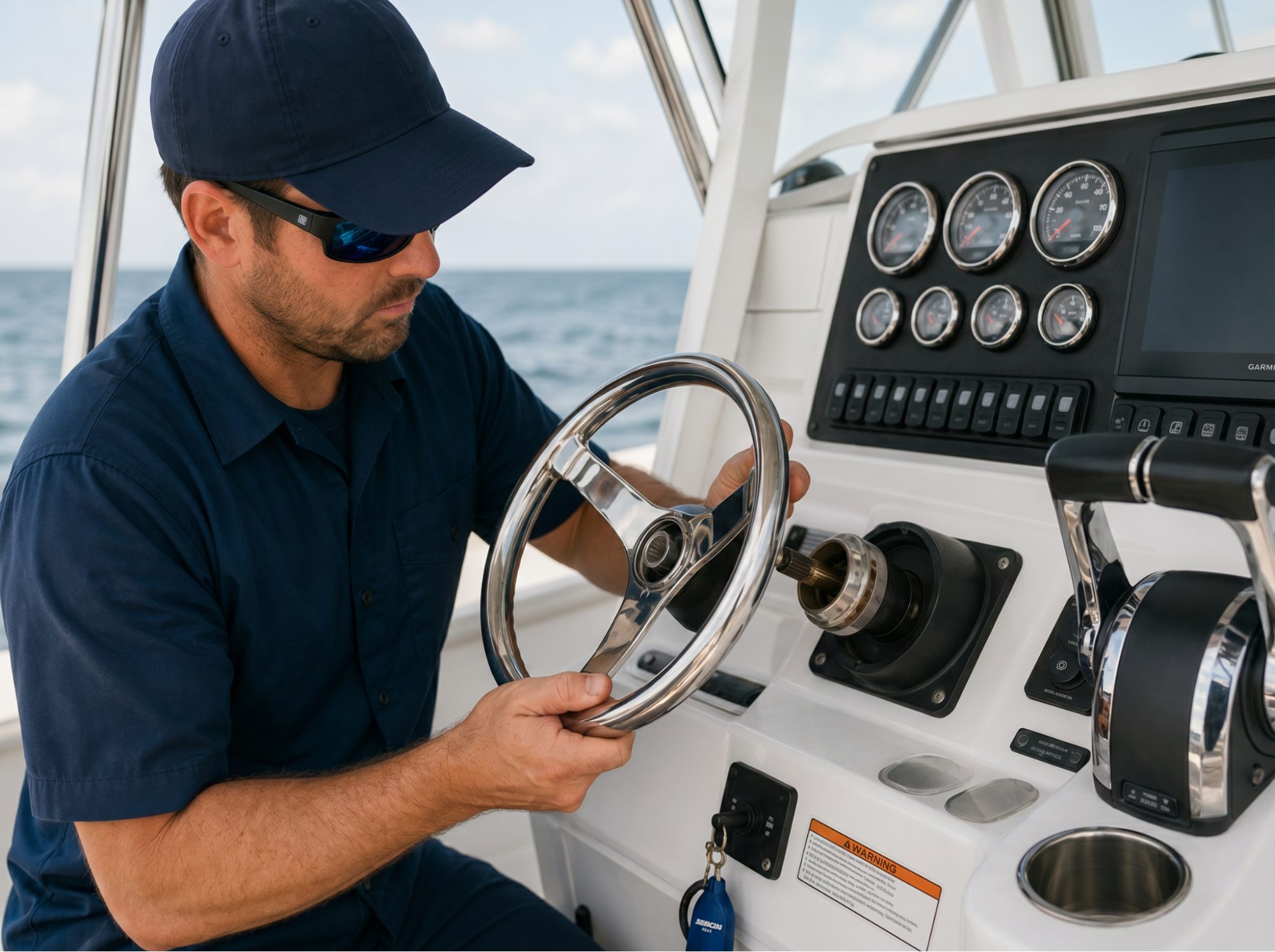
Picking a boat steering wheel comes down to three things: the right size for your helm and steering type, a spoke style and material that holds up to your environment, and, most important, a hub that fits your shaft. Most powerboats use one of two sizes, 13.5″ or 15.5″, on a standard 3/4″ tapered or 1 “ straight shaft. Get the shaft right and swapping the wheel takes about 20 minutes.
That last part is where most swaps go wrong, so this guide covers choosing and fitting together. You'll learn how to size the wheel, how to read your shaft, how to tell when a wheel needs replacing, which style suits your boat, and how to take the old wheel off without harming the shaft under it. By the end, you'll be able to order the right boat steering wheel the first time and fit it yourself.
What size steering wheel do I need
Almost every powerboat uses one of two sizes: 13.5″ or 15.5″. A smaller wheel turns faster from side to side and gives you more room and a clearer view of your gauges. A larger wheel takes a few more turns from lock to lock, but it is easier to turn. Sailboats and bigger boats use larger wheels, and Go2marine stocks sizes from about 11″ up to 60″ for special helms.
Two simple rules guide the choice:
-
Your steering type matters more than your boat size. With hydraulic or power steering, wheel size barely changes how hard the wheel is to turn, so pick your size for comfort, knee room, and a clear view of the dash. With cable (mechanical) steering, a bigger wheel is easier to turn because it gives you more leverage. If your cable steering already feels heavy, going up a size helps right away.
-
Stay within the helm's largest allowed size. A wheel that is too big strains the helm and can hit the dashboard or your legs. On common Teleflex/Morse mechanical helms, the largest wheel is 16″, which Go2marine's own Morse/Teleflex guide confirms. Check your helm's limit before going bigger.
Think about where you sit, too. If you stand at the helm, a wheel angled toward you with a slightly larger diameter feels natural. If you steer from a seat, a smaller wheel that clears your thighs is more comfortable on a long day. The right boat steering wheel is the one you can hold for hours without fatigue.
Key takeaway: On hydraulic or power steering, choose size for comfort. On cable steering, lean toward the bigger wheel for easier turning, but never go past your helm's limit (16″ on most mechanical helms).
Tapered or splined? Read your shaft before you buy
This is the most important check, and it's the one most guides skip. Before you order any wheel, look at the shaft where the old wheel sits:
-
Tapered shaft (the standard): a smooth cone with a small notch cut into it. Almost all boats use a 3/4″ tapered shaft. A small half-moon metal piece, called a Woodruff key, sits in the notch and stops the wheel from spinning loose. Nearly every wheel Go2marine sells is made for this shaft.
-
Splined shaft: the shaft has fine grooves running along it instead of being a smooth cone. Some boats, often jet boats, use a splined shaft (usually a 19-groove, 6-bolt pattern). A standard tapered wheel will not fit a splined shaft, and the reverse is also true. The two are completely different.
To confirm a tapered shaft is the standard 3/4″ size, measure across the wide end of the cone with a caliper or a steel rule. The 3/4″ taper is cut at one inch of drop per foot of length, so the shaft looks like a gentle cone rather than a straight post. If your measurement comes out closer to 1″, you have a larger shaft and will need an adapter, not a standard wheel.
If your shaft is tapered and the right size, you're on the standard path, and any 3/4″-taper wheel in the boat steering wheel collection will fit straight on. If your shaft is splined, or a size other than 3/4″, you need an adapter made for your exact shaft. Find the groove count and bolt pattern first, and confirm the fit before you order.
When you need an adapter or bushing: Go2marine carries taper bushings for helms that aren't a plain 3/4″ taper. One adapts a 3/4″ tapered wheel to a 1″ tapered shaft, and another adapts a 3/4″ taper to a 1″ straight shaft. You'll find these next to the center nuts, caps, and knobs in the wheel hubs, nuts, and knobs collection.
Key takeaway: Tapered means a smooth cone (the 3/4″ standard, fits straight on). Splined means grooves (needs a matched adapter). Check which one you have before ordering. It decides whether the wheel fits at all.
Are boat steering wheels universal?
Mostly, but not quite. Because the 3/4″ tapered shaft with a Woodruff key is used on almost every boat, most wheels fit most boats, which is why people call them "universal." The exceptions are splined shafts, odd shaft sizes, and helms with a size limit. So the honest answer is: a 3/4″-taper wheel fits most helms directly, but always check your shaft type and helm limit first. A quick check now saves a return later.
How do I know when to replace my steering wheel?
Sometimes a new wheel is about looks or comfort, and sometimes it's about safety. Replace your boat steering wheel when you see any of these:
-
Cracks or splits in the rim or spokes, especially on older plastic or coated wheels that have baked in the sun for years.
-
Rust streaks, pitting, or a rough surface on a stainless wheel, which point to a lower-grade metal breaking down in salt air.
-
Play or wobble at the hub, where the wheel moves on the shaft before the boat responds. This often means a worn Woodruff key or a loose nut, and it makes steering feel vague.
-
A grip that has gone sticky, flaky, or slippery, which is tiring and unsafe with wet hands.
-
A bent rim from a knock or a fall, which you can feel as a thump each turn.
If you feel play but the wheel itself looks fine, check the nut and key first before buying a new wheel. If the wheel is corroded or cracked, replace it, because a spoke that lets go at speed is a real hazard. A boat steering wheel replacement is inexpensive next to the risk.
Steering wheel styles and materials
Once the fit is settled, style and material are about how tough the wheel is and how it feels in your hands. Go2marine carries wheels from Schmitt & Ongaro, SeaStar Solutions, Uflex, Edson, and Sea-Dog. The common types:
|
Wheel style |
What it's made of |
Best for |
|---|---|---|
|
Three-spoke stainless |
Cast 316 stainless spokes and hub |
Saltwater; the most popular all-round pick |
|
Five-spoke "destroyer" |
Stamped stainless, often with a foam grip |
Factory replacements, classic look, wet hands |
|
Sport / dished |
Stainless, sometimes with a knob |
Performance and center-console helms |
|
Polyurethane (three-spoke) |
Aluminum spokes, soft rim |
Freshwater ,ski, wake, bass, pontoon |
|
Wood / classic |
Varnished wood |
Sailboats and traditional helms |
On material, stainless steel lasts longest and resists rust, but it feels cold in cool weather. Foam or padded grips feel better with wet hands and in open helms. Polyurethane rims stay comfortable in the sun and won't corrode, which suits freshwater boats. Wood and vinyl feel warmer but need more care. For saltwater, cast 316 stainless is the safe choice because it stands up to spray for years.
As a real example of the standard build, the Uflex 5-spoke stainless wheels (V42–V48) use non-magnetic stainless with a standard 3/4″ taper and meet the EN 28848 and ABYC P22 safety standards, so you know the hub and spokes are built to a recognized marine spec.
A destroyer steering wheel is just the multi-spoke, deep-rim style, like an old ship's wheel. Go2marine carries destroyer-type wheels for both power and sailboats, and they suit a boater who wants a classic look with a firm, full-hand grip.
Do I need a spinner knob?
A spinner knob (also called a power knob) clamps to the rim and lets you turn the wheel with one hand. It's a real help when docking, backing into a slip, or holding a course while you reach for a throttle. Most fit a certain rim shape, so check that it works with your wheel before you buy. Go2marine stocks stainless and stainless-and-nylon knobs, including Edson Pro Series and Comfort Grip knobs, in the wheel hubs, nuts, and knobs collection.
How to take off and put on a boat steering wheel
Swapping the wheel is easy. The danger is harming the shaft by forcing it. The tapered fit can seize up after years in salt, so patience beats brute force every time.
-
Take off the center cap or nut cover. Pop off the cover to reach the nut. Some caps snap off, and some unscrew.
-
Loosen the nut, but leave it level with the end of the shaft. Don't remove it fully. Backing it out until it sits flush with the shaft end protects the threads and stops the wheel from flying at your face when it lets go.
-
Soak the taper in penetrating oil. Put marine penetrating oil where the hub meets the shaft and let it sit for an hour, or overnight for a badly stuck wheel. The oil creeps into the joint and breaks the grip of old salt and corrosion.
-
Use a wheel puller for even pressure. A gear or wheel puller is the safest tool. It pulls the wheel straight off without pushing the shaft sideways. A sharp, straight tap on the nut can help break the tight fit.
-
Catch the Woodruff key. The small half-moon key usually drops out as the wheel comes off. Don't lose it. You'll use it again unless it is worn or damaged, in which case fit a fresh one.
-
Put it back on with grease. Clean the shaft, add marine grease to the shaft and key, fit the new wheel, and tighten the nut to the maker's setting before you snap the cap back on. Greasing now makes the next removal much easier.
What never to do: never hammer the shaft, never hit the wheel from the side to knock it loose, and never use the steering system itself to hold the wheel while you loosen the nut. All three can bend the shaft or damage the helm. If the nut is stubborn, have a helper hold the wheel while you break it free.
If your check turns up a worn helm, a stiff cable, or a leaking pump behind the wheel, that's a separate job. Our guides on boat steering maintenance and replacement and hydraulic vs mechanical steering walk through the system behind the wheel, and the Morse/Teleflex reference helps you match older cable parts.
Key takeaway: Loosen the nut flush, soak the taper, pull it straight off, and catch the key. Never hammer the shaft. Grease everything when you put it back.
Matching the wheel to your helm
Here's the quick path:
|
Step |
What to check |
Why it matters |
|---|---|---|
|
1. Shaft type |
Tapered (3/4″ cone) or splined |
Decides if the wheel fits at all |
|
2. Steering type |
Cable or hydraulic/power |
Cable steering likes a bigger wheel |
|
3. Size |
13.5″ or 15.5″, within helm limit (16″ typical) |
Effort, knee room, and view |
|
4. Material/style |
316 stainless, foam grip, or soft rim |
Rust resistance and comfort |
|
5. Hardware |
Matching nut, cap, adapter if needed |
A correct, tight fit |
Before you buy, run this 30-second shaft check
Look at your shaft and answer three quick questions: is it a smooth cone (3/4″ tapered) or grooved (splined)? What is its diameter? And do you want three spokes or five? With those three answers, open the boat steering wheels collection and you'll spot the wheels that fit yours right away, no guessing. Still not sure what you're looking at? Snap a photo of your shaft and send it to our team before you order. We'll confirm the fit so your new wheel bolts straight on the first time, with no return trips and no wrong parts.