
Commercial fishing boats rely on specialized deck equipment to handle heavy gear, manage lines, and operate safely in demanding offshore conditions. From hauling nets and crab pots to securing lines at the dock, every piece of hardware on the working deck plays a critical role in daily operations.
Equipment such as winches, windlasses, and electrical systems must be built to withstand constant loads, saltwater exposure, and long hours of use. When these systems are properly selected and maintained, they help crews work more efficiently while reducing safety risks on deck.
This guide explains the essential deck equipment used on commercial fishing boats, how each system functions, and what to consider when choosing reliable gear for professional fishing operations.
What Is Deck Equipment on a Commercial Fishing Boat?
Deck equipment is every piece of mechanical hardware your crew physically uses on the working surface of the vessel, the systems that haul, lift, moor, anchor, and manage cargo trip after trip.
On a commercial fishing boat, this hardware operates under conditions most equipment was never designed for. Saltwater corrosion, constant mechanical stress, extreme temperatures, and hours of continuous use don't leave room for anything just good enough.
The categories that matter most for commercial fishing vessels are:
-
Winches for hauling lines, nets, and pots
-
Windlasses for anchor and mooring management
-
Cleats, chocks, and deck fittings for securing lines and dock management
-
Load management systems and practices for keeping the vessel stable
-
Deck safety equipment for keeping the crew alive
-
Marine electrical panels for powering everything reliably
Each one plays an essential role. None of them is optional.
Winches: The Engine Room of Your Deck
No piece of deck equipment gets more use on a commercial fishing boat than the winch. Whether you're hauling longlines, retrieving crab pots, pulling nets, or managing anchor rode in deep water, your winch is running constantly.
Getting this choice right matters more than almost any other equipment decision on the vessel.
Hydraulic Winches vs. Electric Winches: Which Is Right for Commercial Use?

Hydraulic winches are the industry standard for professional fishing operations, and for good reason. The hydraulic motor is extremely powerful for its physical size. Because it is fully sealed from the elements, it performs reliably in the kind of continuous saltwater exposure that commercial fishing demands. Hydraulic winches from brands like Pullmaster handle pull capacities ranging from around 1,100 lbs to several tons, making them the ideal tool for heavy-duty work, including pot hauling, anchor handling, and trawl retrieval.

Electric winches are easier to install and cost less upfront. They're a reasonable choice on smaller vessels or for applications with lighter, less frequent loads. The tradeoff is battery drain and limited sustained output during a long haul day; that difference matters.
For most crabbing, longline, trawl, or seine operations, a quality hydraulic winch pays for itself in reliability alone.
Shop hydraulic winches at Go2Marine, including Pullmaster, built for commercial duty.
What to Look for When Buying a Commercial Fishing Winch
Buying the wrong winch costs you twice, once at purchase, once when it fails. Here's what actually matters:
-
Pull capacity matched to your heaviest realistic load, don't undersize, and don't rely on a winch being "close enough."
-
Drum capacity makes sure it holds enough cable or synthetic rope for your typical depths and working distances.
-
Corrosion-resistant sealed motors, stainless steel hardware, or hot-dip galvanized construction for saltwater environments.
-
Manual override if the hydraulics fail offshore, you need a way to work the drum by hand.
-
Spare parts availability, a winch from a brand with no parts support, becomes a paperweight the moment something breaks.
Windlasses and Capstans: Anchor and Mooring Power
Commercial fishing boats spend significant time at anchor, holding position on productive grounds, waiting out weather, or soaking gear. A reliable windlass or capstan is what makes that work manageable rather than back-breaking.
Windlass vs. Capstan: What's the Actual Difference?
A windlass uses a horizontally-oriented/vertically oriented drum called a gypsy to haul chain and rope, and is most commonly mounted at the bow for anchor management. A capstan uses a vertically-oriented drum, is typically installed at the stern, and is used for warping and mooring line handling.
Both do the same fundamental job, mechanically managing your lines so the crew doesn't do it by hand. The difference is orientation and where on the vessel they're most useful.
On working vessels and certain commercial applications, capstans are particularly valuable because many models use foot-switch controls, keeping the operator's hands free for rope handling. When you're managing heavy lines in rough conditions or wearing bulky gloves, that matters.
For commercial vessels, look for systems from Lewmar, Maxwell, or Lofrans, brands with sealed motors, corrosion-resistant drums, and load ratings designed for commercial-grade use.
Browse windlasses, capstans, and anchor hardware at Go2Marine
Cleats, Chocks, and Deck Fittings: Small Parts, Serious Consequences
On a commercial fishing boat, cleats, chocks, and deck fittings are essential pieces of marine deck hardware that manage dock lines, anchor rode, and mooring loads. These components face constant stress from vessel movement, tidal changes, wind pressure, and lines under heavy tension. Hardware designed for recreational boats often isn’t strong enough for the demands of a working fishing vessel.
Commercial-grade cleats made from 316 stainless steel or heavy-duty marine metals provide the strength and corrosion resistance required for harsh saltwater environments.
Equally important are chocks and hawse pipes, which guide dock lines and anchor rode through the vessel’s fairleads, reducing friction, preventing line chafing, and protecting deck hardware under load.
Go2Marine carries a wide selection of stainless steel cleats, chocks, hawse pipes, and marine deck fittings from trusted brands like Sea-Dog and Perko, built for the durability and load demands of commercial vessels.
Load Management: The Safety Principle Behind All of It
Here's the truth that experienced commercial fishermen learn the hard way, or learn from someone who did:
Your deck equipment can be perfect, your crew can be skilled, your boat can be well-maintained, and you can still capsize if your load management is wrong.
Why Load Management Kills More Fishermen Than Bad Equipment Does
Commercial fishing vessel instability is a leading cause of fatalities in the industry. The NTSB found that 25% of commercial fishing vessel casualties investigated between 2010 and April 2024 involved vessels under 79 feet with stability or flooding issues. Overloading, improperly distributed catch, and poorly secured deck gear are consistently among the top contributing factors.
The core physics is simple: the higher your center of gravity, the less stable your vessel. When you stack crab pots too high on deck, load more catch than your stability letter allows, or store heavy equipment in elevated positions, you reduce the margin between a rough trip and a catastrophic one. The danger is that initial stability levels may feel nearly the same right up until they aren't.
6 Load Management Rules Every Commercial Fisherman Should Follow
1. Know your vessel's stability limits and never exceed them. Your stability letter or stability book exists for a reason. Know the numbers, know how weight distribution affects your vessel's behavior, and if you've added new equipment or made modifications since the last assessment, have a qualified naval architect review the stability calculations.
2. Keep heavy gear as low on deck as possible. Crab pots, trawl doors, spare equipment, all of it belongs as low as you can stow it, secured to withstand wave impact and heavy rolling. Any weight stored high on deck raises your center of gravity and makes the vessel more vulnerable in adverse conditions.
3. Secure your deck load for the worst conditions you might encounter, not the current ones. Gear that can shift in a swell is a hazard to the crew and to the vessel's stability. Use proper lashing and fastenings rated for the actual loads they'll see. Conditions change fast at sea.
4. Keep your scuppers and freeing ports clear. A wave on deck can drop several tons of water weight in seconds. That water creates a free-surface effect that dramatically reduces stability. Clogged scuppers are a serious hazard that is also completely preventable.
5. Treat lifting operations with respect. The instant a load clears the deck and hangs free from a boom or crane, the effective center of gravity immediately shifts to the tip of the boom, reducing vessel stability in that moment. In moderate to rough conditions, suspend all lifting operations and secure gear until conditions allow.
6. Never improvise with ballast. Improper ballasting, even ballasting done with the intention of improving stability, can actually reduce overall vessel stability. Never add or modify ballast without consulting your vessel's stability guidance or a qualified marine professional.
Deck Safety Equipment: The Non-Negotiables

The USCG Commercial Fishing Vessel Best Practices Guide makes it clear: every working deck on a commercial fishing vessel should have slip-resistant surfaces maintained in good condition, and every person on open, exposed decks should have access to properly fitted personal flotation devices.
These aren't suggestions. They're the baseline.
What Every Commercial Fishing Vessel Deck Needs
Non-slip deck surfaces: Wet, moving decks are among the most common sources of crew injuries. Non-slip coatings and materials are inexpensive relative to what they prevent.
Deck rails, lifelines, and storm rails: Required under 46 CFR Part 28 on many vessel sizes, these are your primary defense against man-overboard incidents, which account for nearly half of all commercial fishing fatalities.
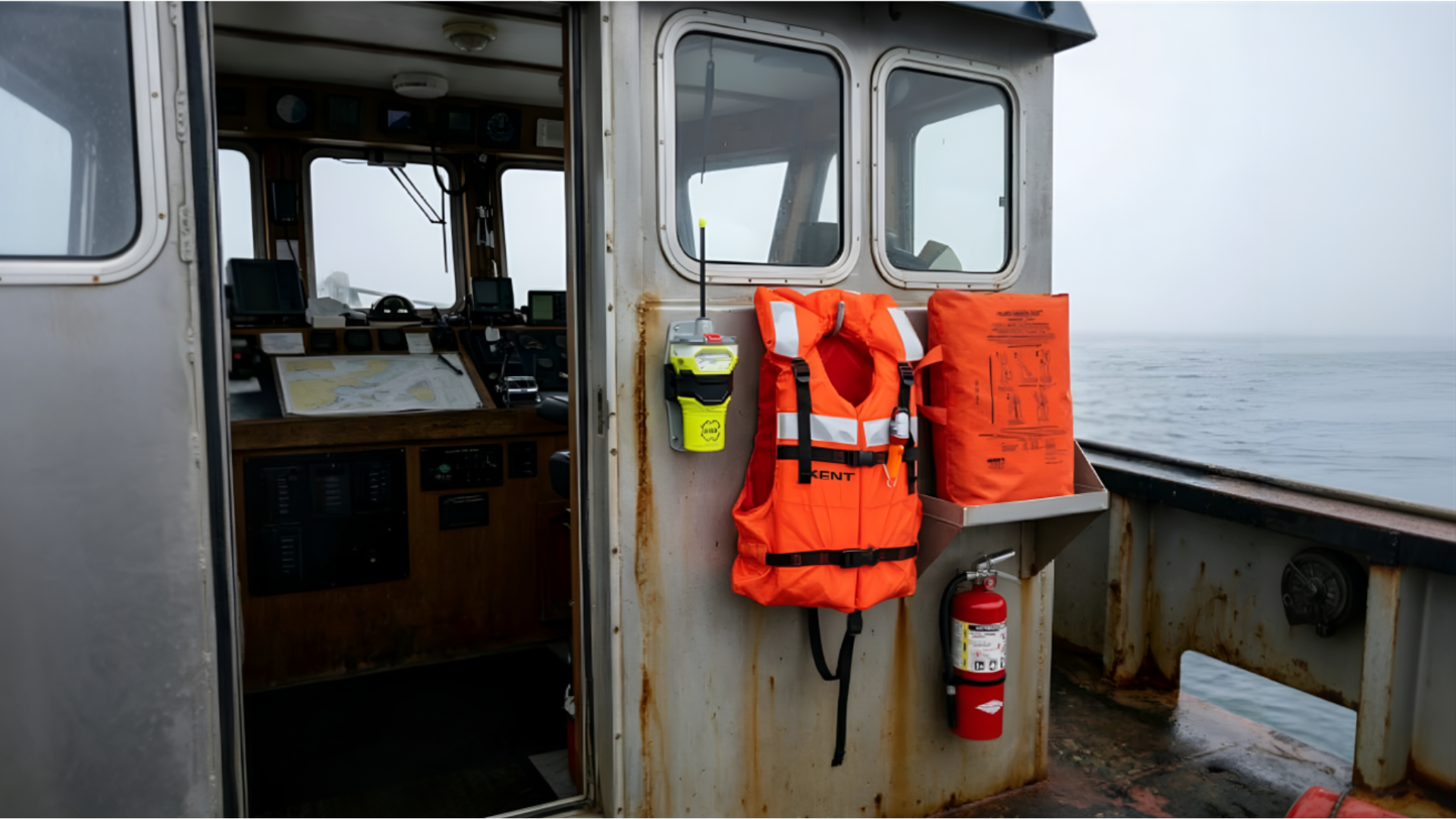
PFDs and immersion suits: Every person on deck in exposed conditions needs access to a properly fitted, USCG-approved life jacket. For cold-water operations, an immersion suit is what keeps hypothermia from being fatal.
EPIRBs and signaling devices: Must be registered with NOAA, GPS-enabled, and tested monthly. Non-negotiable. Check battery and hydrostatic release expiry dates.
Fire protection: Vessels 36 feet and over require a power-driven fire pump and accessible fire extinguishers under 46 CFR Part 28. Keep them serviced and accessible, not buried under gear.
Shop USCG-required safety gear at Go2Marine life jackets, EPIRBs, immersion suits, fire extinguishers, and more.
Final Thoughts
Every time a commercial fishing vessel leaves the dock, the crew is trusting that the equipment on deck will hold up. The winch will haul. The cleats will hold. The load will stay balanced. The safety gear will be there if something goes wrong.
That trust is built before the trip in the buying decisions, the installation, the maintenance, and the daily habits around load management and safety.
From heavy-duty hydraulic winches and corrosion-resistant deck fittings to proper load management and USCG-compliant safety gear, Go2Marine stocks the commercial-grade equipment that professional fishermen rely on.