
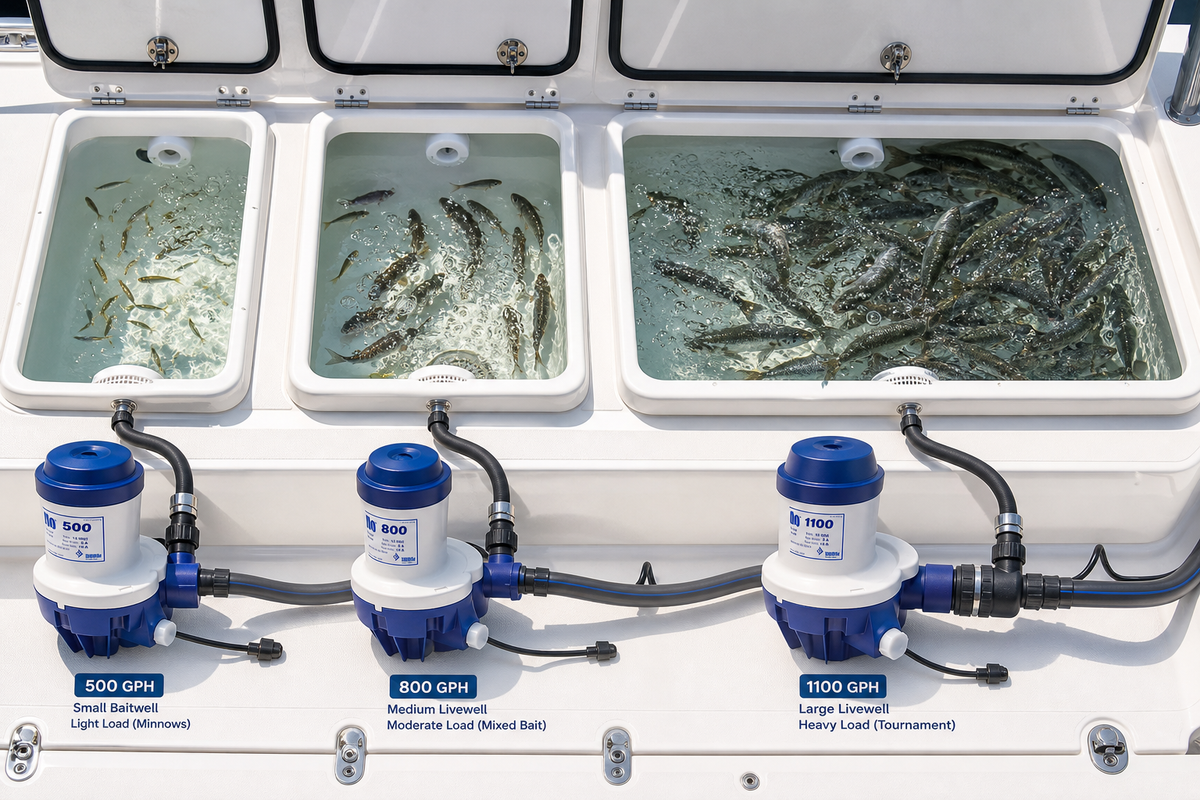
To size a livewell pump, take your tank's size in gallons and multiply by six. A 30-gallon livewell needs about an 180 GPH pump at a minimum, and most anglers run a 500 GPH pump on a tank that size for extra flow. A 100-gallon tank needs about 600 GPH. More flow swaps the water faster, holds more bait, and keeps tougher fish alive. Just as important, match the fuse to the pump: 2.5A for a 500 GPH pump, 5A for 800 GPH, and 6A for 1100 GPH.
That's the short answer. The rest of this guide explains why flow rate matters, how to pick between the pump types, how to wire and mount the pump the right way, how to keep bait alive once the water is moving, and how a livewell pump is different from the bilge pump it often gets mixed up with. Get the livewell pump sizing right and your bait stays lively from the ramp to the last cast.
What size livewell pump do I need?

The easiest rule in the field is tank gallons × 6 = target GPH. The goal is to fully swap the water in your tank about every ten minutes, so oxygen stays high and heat and waste stay low. A 500 GPH pump cycles a 30-gallon tank many times an hour, which is plenty for a light bait load. A serious tournament tank of 40 to 60 gallons wants 800 to 1100 GPH so the water stays fresh even when the tank is full of fish.
Two things push you toward the higher end: how much bait you carry, and how tough it is. More baitfish, or soft species like herring, shad, and pilchards, use up oxygen faster and need more flow than a few hardy shiners. Warm water holds less oxygen too, so summer fishing calls for more flow. When in doubt, go one size up. A bigger pump you can turn down with a valve is far safer than one that can't keep up on a hot afternoon.
|
Flow rate |
Tank size it suits |
Typical use |
Rule STC model |
|---|---|---|---|
|
500 GPH |
up to about 30 gal |
Shiners, minnows, light loads |
401STC |
|
800 GPH |
about 30–45 gal |
Mixed bait, game fish |
403STC |
|
1100 GPH |
about 45–60 gal |
Tournament loads, soft bait |
405STC |
Key takeaway: Multiply tank gallons by six for a starting GPH, then go up a size for a heavy bait load, soft species, or warm water. Aim to swap the full tank about every ten minutes.
What's the difference between a livewell and a baitwell pump?
People use the terms almost interchangeably, and the pumps are built the same way, but there's a practical difference in how you size them. A baitwell is usually a smaller tank that keeps live bait, minnows, shiners, or shrimp frisky and ready to hook. A livewell is often larger and keeps the fish you catch alive and healthy until weigh-in or release. Because a livewell holds bigger, heavier fish and more water, it usually needs more flow than a baitwell of the same footprint. The gallons-times-six rule still works for both; you just start from the tank's real volume. If your boat has separate bait and fish tanks, size each one on its own, and think about a dedicated pump for each so a crowded fish tank never steals flow from your bait.
Fill, recirc, or aerator ,which pump do you need?
"Livewell pump" covers a few different jobs, and knowing which one you're doing changes what you buy:
-
Fill (aerator) pump pulls fresh water from outside the boat and pumps it into the tank. It replaces old water and adds oxygen. This is the standard single-pump setup and what most boats run.
-
Recirculation pump moves water around inside the tank, often through a spray head, to add oxygen without drawing in new water. This helps in muddy or dirty water where you don't want what's outside the hull, and it saves the fresh water in a tank you've treated.
-
Spray head vs. fill outlet sets how the water comes in. A spray head breaks the surface and adds oxygen fast. A plain fill sends a smoother flow that is easier on soft bait.
Serious anglers often run two pumps, one fill pump and one recirculation pump, for tighter control in tough conditions. Many pumps also have a second outlet, so one thru-hull can feed both a livewell and a low-pressure washdown line. If you fish tournaments, a timer or aerator controller that runs the pump in cycles keeps oxygen up without overworking the pump or draining the battery.
Do I need a livewell timer or controller?

If you fish long days or tournaments, a timer or aerator controller is a smart add-on. Instead of running the pump non-stop, it cycles the pump on and off, for example, on for a minute or two, then off for a few, which keeps oxygen steady, cuts the drain on your battery, and lets the pump run cooler and last longer. Some controllers also have a recirculation mode and a fresh-fill mode, so you can switch between adding new water and just moving what's already in the tank. On a hot, still day, you run more; in cool water, you run less. Pair a controller with a right-sized aerator pump, and you get healthy bait with the least fuss and the least battery draw.
What fuse and wiring does a livewell pump need?
Matching the fuse to the pump's power draw keeps you safe. Too small a fuse blows for no reason. Too big a fuse won't protect the wiring. Here are the common ratings, confirmed on the Rule STC Tournament Series pumps:
|
Pump flow |
Power draw |
Fuse |
|---|---|---|
|
500 GPH |
about 2.1 A |
2.5 A |
|
800 GPH |
about 2.8 A |
5.0 A |
|
1100 GPH |
about 3.3 A |
6.0 A |
Use marine-grade tinned wire sized for how far the run is, because a long, thin wire drops voltage and slows the pump. Keep the connections above the bilge water where you can, seal them with adhesive-lined heat shrink, and protect the circuit at the source with the right fuse or breaker. A magnetic-drive pump like the Shurflo Bait Sentry has no seals to leak and shrugs off debris, which is worth the extra cost on a boat that sees grit and shell. If you want a pump that also handles running dry, the Shurflo Pro Baitmaster II self-primes and can run dry without damage. You'll find both, along with Rule, Johnson Pump, Attwood Tsunami, and more, in the livewell and baitwell pumps collection.
Key takeaway: Match the fuse to the pump, 2.5A/5A/6A for 500/800/1100 GPH, and use tinned marine wire sized to the run. Don't reuse an old fuse of unknown size.
Where should a livewell pump mount?
Most fill pumps can't prime themselves, so they must sit below the waterline and as close to the intake as you can get them. That lets water flow into the pump on its own and cuts down the air and flow loss that starve the pump and shorten its life. Add a through-hull strainer at the intake to keep weeds, sand, and shell out of the impeller, and fit a seacock at the thru-hull so you can shut the system off if a hose or fitting ever leaks. A ball valve after the pump lets you turn the flow down if the current is stressing the bait.
Run smooth-bore hose in full sweeps rather than tight kinks, and support long runs so they don't sag and trap air. Double-clamp the hose at the thru-hull and seacock with marine-grade stainless clamps. A clean, well-supported plumbing run is the difference between a livewell pump that primes instantly every trip and one that fights you at the ramp.
If your pump won't prime or the flow is weak, the usual causes are an air leak on the intake side, a clogged strainer, a kinked hose, or the pump mounted too high. Work through them in that order: clean the strainer, check every hose clamp, straighten any kinks, and make sure the pump sits below the waterline before you decide the pump itself has failed. Most "dead" livewell pumps are really a blocked strainer or an air leak.
How do I keep bait alive once the water is moving?
Flow is most of the battle, but a few habits keep a livewell healthy on a long day. Don't overcrowd the tank, because too many baitfish burn through oxygen no matter how big the pump is. Keep the water cool with a frozen bottle of water (not loose ice, which changes the water) on hot days, since cool water holds more oxygen. Run the pump or aerator on a cycle so oxygen stays steady, and switch to recirculation in muddy or hot surface water. If you're moving spots, a lid and a full tank slosh less and stress the bait less. These simple steps, paired with the right-size aerator pump, keep shiners frisky and tournament bait tank-strong.
Quick fixes for common livewell pump problems
Most livewell pump trouble is plumbing, not the pump itself. Run through these before you replace anything:
|
Problem |
Most likely cause |
Quick fix |
|---|---|---|
|
Pump won't prime |
Air leak, or pump mounted too high |
Check every clamp; confirm the pump sits below the waterline |
|
Weak or dropping flow |
Clogged strainer or kinked hose |
Clear the strainer; straighten the hose run |
|
Runs but no water |
Blocked intake or lost prime |
Clear the thru-hull; check the seacock is open |
|
Fuse keeps blowing |
Fuse too small, or debris jamming the impeller |
Fit the correct fuse; clear the impeller |
|
Noisy or hot pump |
Running dry or worn bearings |
Restore the water supply; replace the pump if worn |

They look alike, and some cartridges even swap between them, but they do opposite jobs. A bilge pump removes unwanted water from the boat and runs now and then. A livewell pump keeps clean water flowing into a tank all the time to keep bait and catch alive. A bilge pump is built to move a lot of water and shrug off some debris. A livewell pump is built for steady, quiet flow that adds oxygen. You can use a bilge pump as an aerator in a pinch, but it isn't made for non-stop running or gentle bait, and it usually lacks the spray and recirc options that keep a tank healthy. Go2marine's full pump range covers both bilge and livewell duty, so it's easy to pick the right pump for each job instead of forcing one to do both.
Matching the pump to your setup
Here's the quick path to picking a livewell or baitwell pump:
|
Step |
What to decide |
Guidance |
|---|---|---|
|
1. Flow rate |
GPH |
Tank gallons × 6; go up a size for heavy or soft bait |
|
2. Pump job |
Fill / recirc / dual |
One fill pump for most; add recirc for dirty water |
|
3. Fuse & wire |
Amps |
2.5A/5A/6A for 500/800/1100 GPH; tinned wire |
|
4. Mounting |
Location |
Below the waterline, near the intake, with a strainer and seacock |
|
5. Extras |
Outlets & control |
A second outlet for washdown; a timer for steady oxygen |
Do the math before you shop, and round up
Grab a tape measure and your tank's gallon rating, run the gallons-times-six number, then pick the pump one step *above* that in the livewell and baitwell pumps collection. The extra flow costs only a few dollars, and it's what saves a full tank of bait on the hottest afternoon of the season. Building the system from scratch? Add the strainer, seacock, and second-outlet fitting to the same order so it's plumbed right the first time, and you're not making a second trip in the middle of the season. Match the pump brand to what you already run. You can shop Rule pumps and parts here, so spares and cartridges swap straight in down the road.