
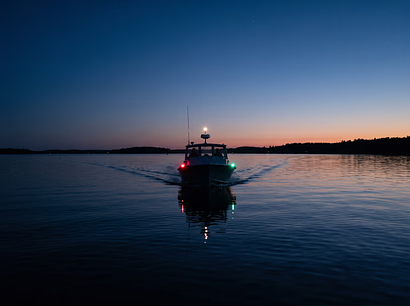
If you operate your boat between sunset and sunrise, or in reduced visibility, federal Navigation Rules require you to show navigation lights so other vessels can see you and judge which way you are heading. The exact lights depend on two things: the type of boat and its length. This guide breaks down what each light does, then lays out what you need by vessel type so you can confirm your boat is legal and buy the right fixtures the first time.
Where the Rules Come From
Navigation lighting in the United States is governed by the Navigation Rules, which combine the International Rules (COLREGS) that apply offshore with the Inland Rules that apply on most lakes, rivers, and coastal waters inside the demarcation line. For the recreational boater, the light requirements are effectively the same in both sets of rules. The goal is straightforward: the color, arc, and position of your lights tell an approaching skipper whether they are looking at your bow, your stern, or your side, and roughly how big you are. Getting them right is a safety issue first and a legal one second.
The Lights and What Each One Does

Before you can tell what your boat needs, it helps to know the standard fixtures by name. Each light is defined by its color and by the arc of the horizon it covers, measured in degrees. The table below is the vocabulary the rest of this guide uses.
|
Light |
Color |
Arc of visibility |
What it tells other boats |
|---|---|---|---|
|
Sidelights |
Green to starboard, red to port |
112.5 degrees each |
Which side you are showing, and your heading |
|
Sternlight |
White |
135 degrees |
They are behind you, seeing your stern |
|
Masthead light |
White |
225 degrees, facing forward |
You are a power-driven vessel underway |
|
All-round light |
White, or colored per use |
360 degrees |
Anchor light, or on small boats a combined masthead and stern light |
Two useful shortcuts fall out of this. On many smaller boats the red and green sidelights are combined into a single bi-color bow light on the centerline. And the sidelights add up neatly: 112.5 degrees on each side plus the 135-degree sternlight equals a full 360 degrees, which is why those three lights together cover the whole horizon. You will find combination fixtures, pole-mounted lamps and fixed housings across the navigation lights collection.
What You Need by Boat Type and Length
Here is the part that answers the real question. Find your situation below.
Power-Driven Boats Under 12 Meters (About 39 Feet)
This covers the vast majority of recreational powerboats. Underway at night you must show red and green sidelights plus a white light. On smaller boats the rules allow a single all-round white light in place of a separate masthead and stern light, combined with your sidelights. So a typical small powerboat runs a bi-color bow light and an all-round white light aft, with that white light mounted high enough to be seen all the way around. The sidelights need to be visible for at least one nautical mile and the white light for at least two.
Power-Driven Boats 12 to 20 Meters
Larger powerboats carry the full set as separate fixtures: a forward-facing masthead light, red and green sidelights, and a sternlight. At this size the masthead light and sidelights must be visible for at least two nautical miles. The masthead light sits on the centerline and is positioned above the sidelights so the pattern reads correctly from a distance.
Sailing Vessels Under Sail
A sailboat operating under sail alone shows sidelights and a sternlight, and nothing else forward, because it is not power-driven. Many sailboats under 20 meters combine those into a single masthead tricolor lamp at the top of the mast, which is efficient and highly visible. The moment you start the engine, though, the picture changes. Under power a sailboat is treated as a power-driven vessel and must show the appropriate masthead light as well. It is a detail that catches a lot of sailors out.
Any Boat at Anchor
When you are anchored outside a marked channel between sunset and sunrise, you must display an all-round white anchor light where it can best be seen. There are two common exemptions worth knowing. A boat under 7 meters is not required to show an anchor light if it is not anchored in or near a channel, fairway or anchorage where other boats normally navigate. And a boat under 20 meters anchored within a designated special anchorage area does not need to display one. When in doubt, show the light. A visible anchor light is cheap insurance against being run down while you sleep.
Kayaks, Dinghies and Other Small Craft
Human-powered and very small boats have their own allowance. A vessel under oars, such as a rowboat, kayak or canoe, is not required to carry fixed navigation lights, but it must have at hand an electric torch or lantern showing a white light, ready to shine in time to prevent a collision. In practice, paddling at night without a reliable white light is asking to be run down, so a waterproof headlamp or a small all-round light is essential kit. Personal watercraft are a separate case, since they are not permitted to operate between sunset and sunrise at all.
Required Visibility Distances at a Glance
The rules also set how far each light must be visible, and the minimum distance grows with boat size. Use this as a quick reference when you compare fixtures, since a lamp rated for a smaller boat may not be legal on a larger one.
|
Vessel length |
Masthead light |
Sidelights |
Sternlight and all-round white |
|---|---|---|---|
|
Under 12 m (about 39 ft) |
2 nm |
1 nm |
2 nm |
|
12 m to under 20 m |
3 nm |
2 nm |
2 nm |
A Word on Strobes and Distress Lights

A high-visibility strobe is not a navigation light, and it should not be used as one. A flashing white light on the water signals distress, so running a strobe as a general be-seen light sends the wrong message and is not compliant. Strobes and other emergency signals belong in your safety kit for genuine emergencies, and you can find them in the safety lights and strobes collection. If you are building out your emergency signaling, our roundup of the best emergency LED boat flares covers the modern electronic options.
Where the Lights Go
Buying compliant lights is only half the job. Mounting them correctly is the other half, because the rules assume specific positions.
-
Height matters. The masthead or all-round white light must sit clearly above the sidelights, so the vertical stack of lights reads correctly from a distance. On small boats a fold-down or removable pole light is a common way to get the white light up high while stowing it out of the way on the trailer.
-
Sidelights face forward and out. Mount them so the green shows to starboard and the red to port, with each covering its arc from dead ahead to just behind the beam. A bulkhead or hull side that blocks part of that arc defeats the purpose.
-
Nothing should shine in the helmsman's eyes. A white light mounted too low or too close to the cockpit will wreck your night vision. Position it so it lights the water around you, not the driver.
If you are running new wiring for a pole socket or a fixed fixture, our guide to basic boat wiring and troubleshooting covers clean, corrosion-resistant connections that will not leave you dark at the worst moment.
Upgrading to LED Without Breaking the Rules

LED navigation lights are the obvious upgrade. They draw a fraction of the power of old incandescent bulbs, run cooler and last for years, which matters on a small boat where every amp counts. There is one catch that is easy to miss: a navigation light has to meet the visibility distance and color standards in the rules, and not every LED lamp does. An uncertified LED can look bright on the bench and still fail to be seen at the required one or two nautical miles, which makes it non-compliant even though it is lit.
The fix is simple. Choose fixtures that are built and certified to the marine standard for their category, and confirm the rated visibility distance matches your boat size before you buy. Reputable marine brands such as Attwood, Hella Marine, Perko and Aqua Signal all build lights to those standards, and you will find fixed and pole-mount LED options in the navigation lights collection. For a boat that trailers or for a tender that needs lights only occasionally, a removable kit from the portable LED navigation lights collection lets you stay legal without permanent fixtures.
Keeping Your Lights Working

A navigation light only protects you if it actually lights. Salt air and vibration are hard on fixtures, so make testing part of your routine before any trip that could run past sunset. Switch every light on and walk around the boat to confirm each one works and shows the right color through its lens.
Corrosion at the bulb socket or a wiring connection is the usual culprit when a light fails, which is one more reason sealed LED units tend to last longer than older bulbs. Keep a spare fuse and, if you still run bulbs, a spare bulb aboard, and check that pole-mounted and removable lights seat firmly in their bases so they cannot vibrate loose or lose contact. Fixtures and replacements are in the navigation lights collection.
Before Your Next Night Run
Compliant lighting comes down to three checks. Confirm you are showing the correct lights for your boat type and length, mount them at the right height and arc, and make sure every fixture is certified for the visibility distance your boat requires. Do that and an approaching skipper will see you early and read your heading correctly, which is the entire point.
Take five minutes before your next evening on the water to confirm your setup, and while you are thinking about being seen, it is a good moment to check the rest of your safety gear too, including your life jackets and PFDs. When you are ready to upgrade, the full range of fixed and portable fixtures is waiting in the navigation lights collection at Go2Marine.