
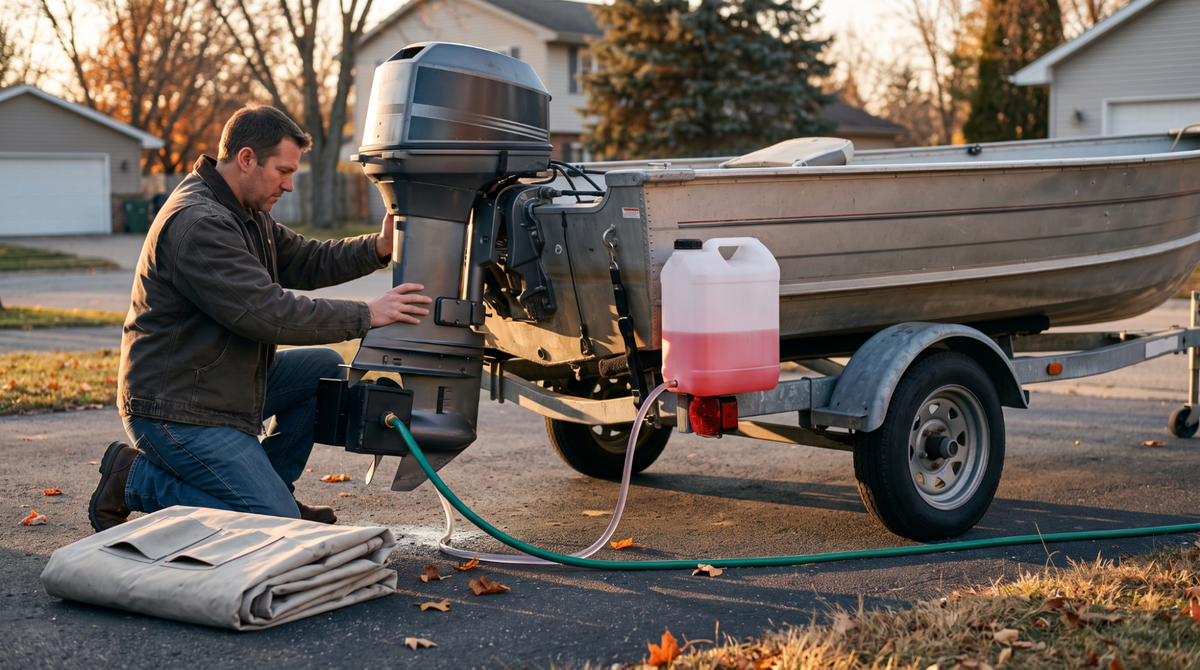
To winterize a boat, get every drop of water out of the engine and cooling system before the first hard freeze. Fill the fuel tank to 95 percent with stabilizer, change the oil and filter, replace the gear lube, run antifreeze through inboard and sterndrive cooling systems, and fully charge the battery.
Water expands about 9 percent when it freezes. In ten years of freeze claims, BoatUS found that more than three-quarters involved cracked engine blocks or exhaust manifolds that were still holding water. Winterizing most boats takes from an hour to a day.
This guide covers the steps in order, when to start, how engine types differ, and the fuel, oil, antifreeze, battery, and storage details, then common mistakes.
What are the steps to winterize a boat?
Work in this order, so stabilized fuel circulates while the engine is warm:
-
Fill the tank to 95 percent, add stabilizer, and run the engine a few minutes.
-
Flush the engine with fresh water, which also warms the oil and gear lube.
-
Change the engine oil and filter, then the fuel filter and water separator.
-
Replace the lower unit or drive gear lube.
-
Run non-toxic antifreeze through an inboard or sterndrive cooling system, or follow your outboard manual.
-
Fog a gasoline engine by the method in your manual.
-
Drain the water system and bilge, then run non-toxic antifreeze through the plumbing.
-
Charge the battery fully and keep it on a marine charger.
-
Clean and dry the boat, then cover it with ventilation.
When should I winterize my boat?
Start before the first hard freeze. BoatUS recommends winterizing the engine if the boat will sit for even a few weeks, unless you boat in Hawaii or the Florida Keys. A boat on land needs it earlier, because it cools faster than one afloat. Do not use a heater as a substitute, because a power outage can shut it off. The BoatUS Boater's Guide to Winterizing is the source for many numbers below.
How does winterizing differ for an outboard, a sterndrive, and a diesel inboard?
Every engine needs fresh oil, a fresh fuel filter, and treated fuel. The difference is how you get the water out of the cooling system.
|
Engine |
Getting water out of the cooling system |
Also change |
Store it |
|
Outboard |
Flush with muffs and fresh water per your manual; some have a built-in winterizing mode |
Gear lube, plus oil and filter on a four-stroke |
In the down position so water drains |
|
Gas sterndrive or inboard |
Run at least 2 gallons of non-toxic antifreeze through the raw-water side, or drain it completely |
Oil and filter, plus drive lube |
Drive in the down position |
|
Diesel inboard |
Run antifreeze through the raw-water side as your manual directs |
Oil, fuel filter, and water separator |
Per your manual |
Inboards and most sterndrives use raw water, the lake or sea water pumped through the block and exhaust manifold. Many also have a closed freshwater loop of 50/50 coolant. Do not exceed 50 percent coolant, because BoatUS notes that 100 percent coolant gels at -8°F.
Key takeaway: Inboards and sterndrives need at least 2 gallons of antifreeze in the raw-water side, outboards follow the manual, and every engine gets fresh oil and a new fuel filter.
How do I winterize the fuel system?

Ethanol-blended gasoline (E10) absorbs moisture over winter, and enough water makes the ethanol separate from the gasoline. This phase separation leaves a caustic layer at the bottom of the tank. Emptying the tank prevents it. If that is impractical, add stabilizer and fill the tank to 95 percent. A nearly full tank has less room to breathe in moist air and still leaves space for expansion. On a 45 gallon tank, 95 percent is about 42.75 gallons.
Add stabilizer such as Star Tron stabilizer before your last run, then run the engine for a few minutes so treated fuel reaches the carburetors or injectors. Replace the fuel filter and water separator, and check them for leaks while the engine runs.
Key takeaway: Fill to 95 percent, stabilize before the last run, run the engine a few minutes, and replace the fuel filter and water separator.
How do I change the engine oil and the gear lube?

Acids and moisture left in the crankcase can pit bearings over winter, so change the oil just before layup. Run the engine a few minutes to thin the oil and carry impurities out, then change the oil and filter, restart, and run about a minute while you check the filter for leaks.
Then drain the lower unit and check the gear lube. Water in the gear case rusts shafts and bearings all winter, and Sierra Marine says milky or gray lube means water has contaminated the gearcase. Pump fresh lube up through the drain hole until it appears at the vent hole, never in from the top. Install the vent screw first, then the drain screw right away, with new gaskets. A gear lube pump does that job. Your manual names the right lube, and it is not always 80W-90. The Quicksilver Premium 80W-90 gear lube is engineered for outboards below 75 HP.
Key takeaway: Change the oil just before layup, treat milky or gray gear lube as water contamination, and always refill from the bottom hole up.
How do I flush the engine, run antifreeze, and fog it?
Flush with fresh water first. Muffs on the lower unit connect a garden hose to the intake, in round or rectangular cups, so match the shape to your lower unit. Many newer outboards have a built-in flush port instead. The flush also warms the oil and lube so they drain more completely.
For an inboard or sterndrive, fill a 5 gallon bucket with undiluted non-toxic antifreeze, and keep at least 2 gallons on hand. Bring the engine to operating temperature so the thermostat is open, then run it at idle on antifreeze until it discharges from the exhaust for 30 seconds or more. The Camco do-it-yourself winterizing kit winterizes an engine with five gallons of antifreeze, and the Star brite do-it-yourself winterizing kit adds a 5 gallon tank, a gate valve, and a clear hose. Make sure antifreeze reaches everything downstream of where you add it.
On a gasoline engine, fog the cylinders with fogging oil, a spray that coats internal parts with a thin film that helps keep rust and corrosion away. With the engine running, spray Star brite fogging oil into the carburetor or air intake until the engine smokes, then keep spraying until it stalls. Your manual may instead have you spray each cylinder through the spark plug holes.
Key takeaway: Flush with fresh water, run antifreeze until it has discharged from the exhaust for 30 seconds or more, and fog a gas engine by your manual's method.
Which antifreeze should I use: -50 or -100?
Use non-toxic propylene glycol antifreeze with rust inhibitors. Never use ethylene glycol, the toxic coolant for a closed engine loop, in a drinking-water system, where it cannot be reliably purged, and avoid it on the raw-water side because it can discharge overboard. The number on the jug is a burst rating, and BoatUS notes that it does not correspond to what you may think.
|
Term |
What it means |
Example |
|
Burst rating |
The temperature at which a sealed copper pipe full of the product bursts from ice expansion |
-50°F on Star brite 31400 |
|
Freeze point |
The temperature at which the product turns slushy |
+12 to +16°F on Star brite 31400 |
|
Dilution |
Water added to the product |
Use winterizing antifreeze full strength |
BoatUS warns that a typical -50°F antifreeze protects PVC water pipes only to about -10°F. Our listing for the 31400 antifreeze, sold in case packs, describes a non-toxic propylene glycol formula that protects water systems and engines. Star brite rates it for burst protection to -50°F with a freeze point between +12°F and +16°F, and recommends its -100°F antifreeze where water systems may see lows below -10°F. Prime Guard antifreeze is listed on our site as ethyl alcohol based and blended with propylene glycol, rated to -50°F, and safe for fresh water systems, so confirm a label covers engine use before it goes through a raw-water circuit. For colder-rated options, contact our team.
Key takeaway: Choose a rating well below your coldest night, use it full strength, and keep pumping after it first appears.
How do I winterize the water system, bilge, and head?
Draining alone is not enough, because water pools in low spots and freezes. Drain the tank through the faucets, then pour 2 to 3 gallons of non-toxic propylene glycol antifreeze into it, with more if you have a water heater. Open the outlet farthest from the tank first and run it until antifreeze flows, then work back toward the tank, hot and cold on each. Leave the bilge drain plug out, and run non-toxic antifreeze through the head as its manual directs, because some head makers warn that it can soften gaskets.
How do I protect the battery over winter?
Charge the battery fully before you store it. A fully charged flooded battery does not freeze until far below zero, around -67°F, but a partly discharged one can freeze at 5 to 16°F, so a half-empty battery can crack its case in an ordinary cold snap. BoatUS suggests topping up wet-cell electrolyte, cleaning and coating the terminals, and leaving the battery on a marine charger with a float setting. If you unplug it, recharge it fully at least once a month.
Size a marine charger at 25 to 40 percent of the battery's amp-hours, so a 100 amp-hour battery needs 25 to 40 amps. The Marinco ProMariner ProSport HD 20 Plus charger is a 20 amp, 3-bank unit with five-stage charging and flooded, AGM, and gel profiles, listed for Group 24 to 31 batteries, so check its 20 amp output against your battery's amp-hours.
Key takeaway: Charge to full, size the charger at 25 to 40 percent of the battery's amp-hours, and never store it partly discharged.
How do I cover and store the boat?

Store outboards and sterndrive legs in the down position, because water that gets in through the propeller hub can freeze and crack the lower unit housing. BoatUS prefers a custom canvas cover on a frame with vents. Shrink wrap traps moisture and breeds mildew unless vents run its full length, and BoatUS says to leave the wrapping to professionals because heat can ignite it. Put moisture absorbers in the cabin, such as the Star brite No Damp dehumidifier bucket, where a 12-ounce bucket treats up to 900 cubic feet.
Common Boat Winterizing Mistakes to Avoid
-
Stopping when antifreeze first appears. It must displace all the water already in the system, and BoatUS says a couple of extra gallons costs less than a cracked block.
-
Buying by the burst number. A -50°F antifreeze protects PVC pipes only to about -10°F, so choose a rating well below your coldest night.
-
Diluting antifreeze. Most winterizing antifreeze must be used full strength.
-
Relying on a heater. A power outage can shut it off just as the temperature falls.
-
Skipping the gear lube check. Water in the gear case rusts shafts and bearings all winter.
-
Leaving the battery half charged. A partly discharged battery can freeze at 5 to 16°F.
Go2marine carries winterizing supplies from Star brite, Prime Guard, Sierra, Camco, and Marinco. Not sure which supplies fit your engine? Contact our team for expert advice. We have been outfitting boaters since 1967. When spring comes, troubleshooting a boat that will not start after sitting all winter picks up where this guide ends. Browse everything in our winterizing collection.