
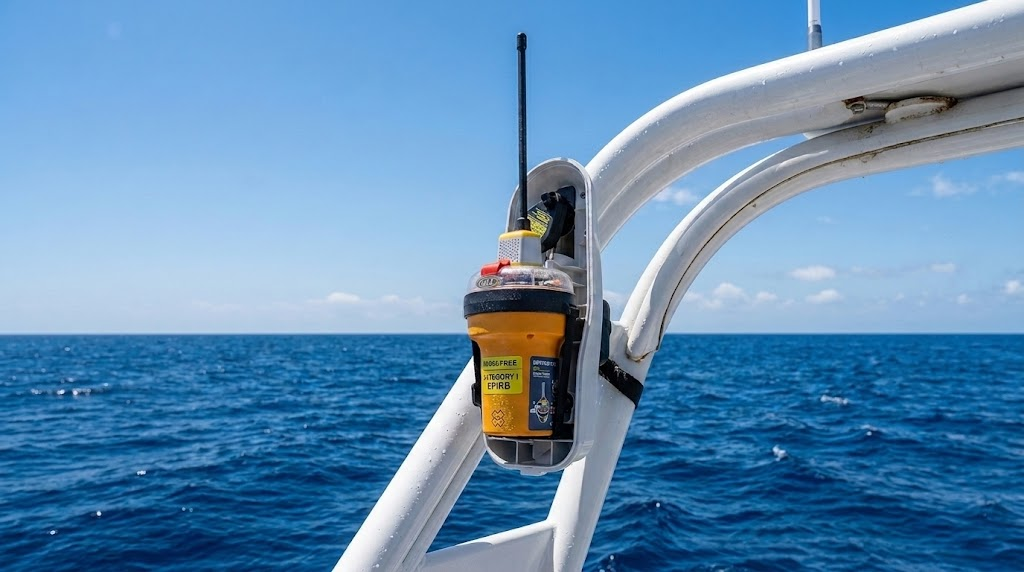
An EPIRB is registered to your boat, transmits for at least 48 hours, and a Category I model floats free and switches on by itself. A PLB is registered to you, transmits for at least 24 hours, and you switch it on by hand. Both send a 406 MHz signal through the Cospas-Sarsat satellite system, so the choice comes down to how you boat. Choose an EPIRB for offshore trips, and add a PLB for every person who could end up in the water away from the boat.
This guide compares the two beacons side by side, matches each to a type of boating, explains Category I and Category II EPIRBs, and adds up what a beacon costs to own over ten years. It also covers registration, mounting, and the mistakes that slow a rescue.
What is the difference between an EPIRB and a PLB?

An EPIRB (Emergency Position-Indicating Radio Beacon) and a PLB (Personal Locator Beacon) each send a coded distress message on 406 MHz. Satellites relay it to a rescue coordination center, which looks up your registration to learn who you are and whom to call. A beacon with built-in GPS adds your position, and ACR lists the position it sends as accurate to about 100 meters, or roughly 330 feet. NOAA explains the process in its overview of the 406 MHz distress system.
|
Feature |
EPIRB |
PLB |
|
Registered to |
The vessel |
A person |
|
Minimum transmit time |
At least 48 hours |
At least 24 hours |
|
Automatic activation |
Yes, a Category I floats free and self-activates |
No, you switch it on by hand |
|
Typical carry |
Mounted on the boat |
On your life jacket or belt |
|
Works away from the boat |
No, it is tied to one vessel |
Yes, including other boats and ashore |
Key takeaway: The satellites treat both beacons the same. What differs is who registers it, how long it runs (48 or 24 hours minimum), and whether it can start itself.
Which beacon fits the way I boat?
|
Your boating |
Best choice |
Why |
|
Bay or lake boating near shore |
A PLB on each person's life jacket |
It covers a person overboard and works on any boat |
|
Coastal fishing beyond sight of shore |
A Category I EPIRB plus a PLB for each person |
A boat can go down faster than anyone can reach a beacon |
|
Offshore passages and races |
A Category I EPIRB plus PLBs |
Race rules often require an EPIRB, so read yours |
|
Kayak, dinghy, or tender |
A PLB |
An EPIRB is registered to one hull |
Federal carriage rules for recreational boats do not include a beacon. Commercial fishing vessels operating beyond 3 nautical miles must carry an EPIRB under 46 CFR Part 28, and vessels 36 feet or longer need a float-free Category I unit, so confirm the rule for your vessel. A PLB also only helps if it is on you, so pair it with a life jacket you can confirm is Coast Guard approved, using our guide to how to choose and verify a Coast Guard approved life jacket.
Key takeaway: Ask which emergency worries you most. If the boat can be lost fast, mount a float-free EPIRB. If a person can fall off, put a PLB on that person.
Should I buy a Category I or Category II EPIRB?

A Category I EPIRB sits in a bracket with a hydrostatic release unit (HRU), the part that lets go when it is submerged. It frees the beacon at a depth of roughly 5 to 13 feet, and the beacon floats up and activates on its own. A Category II EPIRB is switched on by hand, so it costs less but depends on someone reaching it.
ACR builds both versions of the GlobalFix V6, the Category I EPIRB and the Category II EPIRB. Both include Return Link Service, which tells you the alert was received, and ACR lists a 10 year replaceable battery, a visual and infrared strobe, and a receiver that tracks GPS, Galileo, and Glonass satellites. If you want an alert that also reaches nearby vessels, look at the ACR GlobalFix V5 AIS EPIRB with a Category I float-free bracket.
Key takeaway: Choose Category I when nobody may have time to reach the beacon, and Category II when the crew can always reach it and deploy it.
What does a beacon really cost to own over ten years?
The purchase price is only the start. Plan for these costs:
-
Battery service: the GlobalFix V6 lists a replacement 10 years after manufacture or after activation, while the ACR ResQLink AIS PLB lists 6 years from manufacture or 5 years after it goes into service, whichever comes first.
-
Release unit: a Category I bracket's HRU is generally replaced about every two years, which means five replacements in ten years. Go2Marine lists a hydrostatic release unit for Sea Shelter EPIRB brackets, and any replacement must match the make and model of your bracket.
-
Registration: NOAA registration is free but must be renewed every two years, which means five renewals in ten years.
Ask any seller what a battery replacement costs and how long it takes. A beacon that is cheaper to buy but slow and expensive to service can cost more over its life than one that is simple to maintain.
Key takeaway: Over ten years, plan for one EPIRB battery replacement at the ten year mark, at least one PLB battery service, up to five release unit replacements on a Category I bracket, and five registration renewals.
What do Return Link Service and AIS actually add?
These two features solve different problems, and neither replaces the satellite alert. Return Link Service (RLS) sends a confirmation back to the beacon through the Galileo satellite network, so you know the digital distress message was received. AIS (Automatic Identification System) is a separate transmission on the marine VHF frequencies that alerts AIS-equipped vessels within radio range of your position, which can bring a nearby boat to you faster than a rescue center can dispatch one. The ACR ResQLink AIS combines both with the standard 406 MHz alert, and its 121.5 MHz homing signal helps rescuers find the beacon on the final approach. Near Field Communication (NFC) is a third feature that lets your phone read the battery and self-test history without switching the beacon on.
Key takeaway: RLS tells you the alert was received, AIS alerts boats within VHF range, and neither replaces the 406 MHz satellite signal.
Do I need both an EPIRB and a PLB?
For a small boat that stays within sight of shore, a single PLB worn on a life jacket may be all you need. For an offshore boat with a crew of four, the strongest setup is one Category I EPIRB on the vessel and one PLB on each person. That is five beacons to register and five renewals every two years, or 25 renewals across ten years, so keep one list of hex IDs and dates. The EPIRB covers the boat in a sudden sinking or fire, when nobody has time to grab anything. The PLBs cover the more common case, a person separated from the boat, and they keep working if the crew is scattered in the water.
Key takeaway: A crew of four with one EPIRB and four PLBs means five beacons, five registrations, and 25 renewals over ten years, so buy toward the risk that is larger for the way you boat.
How do I register my beacon?
An unregistered beacon slows rescue, because responders cannot identify you or call your contacts.
-
Find the 15 character hex ID printed on the beacon.
-
Register it with NOAA using your boat details and at least two emergency contacts.
-
Update the record when you change boats, phone numbers, or ownership. An EPIRB must be re-registered if it moves to another vessel.
-
Renew the registration every two years.
You can register a U.S. beacon on NOAA's beacon registration site.
Where do I mount an EPIRB, and how do I test it?
A Category I EPIRB floats free only if nothing blocks it. Mount the bracket on an exterior surface with clear space overhead, not inside a locker or under a hardtop, canvas, or rigging, and keep it within reach of the helm so you can also grab it by hand. Test it only with its built-in self-test on the schedule in the manual. On the GlobalFix V6, you can scan the NFC antenna with your phone to view detailed test results in ACR's app.
Why not rely on my phone or a VHF radio?

A cell phone loses coverage a few miles out, and a wet or dead phone calls no one. A 406 MHz beacon needs no cell signal and reports to government-monitored rescue systems. A VHF radio is still your first call when help is within range, so keep a floating handheld aboard, such as the Standard Horizon HX210 floating handheld VHF. The beacon is your backup for when nobody answers.
A beacon is one layer of your abandon-ship plan.
Common Emergency Beacon Mistakes to Avoid
-
Buying a beacon and never registering it. Responders cannot identify an unregistered beacon, so register before your first trip and renew every two years.
-
Mounting a Category I EPIRB where it cannot float free. A bracket under a hardtop or inside a locker blocks the release.
-
Testing by switching the beacon on. Use only the self-test, because a false alert pulls rescuers away from someone who needs them.
-
Leaving a PLB in a bag. A PLB works only if it is on you, and the ResQLink AIS can be activated by the inflation of a compatible inflatable jacket.
-
Assuming every PLB floats. The ResQLink AIS is not buoyant and lists an optional flotation pouch, while the ACR ResQLink 400 is buoyant.
-
Missing the release unit date. An HRU past its date may not free the beacon, so replace it about every two years.
Go2marine carries EPIRBs and personal locator beacons from ACR, including the GlobalFix V6, the ResQLink AIS, and the ResQLink 400. Not sure which beacon is right for your boat? Contact our team for expert advice. You can compare current models in our EPIRB and personal locator beacon collection.