
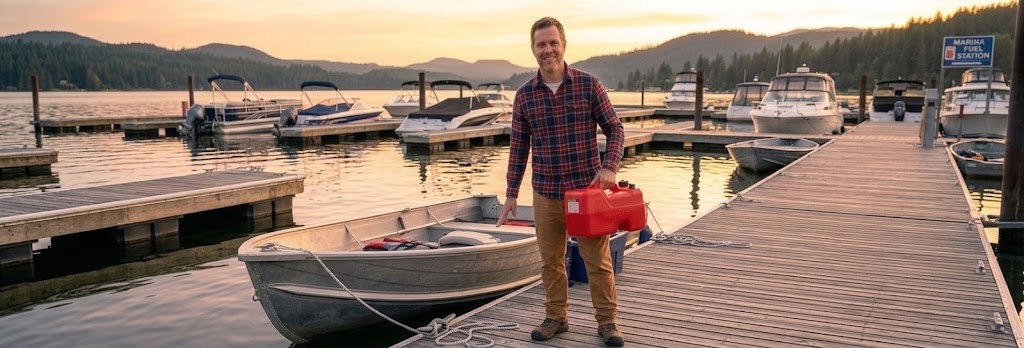
Size a boat fuel tank from your engine's fuel burn, not your boat's length. Multiply the hours you will run by gallons per hour, then divide by 0.67 so one third of the fuel stays in reserve. A 60 mile round trip at 25 mph with a 12 gallon per hour engine burns about 29 gallons and calls for a tank of about 43 gallons, so 45 gallons is the sensible floor. Most small outboards run a full day on a 6 to 12 gallon portable tank, and a fixed tank should be installed to ABYC H-24 for gasoline or H-33 for diesel.
This guide covers sizing, portable versus permanent tanks, materials, the fittings and sender you have to match, how to fit a replacement, and which regulations apply. It ends with the mistakes that cost boaters the most.
How big a fuel tank do I need?

Use the rule of thirds: one third of the fuel to get out, one third to get home, and one third in reserve.
-
Find your cruising fuel burn in gallons per hour from the engine maker's data or your fuel-flow gauge.
-
Divide the trip distance by your cruising speed to get the hours out and back.
-
Multiply hours by gallons per hour to get the fuel the trip uses.
-
Divide that number by 0.67 to add the reserve. The result is your minimum usable capacity.
The 60 mile example above runs 2.4 hours at 25 mph. At 12 gallons per hour that is 28.8 gallons, and dividing by 0.67 gives about 43 gallons. A small tender that runs one hour at 3 gallons per hour needs 3 gallons for the trip, so a 6 gallon portable leaves a comfortable margin. Weight matters too: gasoline weighs about 6 pounds per gallon, so a full 45 gallon tank adds roughly 270 pounds, and where it sits changes how the boat trims.
Key takeaway: Multiply hours by gallons per hour, divide by 0.67, and round up to the next real tank size. Then check where 6 pounds per gallon of extra weight will sit in your boat.
Should I choose a portable tank or a permanent tank?
|
Tank type |
Best for |
Trade-off |
|
Portable |
Small outboards, kickers, tenders, and day boats |
Limited capacity, and you refuel ashore |
|
Fixed, above deck |
Center consoles and open boats with a dedicated tank space |
Takes deck or console volume |
|
Fixed, below deck |
Larger boats that need range and a clean install |
Must be installed to standards, and is hardest to inspect |
For a small outboard, the Moeller 3 gallon portable outboard tank with handle suits a tender, and the Moeller 12 gallon portable tank covers a full day on a small boat. For a permanent install, the Moeller 12 gallon permanent below deck tank measures 24.5 by 18.5 by 9.75 inches, comes with a molded fill neck and withdrawal and vent fittings molded into the shell, and is listed as a replacement for boats built before 2011.
Key takeaway: Choose portable when you can lift and carry the fuel, and permanent when you need more range than a portable can hold. Install permanent tanks to ABYC H-24 or H-33.
Aluminum, polyethylene, or stainless: which material should I buy?
|
Material |
Strengths |
How it usually fails |
Best for |
|
Aluminum |
Light and strong, and can be built to fit odd spaces |
Pits and corrodes where moisture sits against it |
Custom below-deck tanks |
|
Cross-linked polyethylene |
Does not corrode and resists ethanol |
Fittings and long sun exposure |
Tight spaces and low-maintenance installs |
|
Molded HDPE (portable) |
Inexpensive, light, and easy to carry |
Cap gaskets, and pressure if the vent is shut |
Portable outboard tanks |
|
Stainless steel |
Very strong |
Cost and weight |
Specialized installs |
Most aluminum tanks fail from the outside in, where moisture sits against the metal under foam, carpet, or bedding. Cross-linked polyethylene, plastic that is chemically bonded so it holds its shape and shrugs off fuel, does not corrode, which is why Moeller builds its permanent tanks from it and lists them as resistant to ethanol and biodiesel. If a tank has held stale ethanol fuel, check its inner surface for a soft or sticky feel before you trust it again.
Key takeaway: Pick the material by how it fails. Choose aluminum for a custom shape only if you can keep it dry, and polyethylene for corrosion-free installs in tight spaces.
Which fittings and which sender do I need?
A tank is easy to order in the wrong configuration, because every opening has to line up with hoses and gauges you already own. Confirm each of these before you buy:
-
Fill and vent. Moeller below-deck tanks accept 1 1/2 inch fill hose and 5/8 inch vent hose. A blocked or badly routed vent causes pressure build-up or a vacuum that starves the engine, so shop deck fills and fill plates and tank vent fittings together. The Attwood EPA certified carbon canister is one example of a vapor-control part used on compliant systems.
-
Pickup tube and anti-siphon valve. The pickup must reach the right depth, and an anti-siphon valve limits leakage if a fuel line is damaged.
-
Sender. It has to match your gauge. Many U.S. marine gauges use a sender that reads 240 ohms empty and 33 ohms full, so check your gauge before ordering. Moeller's universal swingarm electric sending unit fits tank depths of 12 to 24 inches, and if your gauge already reads wrong, see how to replace a fuel sender when the gauge reads incorrectly.
-
Portable connections. Primer bulb and hose fittings must match your engine, and Moeller connectors are available for Honda, Mercury, Nissan and Tohatsu, and Yamaha outboards.
-
Hose. Use hose rated for marine fuel, and never reuse old hose on a new tank. Browse marine fuel hose if you need to replace a run.
How do I fit a replacement tank to my boat?

Replacing a tank is mostly careful measuring.
-
Record the length, width, height, and capacity of the old tank.
-
Mark the position and size of every opening: fill, vent, pickup, and sender.
-
Photograph the tank in place, the fittings, and any label or part number.
-
Add 2.5 inches to the body height for the fill neck, because listed dimensions do not include fittings.
-
Add 3 percent to every dimension, because plastic tanks swell slightly as they absorb fuel.
Here is the math for the Moeller 12 gallon tank. Its 9.75 inch listed height already includes the fill fitting, and adding 3 percent to 24.5 by 18.5 by 9.75 inches gives about 25.2 by 19.1 by 10.0 inches. Your opening needs to be at least that big. A Moeller permanent tank hold-down kit secures the tank without crushing it.
Key takeaway: Add 2.5 inches for the fill neck and 3 percent in every direction for swelling, then compare the result to your opening.
What do EPA, CARB, ABYC, and the Coast Guard require?
Fuel tank rules come from several places, which is why the labels can look confusing.
-
EPA. Portable marine fuel tanks sold in the United States have had to meet EPA permeation standards since January 1, 2011. The rule also limits diurnal emissions, the vapor a tank releases as it warms and cools, and it sets a useful life of 10 years for portable marine tanks. Read the EPA evaporative emission standard for marine tanks for the detail, and look for the EPA compliant marking.
-
CARB. California regulates portable outboard marine tanks of 30 gallons or less separately, so buyers there should confirm the tank meets CARB requirements.
-
ABYC and the Coast Guard. ABYC H-24 covers permanently installed gasoline systems, H-25 covers portable gasoline systems, and H-33 covers diesel systems. Have a qualified installer follow them for permanent tanks.
Do diesel tanks need anything different?
Yes. A diesel system usually needs a return line that sends unused fuel back to the tank, plus a low point to drain water and sediment. The Moeller 12 gallon tank is listed for gasoline or diesel use with return kit 035724-10. Browse diesel fuel system parts for the filters and lines that go with it, and if a boat cranks but will not start after a tank change, work through troubleshooting fuel delivery when an engine cranks but will not start.
How do I install and care for a tank?
Secure a fixed tank with supports and straps that spread the load, keep aluminum up off standing bilge water, and route the vent so it cannot trap water. Keep the fill hose short, sloped, and supported, and check every fitting for leaks before the first fill. For a portable tank, fill it on the ground away from ignition sources, leave room for expansion, and check the vent setting before you start the engine. If a tank will sit for weeks, add a fuel stabilizer such as Star Tron. Replace a tank rather than repairing it when you see pitting, cracking, a soft or sticky feel, or fittings that no longer seal.
Common Boat Fuel Tank Mistakes to Avoid

-
Sizing by boat length. Fuel burn sets range, so a 12 gallon per hour engine needs about 43 gallons for a 60 mile round trip, whatever the hull length.
-
Ignoring the reserve. Run a tank down and it picks up water and debris first, so always keep one third.
-
Skipping the swelling allowance. A polyethylene tank that fits to the exact inch can bind once it swells 3 percent.
-
Buying the wrong sender. A sender outside your gauge's ohm range gives false readings, so match the range before you order.
-
Reusing old fuel hose. Old hose hardens and leaks, so replace it whenever you replace the tank.
Go2marine carries fuel tanks, fittings, and vapor-control parts from Moeller and Attwood, along with Star brite fuel treatment. Not sure which tank fits your boat? Send our team your measurements and photos for expert advice. We have been outfitting boaters for more than 50 years. You can compare fuel tanks, hoses, and vents in one place. When you plan more range.