
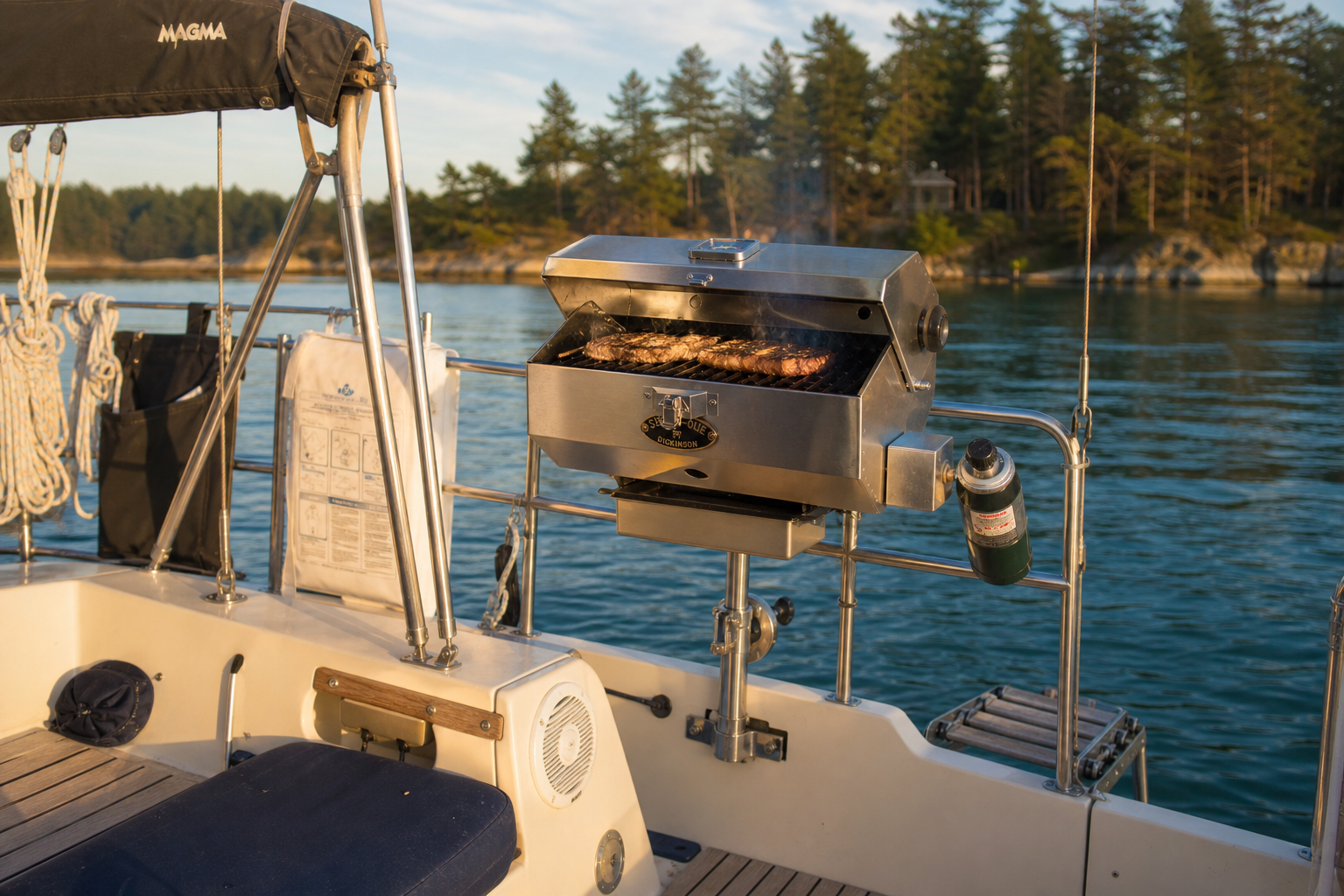
For most boats, propane is the most popular fuel. It's small, lights fast, handles wind well, and is easy to store, using either throwaway one-pound canisters or a hookup to your boat's own gas system. Charcoal skips the gas that some sailors would rather not carry, but it brings ash and cleanup. Whatever the fuel, the two choices that make or break a setup are matching the mount to your boat and keeping about two feet of space between the grill and anything that can catch fire.
A marine grill is built for a job a backyard grill can't do. It uses shiny stainless steel that resists salt rust, a hinged lid that won't fly open in a chop, and a design meant to be mounted to a rail, rod holder, or deck instead of sitting on your fiberglass. This guide covers fuel, mounting, sizing, materials, safe spacing, and the care and accessories that keep a boat grill going for years, so you can pick the right marine grill the first time.
Propane, charcoal, or electric ,which grill for a boat?
Each fuel has a clear best use:
|
Fuel |
Good points |
Trade-offs |
Best for |
|---|---|---|---|
|
Propane |
Easy to use, quick heat, handles wind, easy storage |
Needs fuel canisters; some sailors avoid gas aboard |
Most powerboats and cruisers |
|
Charcoal |
No gas aboard; classic flavor |
Ash, lighter fluid, longer cleanup |
Sailors who prefer no gas |
|
Electric |
No open flame, no fuel |
Needs shore power, a generator, or a big battery bank |
Docked boats with AC power |
Propane boat grills are by far the most popular because they light fast, hold heat in wind, and store small. They usually run on standard throwaway one-pound canisters, or you can hook them to your boat's own propane (LPG) or natural gas (CNG) system. Charcoal suits boaters who'd rather not carry gas. A marine kettle charcoal grill seals its coals with a draft door so you can save them for next time, but you trade easy use for ash and cleanup. Electric skips the flame, which is nice at a dock, but it needs AC power or a generator that most boats don't have while underway.
Key takeaway: Propane is the default for most boats, easy to use and good in wind. Choose charcoal only if you'd rather skip gas, and electric only if you have steady AC power.
How do I mount a grill on my boat?

Never set a grill straight on the deck. A hot grill on fiberglass can mark the deck at best and start a fire at worst. Marine grills are made to be mounted, and the fold-out legs on many models are for use on shore only. The common mount types:
-
Rail mount (round or square rail): clamps to your boat's rail. Round-rail mounts fit common sizes, roughly 7/8″ to 1″ for standard mounts and up to 1.25″ for larger rails. A quick-release lets you take the grill off without leaving hardware on the rail.
-
Rod-holder mount: slides into a rod holder you already have and adjusts for the holder's angle to keep the grill level. It's popular on fishing boats because it needs almost no setup and swivels so you can point it out of the wind.
-
Pedestal / deck mount: a post that locks into a base fixed to the deck. Good for larger grills or boats without a good rail.
One key point: standard mounts are made for idling and slow trolling only. You need a heavy-duty mount to run with the grill on at speed (heavy-duty mounts are built to handle up to 80 MPH). If you'll leave the grill mounted while underway, buy the heavy-duty version. On sailboats, a stern-rail mount that hangs the grill over the water keeps grease off the deck and lets you cook from the swim step. Measure your rail's diameter before you buy a mount, because a clamp that's a size off won't hold safely.
Key takeaway: Match the mount to your boat ,rail (size it to your 7/8″–1.25″ rail), rod holder, or pedestal ,and pick a heavy-duty mount if you'll run at speed. Never use the fold-out legs on the boat.
What size marine grill do I need?
Size the cooking area to your usual crew, not the biggest party you'll ever throw. A small kettle grill (about a 15″ round) cooks for one to three people and suits small boats and tight rail space. A mid-size gas grill around 160 square inches (about 9″ × 18″) feeds a family. Larger gourmet grills are for bigger boats set up to entertain. Keep in mind that a bigger grill also needs a bigger mount and more clearance, so cooking space, mounting, and safe spacing all grow together. If storage is tight, look for a model with a quick-release mount so the grill lifts off and stows in a locker between uses. It's better to run a right-sized grill hard than to haul a big one you rarely fill.
Does the type of stainless matter?
Yes. A marine grill lives in salt spray, so rust resistance is what you're paying for. Good marine grills use shiny 18-8 (also called 304) stainless steel for the bowl, lid, and hardware, which holds up in salt air far better than a painted or plated backyard grill. Mounts often pair 18-8 stainless with hard-coated aluminum for the same reason. Higher grades of stainless resist rust even more in the harshest saltwater, but shiny 304 is the standard for marine grills and lasts for years with a fresh-water rinse and a cover. The main point holds: a normal grill's parts rust and fail fast in salt air, which is exactly why a purpose-built marine grill is worth it.
How much space does a boat grill need?

Give the grill about two feet of clearance from anything that can catch fire. That includes cushions, canvas, gelcoat, and wood trim, plus anything that heat could damage. This spacing often decides where the grill goes as much as convenience does. A spot that's handy but crowds a cushion or a fuel locker isn't safe. Put the grill outboard where you can, so a rail or stern mount that hangs it over the water is ideal. Keep the propane connection tight so it can't work loose in a chop, and never leave a lit grill alone while underway. It's also smart to keep a fire blanket or a small extinguisher rated for grease and gas fires within arm's reach of the cooking area, just in case.
How do I use propane safely on board?

Treat gas with respect and it's perfectly safe. Store spare one-pound canisters in a ventilated locker, upright, away from heat and out of the cabin, since propane is heavier than air and pools low if it leaks. Check the connection and hose for leaks with a little soapy water; growing bubbles mean a leak, so shut the gas off and fix it before lighting. Turn the gas off at the canister when you finish, not just at the grill, so nothing seeps overnight. Light the burner promptly after turning on the gas, and keep a fire blanket or extinguisher within reach. These simple habits let you enjoy a propane marine grill without worry.
What accessories are worth having?
A few extras make a boat grill easier to live with. A fitted cover keeps spray and grime off the stainless between trips and slows corrosion. A grease tray or catch cup keeps drips off the transom and the water. Marine grill tools with a lanyard won't roll overboard, and a folding grate or griddle plate widens what you can cook from burgers to breakfast. A clip-on lid thermometer takes the guesswork out of cooking in wind, and a simple windscreen helps a smaller grill hold heat on a breezy day. Keep a spare one-pound canister and, for older grills, a spare igniter or burner tube aboard, since Go2marine stocks these replacement parts alongside the grills. Small add-ons like these are the difference between a grill you use every trip and one that becomes a chore.
Does propane or charcoal cook better?
Both cook well; they just suit different cooks. Propane heats fast, holds a steady temperature, and is easy to control, so it's forgiving for everyday grilling and quick meals at anchor. Charcoal burns hotter and gives that smoky flavor many people love, but it takes longer to light, is harder to hold at a set temperature, and leaves ash to deal with. On a boat, propane wins on convenience and safety in wind, while charcoal is a treat for boaters who don't mind the extra time and cleanup. If you can't decide, propane is the easier daily choice and the one most boaters reach for.
How do I clean and maintain a marine grill?
A clean grill lights better, cooks evenly, and lasts longer in salt air. After each cook, run the burner on high for a few minutes to burn off residue, then brush the grate while it's warm and empty the grease tray so nothing drips onto the transom or the water. Every few trips, wipe down the stainless, rinse off salt spray, and check the igniter and gas hose. Once a season, pull the grate and burner, deep-clean the bowl, clear any blocked burner ports with a thin wire, and check the regulator. Keep a fitted cover on between trips. A little care keeps the shiny 18-8 stainless bright and stops rust from getting a foothold.
|
When |
Do this |
|---|---|
|
After each cook |
Burn off on high, brush the grate, empty the grease |
|
Every few trips |
Wipe the stainless, rinse off salt, check the igniter and hose |
|
Off-season |
Deep-clean, dry fully, store the canister off the boat, fit the cover |
What about infrared burners?
Some marine grills use an infrared burner instead of an open flame. Infrared plates spread heat evenly and, importantly on a boat, hold their heat better in wind, so you get fewer cold spots and less flare-up when a gust hits. They sear well and warm up fast. The trade-offs are a higher price and a burner you need to keep clean for even heat. If you often cook underway or at anchor in a breeze, an infrared boat grill is worth a look; for calm-water cooking, a standard gas burner is simpler and cheaper.
Choosing your marine grill
Here's the path from fuel to finished setup:
|
Step |
Decision |
Guidance |
|---|---|---|
|
1. Fuel |
Propane / charcoal / electric |
Propane for most; charcoal to skip gas; electric only with AC power |
|
2. Mount |
Rail / rod holder / pedestal |
Match to your rail size (7/8″–1.25″); heavy-duty if running at speed |
|
3. Size |
Cooking area |
Match to your crew; kettle for small boats, gourmet for entertaining |
|
4. Material |
Stainless type |
Shiny 18-8 (304) is the marine standard |
|
5. Space & safety |
Placement |
About 2 ft from anything flammable; secure the gas; mount outboard |
Go2marine carries marine grills from Magma, Kuuma, and Dickinson, from the compact Dickinson Sea-B-Que to the full Magma lineup ,kettle and gourmet, gas and charcoal ,plus the rail, rod-holder, and pedestal mounts to fit them, and spare parts like burner tubes, regulators, and igniters.
Buy the mount with the grill, not after
Here's the order that saves a return: measure your rail size first, decide standard or heavy-duty based on whether you'll cook while moving, then pick the grill and its matching mount together in the barbecues and grills collection (or the Magma products collection for grills, mounts, and accessories in one place). The mount is the part people forget, and a grill with no mount sits in the box all summer. Add both to the same order, grab a cover while you're there, and you'll be cooking over the water on your very next trip.