
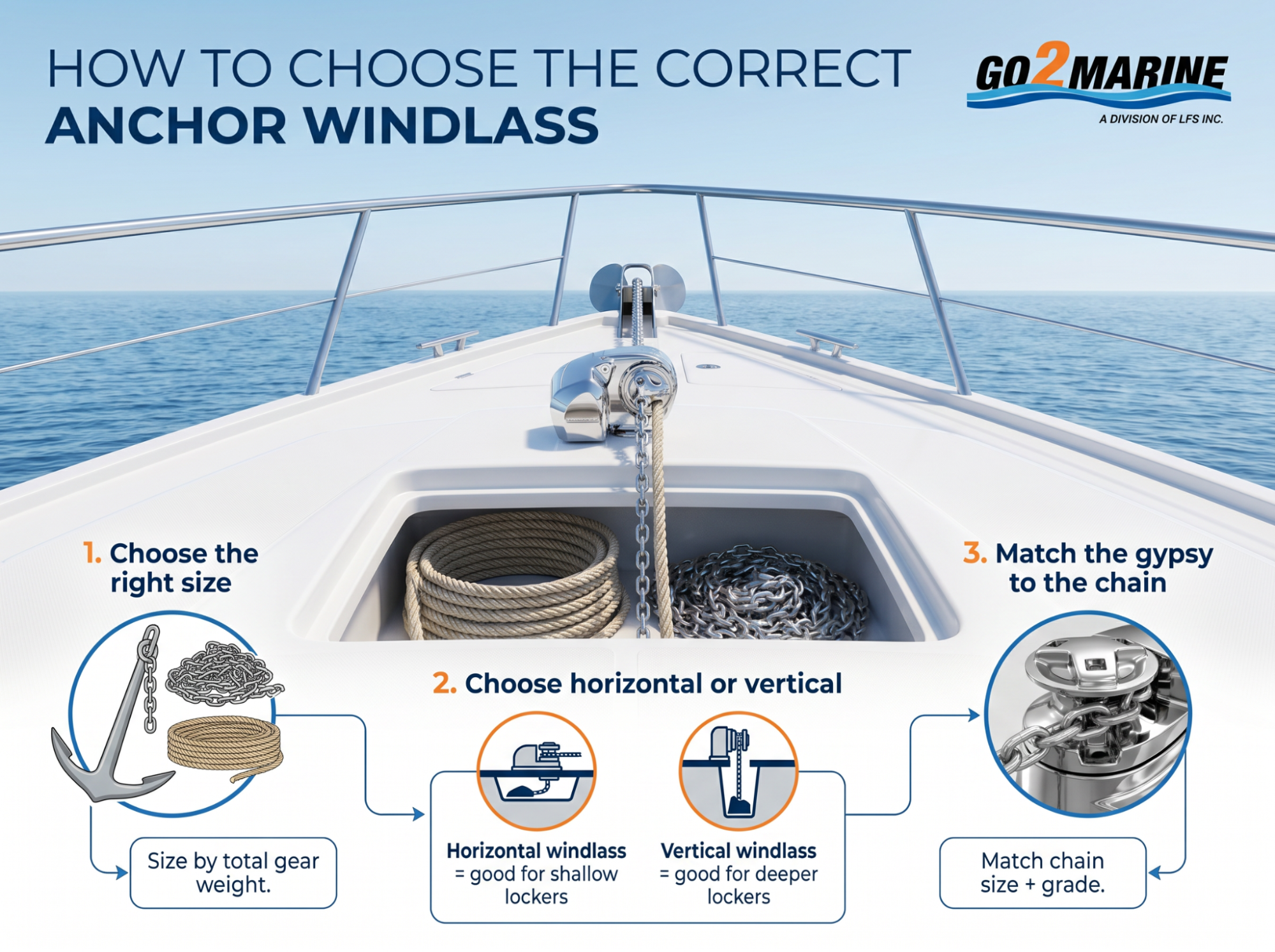
Size an anchor windlass by the weight of your gear. Add up the weight of your anchor, chain, and rope. That total should be less than the windlass's maximum working load. As a second check, multiply that total by three, and the result should be less than the windlass's maximum pull. For a 32 to 38 foot boat, this usually points to a windlass with a 600 to 700 lb maximum working load. Then match the gypsy (the toothed wheel that grips the chain) to your chain's size and grade. That last step is the one most people miss.
A windlass is one of the best upgrades on any boat that anchors often. Even a modest length of chain gets hard to haul by hand over time. This guide covers how to size the windlass, how to choose between horizontal and vertical, how to match the gypsy to your chain, how to set up your rode, and how to wire, install, and maintain the windlass so it deploys and retrieves at the push of a button for years.
How do I size an anchor windlass?

Two numbers on a windlass matter: maximum working load (what it pulls all day) and maximum pull (its short peak). Size against both:
-
Add your gear weight. Total the weight of your anchor, all your chain, and your rope. This number must be less than the maximum working load.
-
Do the ×3 check. Multiply that total by three. The result should be less than the maximum pull. This gives you a safe margin for a set anchor and a loaded boat pulling against it.
-
Size up if you cruise or anchor a lot. Going one size larger is advice you'll never regret. The windlass lasts longer and hauls faster.
For a 32 to 38 foot boat, a 600 to 700 lb working load windlass is usually the right pick. Larger, heavier boats with more chain step up from there. The other things to weigh are the boat's weight, how much wind it catches, the anchor size, and the rope-and-chain setup, plus your locker space and drop depth.
|
Boat length |
Typical max working load |
Common electric windlass class |
|---|---|---|
|
20–30 ft |
about 250–500 lb |
Compact horizontal, gypsy-only |
|
32–38 ft |
600–700 lb |
Mid-size horizontal or vertical |
|
40–45 ft |
900 lb and up |
Larger horizontal/vertical, higher power |
Key takeaway: Total your gear weight (keep it under the max working load), multiply by three (keep it under the max pull), and size up if you anchor often. A 32 to 38 ft boat usually wants a 600 to 700 lb working-load windlass.
Electric, manual, or hydraulic?
Almost all boat windlasses are electric, for good reason:
-
Electric windlasses are the most popular and come in the most setups ,vertical or horizontal, with a motor enclosed on deck or mounted below deck. They need enough charging power to keep the batteries up, and most have a manual backup so you can haul the anchor if the power fails.
-
Manual windlasses suit smaller boats, or boats that don't have the electrical power for an electric one. Most have a drum on one side and a gypsy on the other, and you work them with a lever.
-
Hydraulic windlasses are rare on private boats. They're for large vessels with heavy gear, where their low failure rate is worth the extra complexity.
Horizontal or vertical windlass ,which do I need?
The choice is mostly about your deck and locker, not personal taste:
|
Type |
How it works |
Best when |
Drop needed |
|---|---|---|---|
|
Horizontal |
Motor and gears sit above deck; the rope/chain makes a 90° turn into the locker |
Shallow or oddly shaped lockers; easy to reach and service |
At least about 12″ (30 cm) |
|
Vertical |
Motor sits below deck; the rope/chain wraps 180° around the gypsy before dropping in |
Deeper lockers; a cleaner deck; extra grip from the deeper wrap |
At least about 16″ (40 cm) |

A horizontal windlass keeps everything above deck, so it's the easiest to fit and service and works fine with small or odd lockers. The rope and chain turn 90° off the gypsy and drop in. A vertical windlass puts the motor below deck for a cleaner look and wraps the rope and chain 180° around the gypsy for extra grip before it drops. Either way, the key number is drop depth, the distance from the underside of the deck to the top of the piled-up rope and chain when it's all stowed. Too little drop and the chain won't feed into the locker under its own weight, and you'll end up flaking it by hand.
Key takeaway: Choose horizontal for shallow or odd lockers and easy service (needs about 12″ of drop). Choose vertical for deeper lockers and a cleaner deck (needs about 16″). Check your locker's drop depth before you buy.
How do I match the gypsy to my chain?
This is the step people get wrong most often. The gypsy (also called the wildcat) is the toothed wheel that grips the chain links, and it must match your chain's size *and* grade ,not just the width. Two chains that look the same size but are a different grade have slightly different link shapes, and that small difference is enough to make the chain skip, jump the teeth, or wear out the gypsy.
In plain terms, a gypsy cut for HT/G4 chain (high-tensile, also labeled G40 or G43, which all work the same) usually will not run BBB or proof-coil chain of the same width, and the other way around too. Most new windlasses are built for HT/G4 chain, which is now the standard, but always check the windlass's own spec. A handy trick many boaters use: buy one foot of the chain you're thinking about and see how it seats in the gypsy before you buy a full length. When in doubt, use only the type and size of chain the maker lists. This is not the place to guess. Matching chain from the anchor chain collection to your gypsy's spec avoids the skipping that comes with a mismatch.
Key takeaway: The gypsy must match your chain's size and grade. An HT/G4 gypsy won't reliably run the same width BBB chain. Test fit a foot of chain, or follow the maker's chain spec exactly.
All chain or a rope and chain rode?
Your rode is the rope and chain that connect the boat to the anchor, and how you build it affects the windlass you choose. An all chain rode is strong, resists chafe on rocky or coral bottoms, and its weight helps the anchor hold, but it's heavy and needs a windlass with a chain only gypsy. A rope and chain rode ,a length of chain at the anchor spliced to nylon rope is lighter, cheaper, and gentler on a small boat's bow, and it needs a windlass with a combination gypsy that handles both. Whichever you choose, put out enough rode: a common rule is about seven times the water depth in normal conditions, and more when it's rough. Make sure your locker can hold and stack that much rode with the drop depth to match.
How do I wire and install a windlass?
A windlass pulls a lot of current, so wiring and mounting matter as much as the unit itself. Use the cable size the maker specifies for your run length to avoid power loss that slows the motor; long runs from a stern battery to a bow windlass need heavy cable or a dedicated bow battery. Protect the circuit with the right breaker or fuse and a solenoid, and add a clearly marked isolator so you can cut power at the helm. The deck under the windlass must be strong: back the bolts with a solid plate to spread the load, and bed everything well so no water gets into the core. Give the motor room below deck and keep it clear of the piled rode. A clean install is what makes a windlass reliable at 2 a.m. in a blow.
How do I protect and maintain my windlass?

A windlass is built to raise and lower the anchor, not to hold the boat's weight while you're anchored. Once the anchor is set, move the load onto a chain stopper or a cleat with a snubber, so the windlass isn't taking the pull of the boat in wind and current. This one habit adds a lot of life to the gypsy and gears. Beyond that, rinse the windlass with fresh water after use to wash off salt, and give it a quick look each season: check the clutch or cone brake, keep the moving parts lightly greased per the maker's guide, and test the manual backup so you know it works before you need it. Controls like a foot switch, a wireless remote, or a chain counter make daily use easier and are worth adding while you install. It also pays to keep a few spares aboard: a spare solenoid and a set of contacts are cheap, and a windlass that won't run is often just a tripped breaker or a corroded connection rather than a failed motor, so check the simple things first.
How do I anchor with a windlass, step by step?
Used right, a windlass makes short-handed anchoring easy and safe. A simple routine:
-
Motor slowly toward your spot and stop the boat over it. Don't use the windlass to drag the boat around.
-
Lower the anchor under control with the down switch until it reaches the bottom, then pay out rode as the boat drifts back.
-
Let out enough scope ,about seven times the water depth in normal conditions ,then snub the load onto a chain stopper or cleat so the windlass isn't holding the boat.
-
Set the anchor by backing down gently on the engine until it digs in and holds.
-
To weigh anchor, motor slowly forward while you take up the slack with the up switch, so the windlass lifts the rode, not the whole boat.
Keep fingers, toes, and loose clothing well clear of the moving gypsy, and use the windlass in short bursts rather than one long pull. A chain counter or a wireless remote makes the job easier still, letting you watch the bow while you control the rode.
Choosing your anchor windlass
The full path, start to finish:
|
Step |
Decision |
Guidance |
|---|---|---|
|
1. Sizing |
Working load and pull |
Gear weight < max working load; ×3 < max pull; 600–700 lb for 32–38 ft |
|
2. Power |
Electric / manual / hydraulic |
Electric for most; manual for small or low-power boats |
|
3. Orientation |
Horizontal or vertical |
Locker shape and drop depth (12″ vs 16″) |
|
4. Gypsy & rode |
Match to chain; all-chain vs rope-and-chain |
Size and grade (HT/G4 vs BBB); combination gypsy for rope-and-chain |
|
5. Install |
Load, wiring, controls |
Chain stopper for the load; right-size wire, breaker, and backing plate |
Go2marine carries windlasses and parts from Lewmar, Quick, Maxwell, Lofrans, Vetus, and Powerwinch, including the Lewmar Pro-Series and Pro-Fish horizontal electric windlasses (316 stainless, for boats about 20 to 45 ft) and Lofrans horizontal units in 500W and 800W, plus solenoids, foot switches, remotes, and spare gypsies.
Check one link before you shop
Do the weight math, check your locker's drop depth, then read your chain's size and grade off the link (it's stamped right on the chain) before you open the windlasses and parts collection. That last detail, size and grade, is what makes the gypsy grip instead of skip, so have it in front of you when you choose. Not sure if your chain is HT/G4 or BBB? Read us the stamp on the link and we'll match the gypsy for you. It's the difference between a windlass you trust at 2 a.m. in a blow and one you end up fighting. When you're ready, the Lewmar collection is a builder-favorite place to start.