
Introduction
Worn boat trailer rollers are easy to ignore until they crack, flat-spot, or seize, and then they stop supporting the hull and start scuffing your gelcoat on every launch and retrieve. Rollers are wear items: sunlight, salt, and the weight of the boat slowly break them down, so most trailer-boaters handle a boat trailer roller replacement every season or two. The good news is that this is one of the most beginner-friendly jobs on a trailer. Once you can identify the roller type, measure for the right size, and turn a wrench, you can swap rollers in an afternoon. This guide covers the roller types, how to tell when they are worn, rubber versus polyurethane materials, how to size a replacement, and a step-by-step install, with the right boat trailer rollers and guides linked throughout.
What Does a Boat Trailer Roller Do?

A boat trailer roller supports and guides the hull so the boat rolls on and off the trailer smoothly and sits centered and protected while towing. Keel rollers down the centerline carry most of the weight on the strongest part of the hull, side rollers cradle the hull and help it self-center, and bow and guide-on rollers line the boat up as you load. When rollers are in good shape, launching and retrieving is a controlled, low-effort process. When they are worn, the hull drags, sits off-center, and can take damage. Each roller turns on a shaft held by a roller bracket, so a complete repair sometimes means replacing the shaft and bracket along with the roller.
What Are the Types of Boat Trailer Rollers?
Most trailers use a few roller types, each doing a specific job. Identifying yours is the first step before you measure or buy.
Keel rollers

The boat trailer keel roller sits on the trailer centerline and carries the hull weight along the keel, the strongest part of the boat. Keel rollers come as smooth barrels or as spool-type rollers with flared ends, and they are usually the first rollers to wear because they carry the most load.
Side and wobble rollers

Boat trailer side rollers, also called wobble rollers, sit outboard of the centerline, cradle the hull sides, and help the boat self-center as you load. Side guide rollers mount on swivel brackets so they follow the curve of the hull.
Self-centering and V rollers

Near the bow, a V-shaped keel roller cradles and centers the keel as the boat comes onto the trailer, guiding it straight so it seats the same way every time.
Guide-on rollers
At the rear, tall guide-on posts or roller guide kits give you a visual target and help you line the boat up when loading in wind or current. Boat trailer guide rollers are not load-bearing, but they make solo loading far easier.
How Do You Know When to Replace Boat Trailer Rollers?
Replace a boat trailer roller when it is cracked, flat-spotted, no longer round, seized on its shaft, or leaving marks on the hull. The quickest way to check is a slow walk around the trailer with the boat off, spinning each roller by hand and looking for problems.
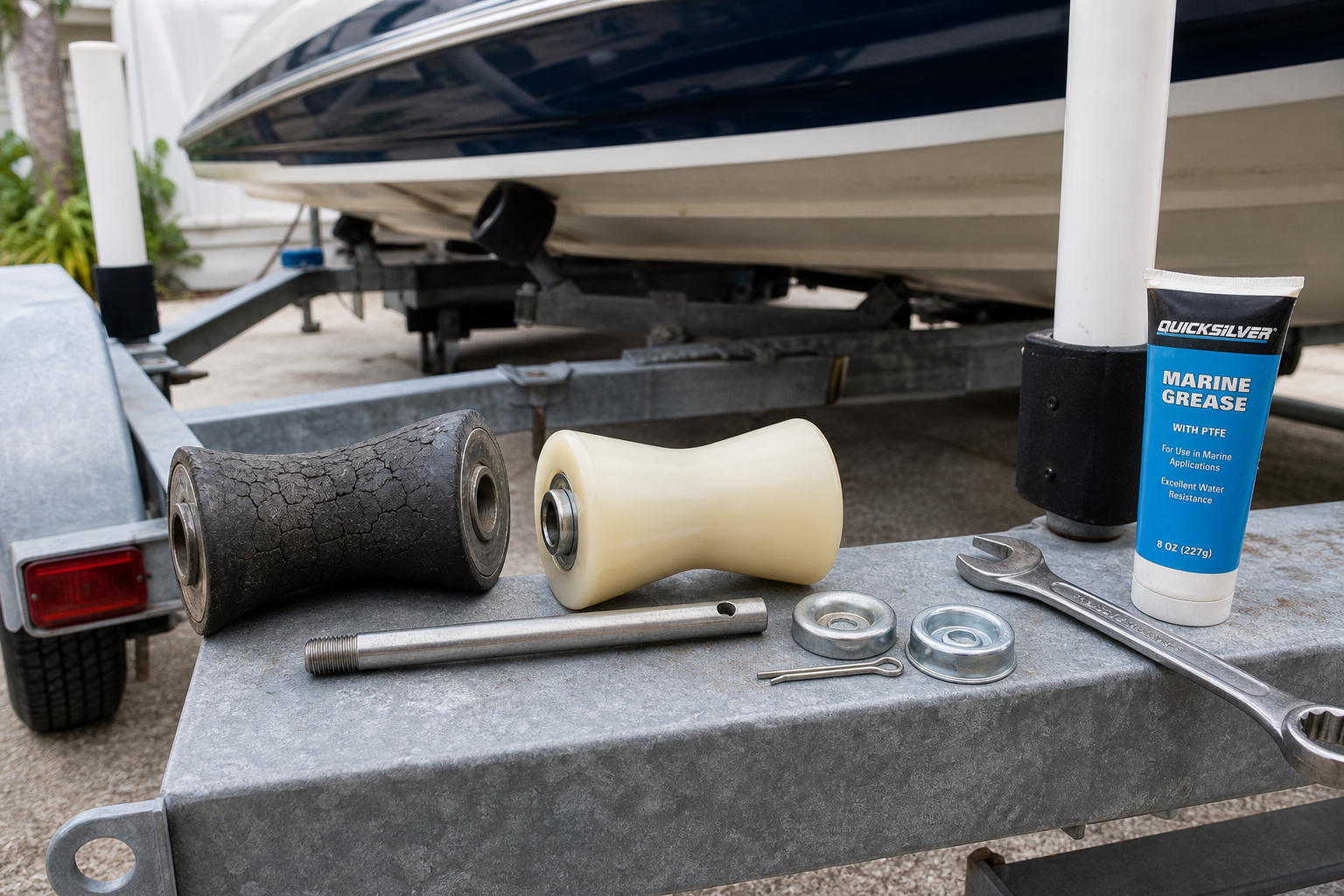
A roller that will not spin freely usually has a seized bushing or a rusted shaft, so free it up or replace the roller and shaft and grease it on reassembly. A flat spot or an out-of-round roller, often from the boat sitting in one place too long, should be replaced because it drags instead of turning. Cracks or missing chunks mean the material has broken down from UV and age, so replace it. Black streaks on the hull point to rubber rollers marking the gelcoat, which is solved by switching to non-marking poly rollers. If the hull sits off-center, the side rollers are usually worn or collapsed and need replacing and realigning. When several rollers are worn, it is worth doing them all at once, because they age together and a fresh set restores smooth, even support across the trailer.
Roller Trailer vs Bunk Trailer: Which Is Better?
Rollers and bunks both support a hull, but they suit different situations, and many trailers use a mix of the two. A roller trailer lets you launch and load in shallow water with little or no dunking of the trailer, and guide rollers help the boat self-center, which is why rollers are popular where ramps are steep or shallow and where you launch often.
A bunk trailer supports the hull on carpeted boards that run under it, spreading the load over a wider area and tending to be gentler during long tows, but it usually needs the trailer backed deeper to float the boat off. Maintenance differs too: with rollers you replace the rollers as they wear, while with bunks you replace carpet and check the boards. There is no single winner. Choose rollers for easy shallow-ramp launching and frequent use, bunks for gentle support on long hauls, or a combination that gives you both. Boat trailer bunk rollers, which add a roller to a mostly bunk setup, are a common middle ground.
Rubber vs Polyurethane Trailer Rollers: Which Material?
The choice between rubber vs polyurethane trailer rollers comes down to cost, durability, and whether they mark the hull. Rubber rollers are economical and widely available, but darker rubber can leave black streaks on a light gelcoat, and rubber tends to break down faster in sun and salt. Poly and polyurethane rollers cost more, but they are non-marking, hold their shape, and generally last longer, which is why many owners switch to them when they re-roller a trailer. Go2Marine carries both rubber keel and side rollers and durable poly rollers, so you can match your budget and your hull. If your current rubber rollers are streaking a light hull, moving to non-marking poly is the simplest fix.
What Size Boat Trailer Roller Do You Need?
The right size is the one that matches your old roller and shaft, so measure before you buy. Three numbers define a roller: its length, which is the face width; its outer diameter; and its bore, which is the shaft hole through the center. You also need the shaft diameter and the bracket bolt spacing so the new roller and hardware fit your trailer.
There is no universal trailer roller size chart that fits every trailer, so measure your own. Take the boat off the trailer or support its weight, then measure each worn roller before removing it. Common trailer roller shafts are 1/2 inch and 5/8 inch, and keel roller lengths are often 8, 10, or 12 inches, but yours may differ. Note the shaft diameter, the roller bore, the length, and the bracket bolt spacing, then match a replacement to those numbers, replacing the roller shaft and end caps if they are worn. When in doubt, bring the old roller and shaft to compare.
How to Replace a Boat Trailer Roller, Step by Step
Here is how to replace boat trailer rollers safely in an afternoon. First, gather your tools and a matching roller.

-
Socket or wrench set and pliers
-
Penetrating oil for rusted hardware
-
Jack and jack stands, plus wheel chocks
-
Matching replacement trailer rollers, and new shafts, cotter pins or lock nuts, and end caps as needed
-
Gloves and eye protection, plus marine grease for reassembly
- Secure the trailer. Park on firm, level ground, chock the wheels, and support the trailer weight on jack stands. Where possible, take the boat off first; if not, support the hull so the roller you are working on is unloaded.
- Identify and measure. Note the roller type, its length, outer diameter, and bore, and the shaft diameter, so the replacement matches.
- Free the shaft. Remove the cotter pin or lock nut from one end of the roller shaft. Spray rusted hardware with penetrating oil and give it time to work.
- Slide out the shaft. Support the roller, then slide the shaft out of the bracket and roller, keeping any spacers or end caps in order.
- Fit the new roller. Slide the new roller, with fresh end caps if needed, onto the shaft, then guide the shaft back through the bracket and roller.
- Reinstall the hardware. Fit a new cotter pin or lock nut, and confirm the roller spins freely without excessive side play. A touch of marine grease on the shaft helps it turn and resist rust.
- Repeat and align. Work down the trailer, replacing worn rollers. Keep keel rollers centered on the keel line and side rollers set so the hull sits straight and level.
- Test load. Load the boat, check that it sits centered and fully supported, and re-check the new hardware after the first launch and the first tow.
If a bracket is bent or badly corroded, replace it too, because a roller is only as good as the bracket and shaft that hold it.
How Do You Keep Trailer Rollers From Marking the Hull?
To stop rollers from marking the hull, use non-marking poly rollers, keep them clean, and avoid leaving the boat parked on one spot for months. Black streaks usually come from rubber rollers, so switching to poly is the most direct cure. Beyond that, rinse the trailer after saltwater use, keep shafts and brackets free of heavy rust, and replace flat-spotted rollers promptly so the hull rides on round, freely turning supports. A quick seasonal check of the rollers, the trailer winch, and the rest of your trailering gear keeps small problems from becoming launch-day surprises. If you are servicing the boat for the season, our boat propeller fit guide is a useful companion read.
How Do You Choose the Right Boat Trailer Rollers?
Choose rollers by location, size, and material: match the roller type to where it sits on the trailer, match the size to your old roller and shaft, and choose rubber for budget or poly for a non-marking, longer-lasting set. For most owners the simplest path is a like-for-like swap in a better material, plus fresh shafts and end caps where the old ones are worn.
Boaters who normally shop stores like West Marine will find the same trailer parts here, including Tie Down Engineering rollers and hardware, so Go2Marine is a straightforward alternative to West Marine for trailer maintenance. If you have been comparing West Marine boat trailer rollers, you can match the type and size here, find your replacement boat part, and buy boat trailer rollers online instead of driving store to store. Worn rollers, shafts, and end caps are the West Marine replacement parts trailer-boaters reorder most, you can compare marine supplies online, and orders ship so you get boat parts delivered fast before launch season.
Replacing Trailer Rollers: The Short Version
Boat trailer rollers are simple, inexpensive parts that do an important job, supporting and guiding your hull every time you launch and retrieve. Replace them when they crack, flat-spot, seize, or start marking the hull. Identify the roller type by where it sits, measure the length, outer diameter, and bore so the replacement fits, and choose rubber for budget or non-marking poly for durability. The install is straightforward: support the trailer, slide out the shaft, swap the roller, reinstall the hardware, and keep keel rollers aligned to the keel. Do it before launch season and every trip on and off the trailer stays smooth.
Shop boat trailer rollers, guides, and hardware at Go2Marine →