
Let's be honest, most boaters don't think about their steering system until it starts fighting back.
You're running at full throttle, and the wheel suddenly feels heavy. You're holding a turn, and your arms are working harder than they should. You come back to the dock after a long day on the water, and your forearms are sore. Sound familiar?
If any of that rings a bell, there's a chance your steering system is the problem, and upgrading to a hydraulic system for your outboard motor is one of the best things you can do for your boat.
This guide will walk you through everything: what hydraulic steering actually is, the clear signs it's time to upgrade, and how to pick the right system for your engine and boat without second-guessing yourself.
So, What Exactly Is a Hydraulic Steering System?
With a standard mechanical cable system, there's a physical cable running from your steering wheel all the way to your outboard. When you turn the wheel, you're literally pulling and pushing that cable to move the engine. It works, but it also means every bit of resistance and vibration from the motor comes right back to your hands.
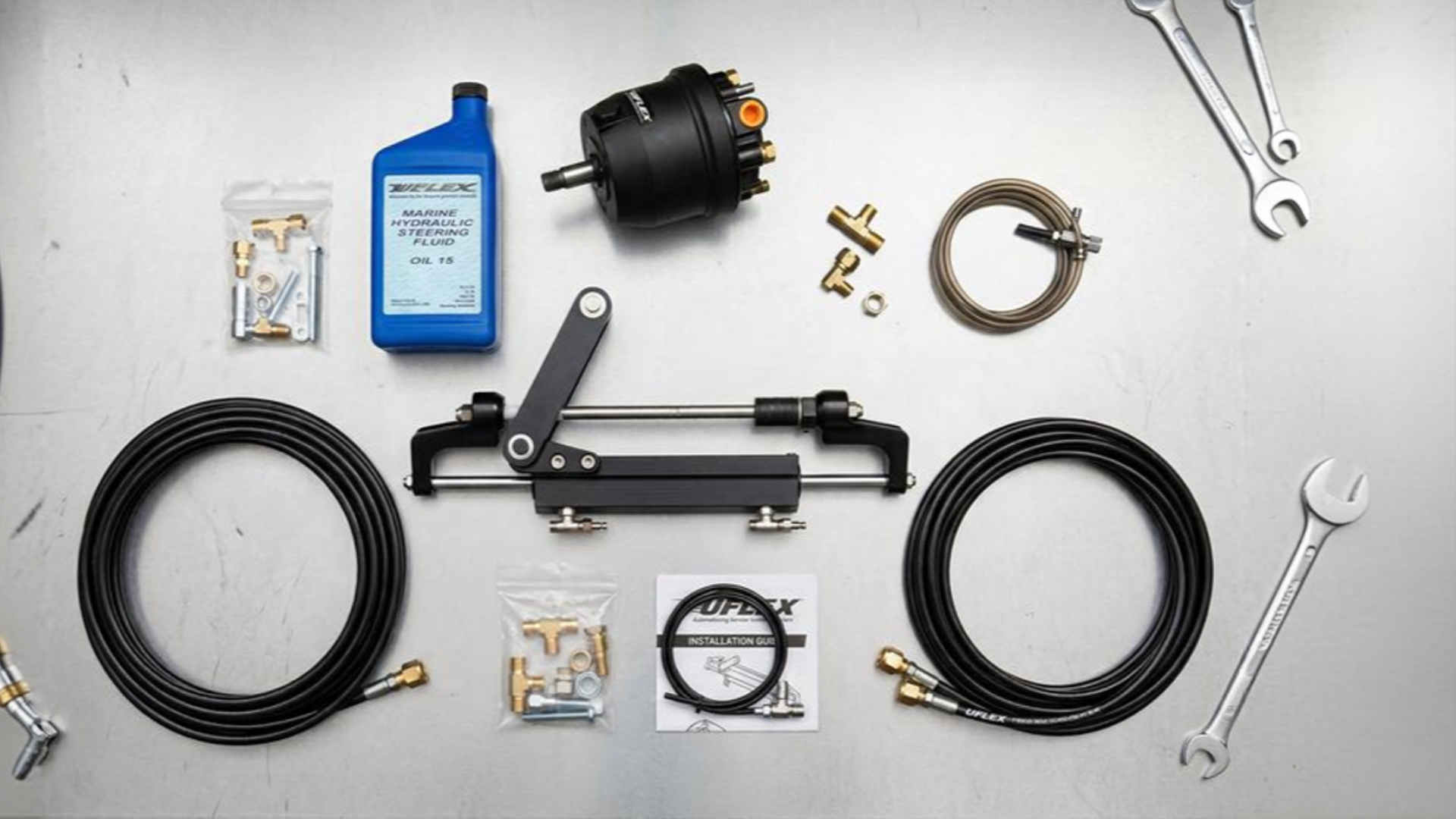
A hydraulic system cuts that direct connection. Instead of a cable, you have a helm pump at the wheel (with a small fluid reservoir inside it), two hoses running to the transom, and a cylinder connected to your outboard. Turn the wheel, and the pump pushes hydraulic fluid through the hoses to move the cylinder. The engine steers, but none of the torque or feedback travels back to you. The result is steering that feels genuinely effortless.
Every complete hydraulic steering kit includes four things:
-
A helm pump (sits at the dash, holds the fluid reservoir)
-
A hydraulic cylinder (bolts to your outboard)
-
Hoses or tubing connecting the two
-
Hydraulic fluid (always use the brand-specific fluid, more on that later)
Hydraulic vs. Mechanical Steering: What's the Real Difference?
Before deciding on an outboard hydraulic steering system, it helps to understand what you’re replacing.
A mechanical steering setup uses a physical push-pull cable that runs from your helm to the engine. When you turn the wheel, you’re directly moving that cable. The downside is that every bit of propeller torque, vibration, and engine resistance transfers straight back to your hands. As horsepower and speed increase, steering effort increases with it.
Hydraulic steering removes that direct mechanical connection. Instead of a cable, a helm pump pushes hydraulic fluid through hoses to a cylinder mounted on the outboard. The fluid absorbs torque feedback, which keeps the wheel steady and dramatically reduces steering effort, especially at higher speeds or with larger engines.
If you want a deeper technical breakdown of how these two systems compare side-by-side, including load handling, maintenance differences, and long-term durability, read our complete guide to hydraulic vs. mechanical boat steering systems.
For this guide, the key takeaway is simple: once horsepower climbs, steering loads increase quickly, and hydraulic systems are designed specifically to manage that torque safely and consistently.
When Should You Actually Make the Switch?
Here's the honest answer: not every boater needs hydraulic steering. But there are some really clear situations where making the switch is a no-brainer.
1. Your Engine is 150 HP or Above
This is the big one. At 150 HP and above, modern four-stroke outboards produce a lot of propeller torque, a sideways rotational force that goes straight to your steering wheel through a cable system. The heavier the engine and the higher the RPMs, the worse it gets.
Hydraulic steering acts as a barrier between all that torque and your hands. You can punch the throttle out of a turn and the wheel doesn't move an inch on its own. That's not just comfort, it's real safety, especially offshore or in rough chop.
Quick Rule: Under 150 HP, a quality cable system is usually fine. At 150 HP and above, hydraulic is strongly recommended. At 200+ HP on a performance boat, it's really the only sensible choice.
2. You Just Repowered to a Bigger Engine
This is one of the most common situations we hear about. You upgraded from a 115 to a 175 HP four-stroke; the boat feels incredible, but now the steering is heavy, and you're constantly fighting the wheel. That's not a coincidence.
Your old cable system was built for the torque loads of a smaller engine. It's now being asked to do a job it wasn't designed for. Anytime you step up in horsepower significantly, your steering system should be part of the conversation.
3. Your Current Cable Is Worn Out

Cables don't last forever. Salt exposure, UV, and years of flexing all take a toll. If you notice any of these signs, your cable is trying to tell you something:
-
Steering feels noticeably stiffer than it used to be
-
There are stiff spots or catches at certain points in the turn
-
The wheel doesn't come back to the center on its own anymore
-
You can see corrosion at the helm connection or where the cable exits the transom
-
You're regularly using two hands just to hold a straight course
When a cable wears out, most boaters replace it with another cable. But this is also the perfect time to just go hydraulic. The installation effort is similar, and you end up with a system that will genuinely last decades with basic care.
4. You Run a Bass Boat, Flats Boat, or Tournament-Style Fishing Boat
These boats live in some of the most demanding steering conditions in recreational boating. You're running high-performance outboards at elevated prop heights (often on a jackplate), operating at high speeds, and making aggressive maneuvers. A standard hydraulic kit isn't always enough here.

For these applications, you need something like the Uflex SilverSteer XP1 or the SeaStar PRO system, both of which are specifically built for extreme rudder torque loads at speeds over 65 MPH. The SeaStar PRO has been the choice of the Bassmaster Classic since 1994, which tells you something about its reputation in the performance world.
5. You're Running Twin or Triple Outboards
Multi-engine setups multiply the steering loads significantly. They also need coordinated steering across both engines, which is mechanically awkward for cable systems. Hydraulic setups with tie-bar cylinders are purpose-built for twin and triple configurations. If you're running twins, this conversation starts and ends with hydraulic.
6. You Want to Add an Autopilot
Here's something a lot of boaters don't know: autopilots need a balanced hydraulic cylinder to work properly. A balanced cylinder uses the same amount of fluid to turn port and starboard, so the autopilot can make equal corrections in both directions.
Most current hydraulic kits use balanced cylinders. But some older BayStar systems (specifically the HK4200 and HK4230 kits) do not, and those can't be connected to an autopilot. If you're planning on adding an autopilot now or down the road, just double-check your cylinder type before buying.
What to Think About Before You Buy
Choosing a hydraulic steering kit isn't complicated, but there are a few things worth getting right the first time.
Always Size Up on Horsepower Rating
Every hydraulic steering kit includes a maximum horsepower rating, but that number represents the upper operating limit rather than the ideal sizing point. Selecting a system with some capacity above your engine’s rated horsepower can provide a more comfortable steering feel and improved durability over time. In real-world conditions, factors like hull design, propeller setup, engine weight, and elevated mounting heights can generate steering loads that approach or occasionally exceed published specifications, so allowing a margin helps ensure consistent performance and longevity.
Your Boat Type Matters as Much as Horsepower
Two boats with the same size engine can put very different loads on a steering system. A pontoon running a 115 HP four-stroke at normal prop height puts relatively low steering loads on the system. A bass boat running 150 HP on a raised jackplate puts more load dramatically on it, because the elevated prop height amplifies the side forces on the cylinder.
This is why you'll see systems specifically called out for "pontoons" or "bass boats"; it's not marketing speak, it's an important distinction.
Make Sure the Cylinder Fits Your Specific Engine
Hydraulic cylinders are not universal. The cylinder has to match your engine brand, model, and year. For example:

The Uflex Hyco 1.1 kit comes in two versions: HYCO-1 for most engines, and HYCO-3 specifically for Honda BF115/BF130 and Mercury Optimax 75/90/115 models.
The Uflex UC128-OBF cylinder (used in the Protech kit) has a detailed fitment guide covering Evinrude, Yamaha, Suzuki, Mercury, Tohatsu, and Johnson models across dozens of year ranges. Always match your exact engine before ordering the team. Go2marine can help you confirm fitment before you buy.
Balanced Cylinder = Autopilot Compatible
If an autopilot is anywhere in your future, make sure you pick a system with a balanced cylinder. The good news is that most current systems are balanced:
Both the SeaStar HC5345 cylinder and the Uflex UC128-OBF cylinder are balanced, meaning they're autopilot-ready out of the box.
Tubing vs. Braided Hose
Most entry-level kits include rigid nylon tubing to connect the helm to the cylinder. It works fine, but a lot of boaters who switch to braided hydraulic hoses report that the steering feels noticeably lighter. Some estimate around 20% less wheel effort. The fittings use the same thread size, so it's an easy upgrade if you want it.
Do You Need Power Assist?
Standard hydraulic steering is unpowered; the force comes entirely from you. For most single-engine boats up to around 250–300 HP, that's plenty. But for big engines, twin setups, pontoons, catamarans, or any setup where even hydraulic steering feels heavy, power assist is worth looking at.
A power assist system adds an electronically-controlled pump that kicks in when you turn the wheel, basically giving your boat power steering like a car. The Uflex MasterDrive™ Tilt Power Assist Kit is another strong option for demanding twin-engine or heavy outboard applications.
If you don't want to go full hydraulic but still want easier steering, Dometic also makes the Xtreme Power Assist (XPA), an electric power assist that bolts onto your existing cable system and works on single engines from 90-200 HP.
Which System Is Right for Your Boat? A Quick Reference
Here's a simple guide to help match the right system to your situation. All of these are available at Go2Marine.
|
System |
Best Application |
HP Range |
Go2Marine Link |
|---|---|---|---|
|
Uflex GoTech 10 |
Pontoon boats, moderate 4-stroke torque |
Up to 115 HP |
|
|
BayStar Plus |
Runabouts and inflatables |
Up to 150 HP |
|
|
Uflex Hyco 1.1 |
General outboard use, easy DIY install |
Up to 150 HP |
|
|
Uflex Protech |
Center consoles, cruisers, offshore |
Up to 300 HP |
|
|
SeaStar 1.7 Cylinder |
Center consoles, offshore, twin engine |
Up to 300 HP (600 HP total) |
|
|
SeaStar PRO |
Bass boats, high-speed boats (65+ MPH) |
Up to 350 HP |
|
|
SilverSteer XP1 |
Flats & tournament boats, extreme torque |
150 – 300+ HP |
Replacing an Old Hynautic System?
If your boat has an older Hynautic hydraulic system, you should know that the Hynautic line has been discontinued, and parts are getting very hard to find. The good news is that modern systems are designed to replace them.
The SeaStar HC5345 cylinder has a Hynautic-specific version (HC5345HY) with compatible fittings to make the crossover cleaner. The Uflex UC128-OBF cylinder also cross-references to Hynautic HC5345 and HC5347.
Keeping Your Hydraulic System Healthy
Hydraulic steering is much lower maintenance than cable steering; there's no cable to lubricate or replace. But it does need a little attention:
-
Check the fluid level at the helm pump periodically. If it's dropping, you may have a slow leak somewhere.
-
Use only the right fluid for your system. SeaStar hydraulic steering fluid is formulated specifically for SeaStar and BayStar systems. Using the wrong oil can damage your seals and void the warranty.
-
If your steering feels soft or spongy, there's likely air in the lines. Bleeding the system will fix it.
-
Check hose connections, the cylinder, and the helm pump for any signs of leaks or corrosion before the start of each season.
-
If you remove any cylinder hardware for service, re-torque everything to spec, especially the nylock nuts securing the cylinder.
Ready to Upgrade? Shop Hydraulic Steering at Go2Marine
Whether you're upgrading from a worn-out cable, stepping up to a bigger engine, or building out a tournament-ready bass boat, Go2Marine has you covered.
We carry the full range of hydraulic steering kits and components from Dometic (SeaStar/BayStar), Uflex, and other trusted brands, including complete helm pumps, engine-specific cylinders, hose kits, power assist systems, and hydraulic fluids.
Browse the full hydraulic steering catalog at go2marine.com