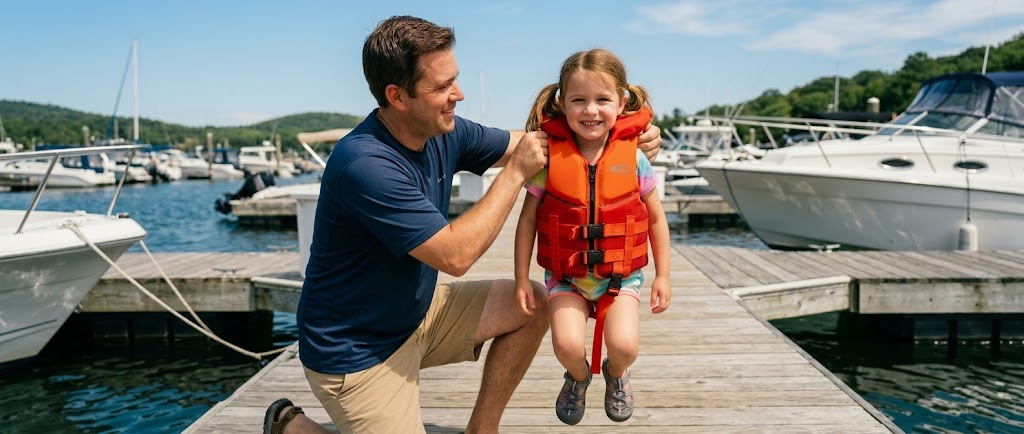
You need one Coast Guard approved life jacket in the right size for every person aboard, plus one throwable device, such as a ring or a cushion, if your boat is 16 feet or longer. Children under 13 must wear theirs whenever the boat is underway, unless they are below deck or in an enclosed cabin. Before you buy, check the label for an approval number, a size range, and any "must be worn" condition, because a jacket that fails those checks does not count.
This guide covers what the law requires, how to choose between foam, inflatable, and dual flotation jackets, how to confirm a label is real, how to fit each person, and how to count what your boat needs. It ends with the mistakes we see most often.
What does the law require me to carry?
Federal rules in 33 CFR Part 175 require one wearable, approved life jacket for each person on a recreational boat. Each jacket must be in serviceable condition, the correct size for its wearer, and used the way its label says. Wearable jackets must be readily accessible and a throwable must be immediately available, so keep both where someone can reach them in seconds, not buried in a locker.
Two details catch people out. Many inflatables count toward the requirement only while you are wearing them, so an inflatable stowed in a locker does not satisfy the rule. And state law can add to the federal rules, for example by setting a different age for mandatory wear by children. Where a state rule is stricter, follow it.
Key takeaway: Count one approved wearable jacket per person, add one throwable at 16 feet or longer, and read the label on every jacket, because the label sets the conditions that make it count.
Should I choose a foam, inflatable, or dual flotation life jacket?

Pick the style first, because the best jacket is the one a person will actually keep on.
|
Style |
How it floats |
Best for |
Watch out for |
|
Foam |
Foam panels give permanent flotation with nothing to service |
Everyday boating, kids, and non-swimmers |
Bulk and heat on summer days |
|
Inflatable |
A bladder inflates from a CO2 cylinder |
All-day wear while fishing, cruising, or working |
Must be worn to count, needs re-arming, and the label may limit age and weight |
|
Dual flotation |
A foam core plus an inflation chamber |
Boaters who want built-in float with less bulk |
Costs more than plain foam |
Inflatables also differ in how they fire. A manual model inflates when you pull the cord. An automatic model uses a bobbin that dissolves when it gets wet. A hydrostatic model fires only under water pressure a few inches below the surface, so rain and spray rarely set it off, and the Mustang Survival HIT inflatable PFD is built that way. Our side-by-side on how automatic, manual, and hydrostatic inflation compare explains when each one makes sense.
Key takeaway: Choose foam when reliability and cost matter most, inflatable when comfort decides whether the jacket gets worn, and automatic or hydrostatic inflation when a fall could leave you unable to pull a cord.
How do I know a life jacket is really Coast Guard approved?
Counterfeit and non-approved vests show up on general marketplaces, so read the label before you trust a jacket. Look for four things:
-
An approval statement and number. The label should say the device is approved by the U.S. Coast Guard and show an approval number. No number means no approval.
-
A size or weight range. Adult jackets are sized by chest measurement and children's jackets by body weight.
-
The intended use and conditions. This is where an inflatable states that it must be worn to meet carriage requirements, along with any age or weight limits.
-
A label you can read. A faded label means the jacket can no longer be counted as approved.
The Coast Guard's lifejacket rule that took effect on January 6, 2025 moves labels from Type numbers to Performance Levels (50, 70, 100, 150, or 275). The number is the minimum buoyancy in newtons, so a Level 70 gives about 15.7 pounds of buoyancy. Older Type I, II, and III jackets stay legal as long as they are approved and serviceable. Levels do not map one to one onto Types, so read the label rather than assuming. Our guide to how Type and Performance Level labels differ has the full breakdown, and the BoatUS Foundation guide to reading life jacket labels shows what a compliant label looks like.
Key takeaway: A jacket is approved only if its label shows an approval number and stays readable. The Type or Level tells you how much it floats, not whether it is legal.
Which life jacket fits the way I boat?
Start with the activity, then confirm the label allows it.
Fishing and all-day wear. A slim inflatable such as the Onyx A/M-24 manual/automatic inflatable stays out of your way. You can compare more models in recreational inflatable life vests from Mustang Survival and Onyx.
Cold water. A float coat combines a warm jacket with flotation and buys time before hypothermia sets in. If you boat in the Pacific Northwest, the Great Lakes, or the Northeast, look at float coats that add insulation for cold water.
Offshore and rough water. Choose higher-buoyancy designs with a crotch strap, a whistle, reflective tape, and a place to clip a light.
Kids and infants. Children's jackets are sized by weight, in bands of about 8 to 30 pounds for infants, 30 to 50 pounds for children, and 50 to 90 pounds for youth. Look for a grab handle and, for small children, head support and a crotch strap among life vests for kids and infants.
How do I fit a life jacket to each person?

An approved jacket that does not fit can slip off in the water, so fit every person individually. Run this test with each wearer:
-
Fasten every buckle and zipper, then snug all the straps.
-
Have the wearer raise both arms while you pull up on the shoulders. The jacket should not rise past the ears or chin.
-
On a foam vest, check that there is no large gap at the shoulders once the straps are tight.
-
For a child, lift by the shoulders. If the jacket slides toward the chin, it is too big.
-
Confirm the wearer can bend, sit, and breathe easily. A jacket that fights every movement gets taken off.
How many life jackets does my boat need?
Count the most people you have ever carried, not your usual crew. Take a 20 foot center console that fishes with two adults, two children weighing 45 and 65 pounds, and sometimes two guests. That boat needs six wearable jackets: two adult jackets, a child jacket in the 30 to 50 pound band, a youth jacket in the 50 to 90 pound band, and two guest jackets. Add one throwable, for seven items in total. For the guest jackets, a set of Kent Type II adult life jackets with a clear storage bag keeps spares together and easy to grab.
Key takeaway: Buy each jacket by chest measurement or weight, count the largest crew you carry, and add one throwable at 16 feet or longer.
What else belongs with the life jackets?

The throwable is the piece people forget. A throwable life ring or float cushion belongs near the helm, and a Taylor Made life ring station keeps a ring mounted where it can be reached in a second. A whistle lets a person in the water be heard, so clip one to each jacket. A light makes a person findable at night, and the C-Strobe H2O life jacket light activates in water or by hand.
A jacket keeps a person afloat but does not call for help. Pair it with a beacon.
How do I check the life jackets I already own?
A jacket that fails any of these checks no longer counts as serviceable under 33 CFR 175.23 and should be replaced:
-
Foam vests: rips, tears, or open seams, hardened or waterlogged foam, broken buckles or torn straps, or a faded label.
-
Inflatables: a leaking bladder, a blocked oral tube, a missing or damaged pull tab, or a status indicator that is not green.
Inflatables also have wear items, the CO2 cylinder and the bobbin or hydrostatic inflator, that must be replaced on the maker's schedule and after every inflation. A Mustang Survival kit such as the MA4031 re-arm kit for automatic/manual PFDs is one example, and our re-arm kit cross-reference by model helps you order the right parts. Between uses, rinse foam jackets with fresh water and store them where air can move around them rather than crushed under coolers.
Key takeaway: Put the cylinder and inflator dates for every inflatable on your calendar, and check the status indicator at the start of each season.
Common Life Jacket Mistakes to Avoid
-
Buying one adult size for the whole crew. Children's jackets are sized in weight bands such as 30 to 50 pounds, and an adult jacket can slide off a child over the head.
-
Leaving inflatables in a locker. An inflatable that says it must be worn counts only while it is on your body.
-
Skipping the re-arm after an inflation. A jacket with a spent cylinder or bobbin will not inflate the next time you need it.
-
Forgetting the throwable. Boats 16 feet or longer need one in addition to the wearable jackets.
-
Trusting a faded or missing label. Without a readable approval number, treat the jacket as not approved and replace it.
Go2marine carries life jackets and throwables from Mustang Survival, Onyx, Kent, Jim Buoy, and Taylor Made. Not sure which jackets are right for your crew? Contact our team for expert advice. We have been outfitting boaters since 1967. You can shop foam and inflatable life jackets in every size.