
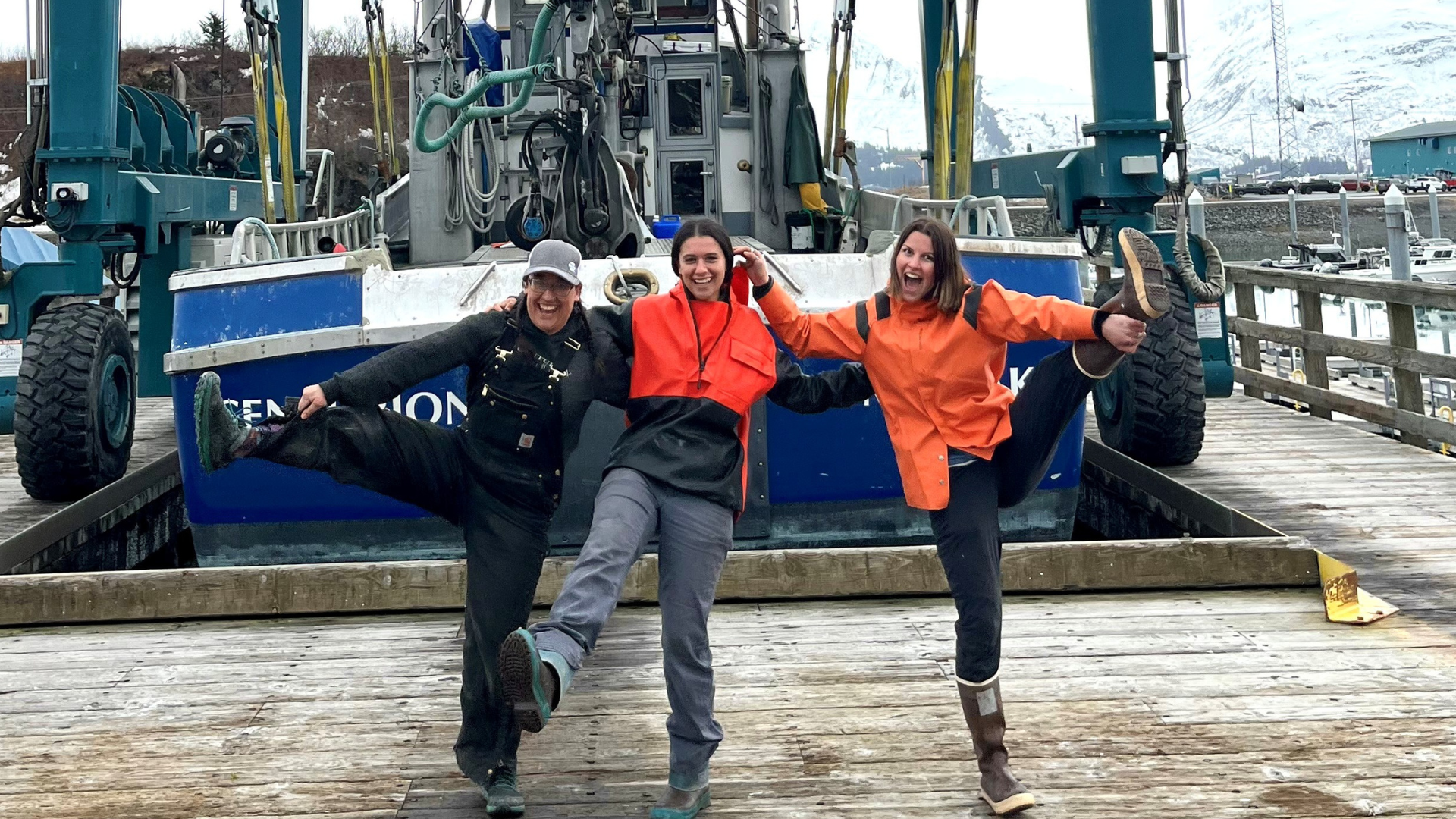
For Captain Megan Corazza, commercial fishing has not just been a career, but her entire life. Raised on a fishing boat from the time she was 17 days old, Megan grew up inside one of Alaska’s most demanding salmon fisheries. Today, more than 25 years into running her own operation, she continues to show what it looks like for women to lead, adapt, and thrive in an industry that has not always made space for them.
We spoke with Megan to discuss her lifelong connection to Prince William Sound, what it meant to buy her first boat at 20, the realities of being a woman running her own seiner, and how she balances fishing with a new chapter in nursing.
Born into the work
Megan’s story starts at sea. Her parents raised her and her brother aboard their commercial fishing boat out of Homer, Alaska, spending every summer chasing salmon and halibut. “I never had a summer on land,” she says. “Fishing was just what our family did.”
Her parents each ran their own boats early on, switching between gillnetting in Cook Inlet and seining in Prince William Sound. By the time Megan was 11 or 12, she was running the skiff alongside her dad. Fishing wasn’t just a job; it was the family’s way of staying connected, working together, and raising children inside the rhythm of the seasons.
Buying in at 20
Even though Megan grew up in a fishing family, she never expected to run her own boat. She had watched her parents handle the pressure of ownership and assumed she would stay on deck rather than in the wheelhouse. That changed in college when she worked for a young skipper close to her age. Seeing someone so young lead a successful operation helped her realize that she could take that step herself.

At 20, she bought into the fishery and took on the responsibility of running her own seiner. The early years were challenging, and the financial strain of starting out was real. Her family supported her through those first seasons, and that support helped her push through the pressure and keep going when the learning curve felt steep.
Over time, she grew her business, built stability, and gained confidence in her ability to lead. Taking the helm at such a young age placed her among the few women in her fleet who had stepped into ownership. It was a turning point that not only shaped her career, but also contributed to the slow shift toward more women holding leadership roles in Prince William Sound.
Raising kids on deck

Megan continued the tradition she was raised in by bringing her own children onto the water. Her older son spent summers on deck through high school, and her younger son has been onboard since infancy. Today he is 14 and her skiff man.
Seeing her son step into the same role she once held has been a full circle moment. “Some days I would look out and think, what is happening. I used to be the kid running the skiff. Now it is him.”
Motherhood in commercial fishing has come with challenges that are rarely discussed. Megan managed crew while parenting, brought a nanny onboard during her early years as a mom, and navigated difficult seasons as a single parent. There were times when the stress pushed her to step back and reassess, but the break only clarified how much she valued the work and the life it created for her family.

“I know so much about this job, and I love that I get to work in a beautiful place and raise my sons in it,” she says. “I did not want to give that up.”
Her experience reflects a part of commercial fishing that often goes unseen. Women are not only working on deck or running boats. They are raising families in the middle of this work, shaping crew culture, and proving that leadership can look many different ways. Megan’s story is one more example of how women continue to write the future of this industry both through their work and through the generations they bring up behind them.
Being a woman at the helm
When Megan started running her own boat, she was the only woman skipper in her fleet and one of the youngest people fishing at the time. Even so, she says she was treated with respect by many of the older fishermen around her, often like a daughter rather than an outsider.
“I have never felt judged for being a woman,” she says. “It has always been about whether you can do the job.”
That does not mean the experience came without challenges. The work itself was not the barrier. The real difficulty was navigating crew culture and leadership as a young female captain. Finding crew who were willing to work for a woman could be harder, and earning trust sometimes required extra effort. Over time she built a boat culture that reflected her values, with mostly female crews who brought strong communication, care, and work ethic to the job.
“I love my crews. They become family. They help me raise my kids.”
As a skipper, she took on the responsibility of setting expectations for how people treat one another on the water. At times that meant addressing inappropriate behavior from other crews, and at other times it meant stepping in on her own deck to make sure everyone felt respected.
“You have to speak up when it matters,” she says. “Sometimes it is easier to stand up for your crew than for yourself, but either way, it has to be done.”
Today, she sees many more women in Prince William Sound than when she began, and the growth of female skippers and crew has become an important part of how the fleet is changing. Several women now run their own seiners, and many more crew each season. “It has become a real community,” she says. “We all talk in the off season, support each other, and share what we have learned.”

Fishing, nursing, and what comes next
For most of her adult life, Megan balanced summer fishing with winter ski coaching. In recent years she felt ready to return to a dream she had years ago of working in medicine. She went back to school and is now focused on her nursing studies. Once her youngest son graduates, she hopes to work as a travel nurse during the winter months.
Even with this new path, she has no intention of stepping away from fishing. “I still love it,” she says. “I love the setting, I love the work, and I love bringing my family with me.”
Advice for the next generation
After decades on the water, Megan’s message to young women entering the industry is simple:
“Don’t try to be a guy in the industry. The essence of women is what makes them valuable there. Their strengths matter.”
For Megan, the job isn’t about proving anything. It’s about doing the work well, leading with integrity, and raising her kids in a place where grit, skill, and respect are what truly define a fisherman.


