
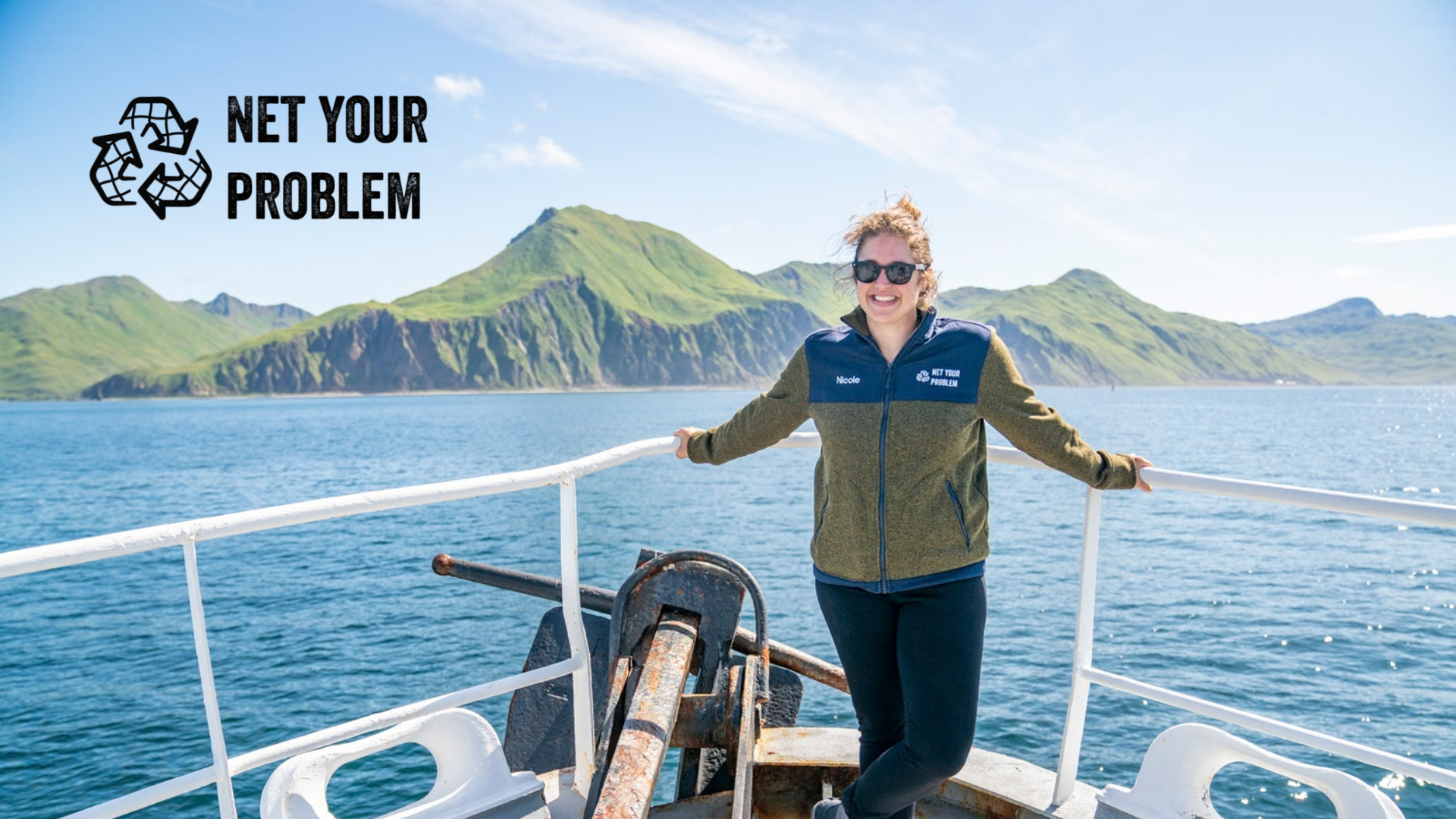
Before Nicole Baker founded Net Your Problem, she was standing on the back deck of commercial fishing vessels in the Bering Sea, clipboard in hand, collecting data in some of the most intense conditions imaginable. As a fisheries scientist, she quickly learned what the general public often gets wrong: commercial fishing is not a lawless frontier.
Fishermen are not pirates. They operate under strict rules so there is fish to eat tomorrow and decades from now. Halfway through those months at sea, something else caught her attention. Plastic. Endless amounts of it. Old nets, discarded line, and gear that had served its purpose. She saw a giant waste stream with no real destination and no one responsible for it.
“Long days at sea gave her a front-row seat to a problem no one else seemed eager to claim.”
Seeing it unfold in real time made the issue impossible for her to ignore. When she came back to shore, the weight of it stayed with her, demanding more than passive concern.

The Birth of Net Your Problem
Eight years later, Nicole is the founder of Net Your Problem, an organization dedicated to keeping maritime plastics out of landfills, burn piles, and waterways. She has helped hundreds of fishermen participate in recycling programs and has created waste systems for rural coastal communities across the United States.

Nicole took on work that many people saw as too complicated or too thankless, and she built momentum by leading the way herself. Her approach is collaborative at its core. She and her team work with fishermen, mariners, recyclers, artists, brands, and everyday ocean lovers, showing that progress grows fastest when everyone has a seat at the table.
“Environmental solutions don’t have to shame an industry, they can empower it.”
Nicole has become a connector between wheelhouses and boardrooms, proving that when people feel respected, they show up for solutions.
A More Inclusive Future at Sea

Recycling nets is only one part of Nicole’s vision. She is energized by the growing number of women working in the maritime industry, particularly in leadership roles on deck and in the wheelhouse. And yes, they prefer to be called fishermen. These women are helping shape a modern version of leadership in the maritime world, one that brings fresh perspective and balance to decisions that affect coastal communities.
“When women are included in natural resource management, the approaches are characterized by long term thinking.”
Nicole says the qualities women bring to natural resource work could strengthen corporate leadership as well. She hopes to see more women stepping into the C suite and building companies of their own, in maritime fields and everywhere else.
Sustainability as Standard Operating Procedure
In the future Nicole imagines, sustainability will not be an afterthought.
“Sustainability at sea will not be a side dish. It will be woven into the fabric of every department and valued as highly as profit margin.”

Her vision reflects the kind of firm, future-focused leadership that has long strengthened maritime communities, even if it has not always been recognized. Nicole didn’t just identify a problem; she acted decisively, setting a standard for what purposeful leadership can look like in an industry that continues to evolve.


